 CARDZ3N — Home
Contact us today for personalized advice and strategic solutions tailored to your goals.

Call us
+1 (702)-623-3528


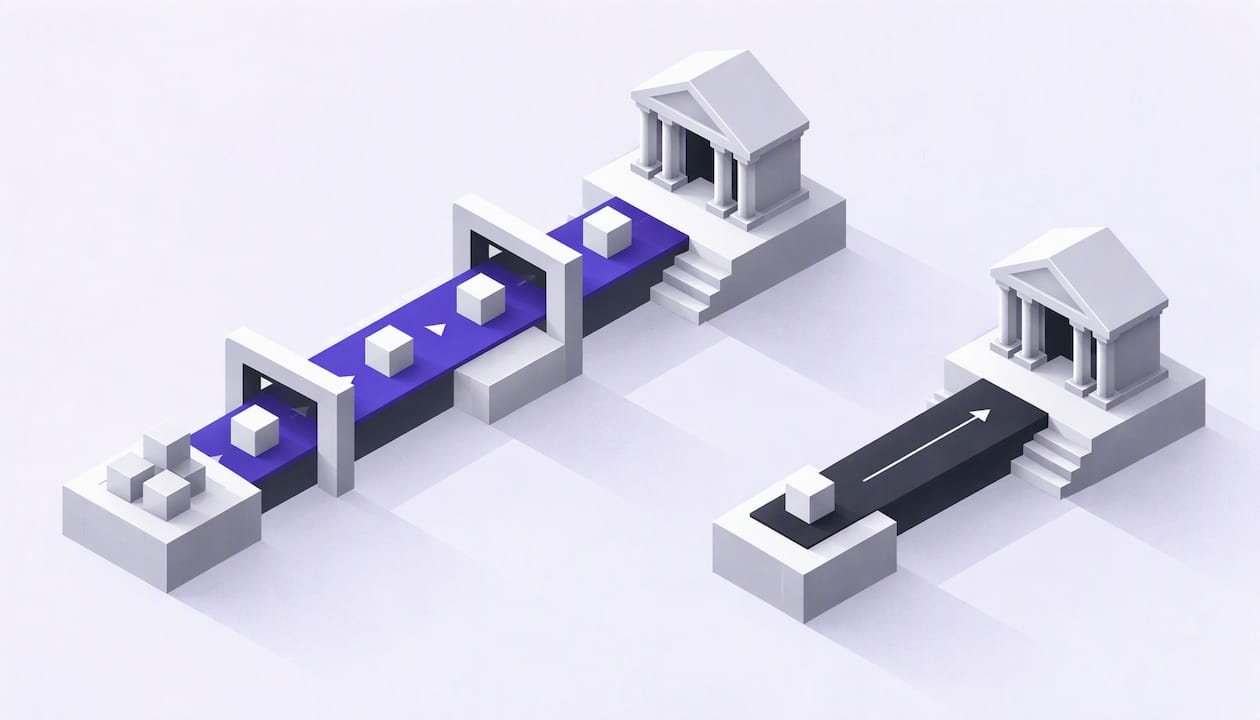




For most B2B payments, ACH is the better default and wires are the exception. ACH costs a fraction of a wire and is built for predictable, repeating payments such as vendor invoices, payroll and subscriptions. A wire costs more but is processed individually and can arrive within hours, so it fits urgent, high-value or international payments. This guide compares the two on settlement time, cost, reversibility and fraud exposure. It then gives you a rule for assigning each payment to the right rail.
Both methods move money from one business bank account to another, but they run on different infrastructure with different economics. The table summarizes the differences that matter most to a finance team.
| Factor | ACH | Wire transfer |
|---|---|---|
| Processing model | Batched through the ACH Network | Processed individually |
| Typical timing | Same day to two banking days | Often within hours if sent before the bank’s cutoff |
| Median fee (Cleveland Fed) | $0.25 to $0.50 per side | $7 per side |
| Reversibility | Returns and reversals allowed in defined circumstances | Generally final quickly and hard to reverse |
| Best for | Recurring, predictable, medium-value payments | Urgent, large or international payments |
| Weekend and holiday settlement | None | Depends on the bank’s wire service hours |
The cost row comes from a Federal Reserve Bank of Cleveland brief on B2B payments published September 21, 2026, which reports median fees for both the sending and the receiving organization. Your own bank’s fee schedule will differ, so treat those medians as a benchmark and check your own pricing.
We have also published a shorter ACH vs wire transfer breakdown if you want the basics before the detail below.
ACH is a batch system. Payments are collected, sorted and settled at set times rather than one by one. According to Nacha, 80% of ACH payments settle in one banking day or less. ACH credits (where the payer pushes funds) may settle the same day, the next banking day or in two banking days. ACH debits (where the payee pulls funds with authorization) settle the same day or the next banking day.
The Nacha fact sheet adds two details worth building into your cash calendar:
So an ACH payment initiated Friday afternoon is not settling Saturday. For a receivable, that is the difference between cash available Monday and cash available Wednesday. Submission time also matters: a file that misses a window rolls into the next one. Our guide to ACH cutoff times and FedACH windows covers how to plan around those deadlines.
Wires are not batched. Each is handled as its own instruction, which is why they can land within minutes to hours. The practical limit is the sending institution’s cutoff. A credit union’s August 2025 explainer notes that a domestic wire often processes within hours if sent before the cutoff. Send after the cutoff and it moves to the next business day, so “instant” is conditional.
If a supplier ships only against cleared funds, or you must close a purchase before a deadline, a wire’s speed can justify its fee. If the payment is one of dozens of routine invoices, a one-to-two-day delay costs you nothing you can measure. In that case, the ACH discount is the better trade.

The Cleveland Fed brief reports median ACH fees of $0.25 to $0.50 for each of the sending and receiving organizations, against a median of $7 for each side of a wire. Banks price these services differently, and many charge more for wires that are outgoing, international or sent through a branch. Some charge receiving fees on incoming wires too.
Here is a simple illustration using those medians, not a quote from any provider:
The difference does not change much with the invoice amount, because both fees are flat per item. That is why wires make the most sense on large payments, where a $7 fee is negligible, and the least sense on small, frequent ones. The Cleveland Fed brief links ACH’s low fee and slower settlement to its role as a substitute for checks in medium-value B2B payments.
Costs you may not see on a fee schedule:
If you accept ACH from customers rather than only pay vendors, per-item pricing from your processor is a separate line. Pricing varies by risk profile and volume, which is why we quote it rather than publish a rate card.
Speed and cost get the attention, but finality is what changes your risk exposure.
Per Investopedia’s comparison, ACH reversals and returns are limited to defined circumstances, and processing time alone does not create a general reversal window. Wires generally become final quickly and are harder to reverse once processed. The same source notes that ACH transfers are generally covered by Regulation E’s electronic-fund-transfer definition, while Fedwire and similar wire systems are generally excluded. Regulation E mainly protects consumers, so do not assume it shields a business account. Ask your bank how return rights apply to your accounts.
The credit union explainer above says the same about wires: once the receiving institution accepts one, it generally cannot be reversed.
For your two roles, this means:
When customers dispute charges, whether card or ACH, a documented process shortens recovery time. Our chargeback management and dispute representment service covers the card side of that problem.
The most common B2B payment fraud does not break the network. It convinces an employee to send money to the wrong place. A spoofed vendor email says “our bank details have changed,” and an urgent wire follows. Because wires are fast and hard to reverse, they are the favored target. ACH credit payments can be redirected the same way, only with slightly more time to catch it.
The Association for Financial Professionals’ 2023 ACH guide for corporates advises companies concerned about payment fraud to take their own precautions, and notes that banks should maintain fraud prevention and detection controls. In practice, fraud control is shared between the company and its bank. It is not a feature of the payment network.
Controls that cost little and stop the most common attacks:
Because most of these attacks start in an inbox, email security belongs in the same conversation. This 90-day business email compromise prevention plan shows how to sequence the operational fixes. Tightening how invoices and payment instructions move through your company is also part of a sound order-to-cash process.
A useful policy is to choose the rail by payment type, not case by case. The J.P. Morgan treasury view is that the choice should follow operational need: traditional ACH for predictable recurring payments, wires when urgency and high-value settlement justify the higher cost (J.P. Morgan). Turned into a working policy:
| Payment type | Usual choice | Why |
|---|---|---|
| Recurring vendor invoices | ACH credit | Low fee, schedulable, easy to reconcile |
| Payroll and contractor pay | ACH credit | Predictable timing |
| Customer invoices on terms | ACH debit or ACH credit | Low cost per item, no card interchange |
| Subscription or retainer billing | ACH debit with signed authorization | Automates collection |
| Time-critical supplier release | Wire | Funds can clear within hours before cutoff |
| Large one-time purchase or deposit | Wire, after callback verification | Speed and finality outweigh a $7-median fee |
| Cross-border payment | Usually wire for urgent or high value | Wider reach and U.S. dollar delivery |
For cross-border payments, a U.S. Bank cross-border analysis says wires generally make more sense for higher-value, urgent payments that need tracking or delivery in U.S. dollars. It adds that international ACH can cost less for smaller, non-urgent payments. Weigh urgency, value, currency, reach, tracking and the total delivered cost, and do not treat a wire as automatically better.
We work every day with merchants whose payment mix is under pressure: high-volume B2B sellers, subscription billers, government contractors and aerospace suppliers. Our view is that most companies reach for a wire out of habit, not because the payment needs one. They pay a $7-median fee per side on invoices that would settle just as well by ACH, then wonder why processing costs keep climbing.
The better model is to put ACH at the center of your receivables and payables, because it is cheap, schedulable and reconcilable. Reserve wires for payments where hours matter. Pair both with a written verification routine, because the most expensive mistakes we hear about involve changed payment instructions and not network failures. If you accept payments rather than only send them, ACH also works as a lower-cost alternative to card acceptance on large invoices. Many B2B buyers, including purchasing departments at government and aerospace customers, expect it.
If you want to see how that fits together, our overview of 1-3 day ACH processing for B2B walks through the settlement timeline from the merchant’s side. Our post on how B2B payments differ from consumer payments explains why these buyers behave differently.
— Joshua Benedetti
If your business receives payments, CARDZ3N offers B2B and B2G payment processing with ACH and eCheck acceptance and a virtual terminal, built for merchants that mainstream processors decline or restrict, including high-risk and regulated sectors. We handle underwriting with sponsor bank support, and we are open about reserve structures and quote-based pricing. Ask for a quote based on your volume, average ticket and industry, then compare it against what you spend today on wires and checks.
ACH moves payments in batches through the ACH Network and typically settles within one to two banking days, with some payments settling the same day. A wire is processed individually, so it can arrive within hours. ACH is much cheaper per item, while a wire is faster and generally final once accepted.
ACH is cheaper. The Cleveland Fed reported median fees of $0.25 to $0.50 per side for ACH versus $7 per side for a wire. Your bank’s actual schedule may be higher, particularly for international or outgoing wires, so check it directly.
Generally not once the receiving institution has accepted it. Contact your bank immediately, because a recall request is possible but not guaranteed. ACH payments can be returned or reversed only in defined circumstances. Either way, verify account details by phone before sending.
No. According to Nacha, ACH settlement does not occur on weekends or federal holidays because the Federal Reserve settlement service is closed. Payments initiated then settle on the next banking day.
Every merchant's processing setup is different, so the right answer depends on your industry, sales channels, average ticket size and chargeback history. CARDZ3N's payments specialists review those details with you and match your business with the right sponsor bank, gateway and risk tools, whether you sell online, in store, by invoice or on a recurring subscription.
We work with merchants across the USA, Canada, the UK and the EU, including high-risk, B2B and fast-growing businesses that traditional processors often turn away. If you would like a second opinion on your current rates, contract terms or approval options, contact our team for a free, no-obligation processing review.
Joshua Benedetti is the CEO of CARDZ3N, a Las Vegas-based merchant services provider specializing in high-risk payment processing and B2B payment technology.
Joshua Benedetti on LinkedInCARDZ3N Inc is headquartered in Las Vegas, Nevada, and provides merchant services to businesses that traditional processors turn away. Backed by top-tier sponsor banks and processors, CARDZ3N combines institutional stability with the speed of a specialized team that understands high-risk industries. Services include high-risk account underwriting and placement, gateway solutions across the major gateway platforms, POS integrations, ACH and check processing, chargeback prevention through ChargebackZ3N, and business lending and working capital. Its AerospacePay division serves OEMs, MROs, FBOs, and repair stations with B2B and B2G payment processing. CARDZ3N serves merchants in the USA, Canada, the UK, and the EU.
Start protecting your revenue from chargebacks today — schedule your complimentary consultation with CARDZ3N’s dispute management specialists.