 CARDZ3N — Home
Contact us today for personalized advice and strategic solutions tailored to your goals.

Call us
+1 (702)-623-3528









Ethoca Alerts are near-real-time notifications, sourced from card-issuing banks, that let merchants know a cardholder has disputed a transaction before it becomes a formal chargeback. Delivered through a portal or API, the alert gives you a defined window to refund the sale or gather evidence and log that outcome. Because Ethoca operates as a Mastercard subsidiary, the network is tightly woven into Mastercard’s dispute-management infrastructure, though its alerts cover disputes across multiple card brands.
The process starts on the issuer’s side. When a cardholder calls their bank to report fraud or contests a charge, the issuer confirms the dispute is legitimate and pushes that confirmation into the Ethoca network. Ethoca’s alert system then routes a notification to the merchant, typically within hours of the issuer’s action rather than the weeks a traditional chargeback cycle takes.
The alert payload usually contains:
Delivery happens two ways: email notifications that route into the Ethoca portal for manual review, or a direct API feed for merchants who want alerts to land inside their own case-management system. Matching relies heavily on the merchant descriptor. If your billing descriptor doesn’t match what the cardholder’s statement shows, or if it changed recently without updating Ethoca, alerts can misfire or simply never arrive, creating false negatives that let disputes slip through unactioned.
Speed determines whether an alert actually prevents a chargeback. Once it lands, your team needs a repeatable sequence, not an ad hoc scramble.
Ethoca recommends completing this cycle as soon as possible after receiving the alert. Acting inside that window is what actually pauses the dispute before the issuer files a formal chargeback; action taken later can occasionally still work, but success drops off the longer the case sits open.
Pro Tip: Build the “update Ethoca” step into your refund workflow itself, not as a separate task. The most common operational failure isn’t missing the alert. It’s issuing the refund correctly and forgetting to close the loop, which leaves the case open and can still trigger issuer action.
The direct payoff is fewer chargebacks landing on your merchant account, which matters for more than just the immediate refund cost.
Prevention outcomes aren’t uniform across every business type. Digital goods and services tend to see stronger prevention rates than physical merchandise, largely because there’s no shipped inventory to claw back and refunds process instantly. A subscription or SaaS merchant catching an alert on an unfulfilled billing cycle recovers essentially the full transaction; an apparel merchant catching one after a package has already left the warehouse only avoids the chargeback penalty, not the shipping loss. Consistent, fast alert handling is one of the more reliable ways to stay under the chargeback ratios that trigger card-brand penalty programs.
Issuers have their own reasons for feeding data into the network, and those incentives shape how much alert coverage a given merchant actually sees.
A merchant whose customer base skews toward smaller regional issuers may see noticeably thinner alert coverage than one whose cardholders bank with large, fully enrolled institutions.
Two paths exist, and the right one depends on your transaction volume and engineering bandwidth.
Portal access works for smaller merchants or teams just getting started. It’s a manual workflow: log in, review each case, mark it resolved, and pull reports on prevention performance. No development work required, but it doesn’t scale well past a modest daily alert volume.
API integration suits higher-volume merchants. Mastercard’s developer documentation outlines endpoints for pulling alerts automatically and pushing status updates back, including acknowledgment semantics that confirm Ethoca received your “Stopped” update.
On timelines, new enrollments often take 45 to 60 days to fully activate, while merchants switching between providers or aggregators tend to move much faster since the underlying network connections already exist. Budget time for:
Ethoca charges a per-alert fee, and merchants weigh that fee against the chargeback costs and penalty exposure it avoids. For most merchants processing meaningful dispute volume, the math favors alerts. That said, alerts aren’t a chargeback cure-all.
That fragmented coverage is exactly why root-cause fraud analysis still matters. An alert tells you a dispute happened; it doesn’t tell you why your fraud screening missed the transaction in the first place. Pairing alert data with AI-driven fraud detection that scores transactions before authorization catches issues alerts arrive too late to fix. Merchants managing high alert volume should also watch for duplicate notifications across multiple gateways or processors, which can inflate case counts and mask the real prevention rate.
Getting alerts flowing is one problem. Actioning every single one inside a tight window, every day, is a staffing and process problem, and it’s where most merchants actually fall short.
Pro Tip: Run a quarterly descriptor audit against every active gateway. A descriptor that quietly drifted out of sync six months ago is often the reason a merchant’s alert match rate looks worse than it should.
Most explanations of Ethoca Alerts treat them as a technical integration problem: connect the API, watch the dashboard, done. That framing undersells what actually separates merchants who benefit from alerts and merchants who let them pile up unactioned.
The research here points to a staffing and discipline problem more than a technology one. The 24-hour window isn’t arbitrary. It’s the gap between converting a dispute into a quiet refund and letting it escalate into a formal chargeback with fees attached. Merchants who treat alert response as a side task, checked whenever someone remembers, consistently underperform merchants who assign it as an owned responsibility with a defined SLA.
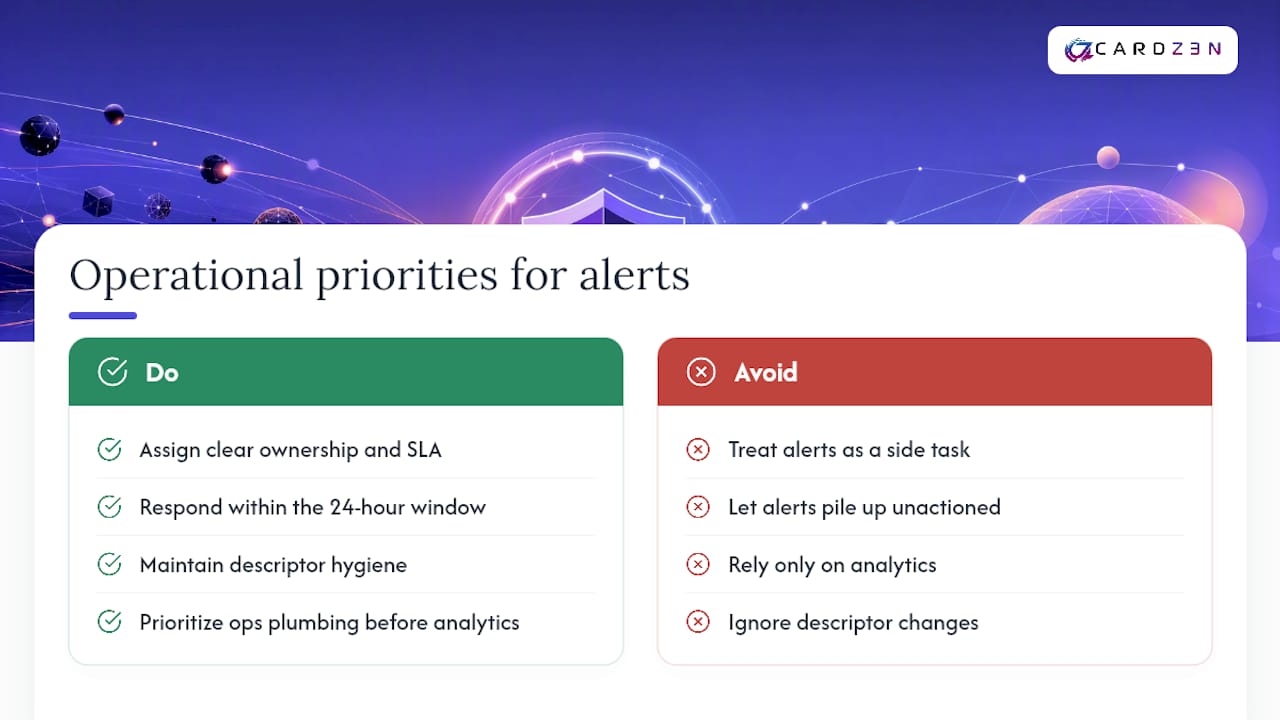
The other underrated piece is descriptor hygiene, which sounds mundane compared to fraud scoring or dispute strategy but quietly determines whether alerts even arrive correctly matched. A merchant can have flawless refund logic and still miss cases because a descriptor changed and nobody told Ethoca.
If you take one thing from this, prioritize the operational plumbing before the analytics. Get matching right, get response times consistent, and the prevention numbers follow.
— Joshua Benedetti
An Ethoca Alert is a near-real-time notification sent to a merchant when a card issuer confirms a cardholder dispute or fraud claim, giving the merchant a chance to refund the transaction and prevent a formal chargeback.
Ethoca receives dispute confirmations from participating card issuers and relays that data to merchants through a portal or API, typically within hours, so the merchant can act before the issuer files a chargeback.
Ethoca charges a per-alert fee rather than a flat subscription, and merchants generally weigh that cost against the chargeback fees and penalties the alert helps them avoid.
Yes. Mastercard acquired Ethoca in 2019 and folded its alert network into Mastercard’s broader dispute-management ecosystem.
No. Ethoca and Verifi are separate alert networks with different issuer participation, which is why many merchants enroll in both to maximize dispute coverage rather than relying on one alone.
Every merchant's processing setup is different, so the right answer depends on your industry, sales channels, average ticket size and chargeback history. CARDZ3N's payments specialists review those details with you and match your business with the right sponsor bank, gateway and risk tools, whether you sell online, in store, by invoice or on a recurring subscription.
We work with merchants across the USA, Canada, the UK and the EU, including high-risk, B2B and fast-growing businesses that traditional processors often turn away. If you would like a second opinion on your current rates, contract terms or approval options, contact our team for a free, no-obligation processing review.
Joshua Benedetti is the CEO of CARDZ3N, a Las Vegas-based merchant services provider specializing in high-risk payment processing and B2B payment technology.
Joshua Benedetti on LinkedInCARDZ3N Inc is headquartered in Las Vegas, Nevada, and provides merchant services to businesses that traditional processors turn away. Backed by top-tier sponsor banks and processors, CARDZ3N combines institutional stability with the speed of a specialized team that understands high-risk industries. Services include high-risk account underwriting and placement, gateway solutions across the major gateway platforms, POS integrations, ACH and check processing, chargeback prevention through ChargebackZ3N, and business lending and working capital. Its AerospacePay division serves OEMs, MROs, FBOs, and repair stations with B2B and B2G payment processing. CARDZ3N serves merchants in the USA, Canada, the UK, and the EU.
Start protecting your revenue from chargebacks today — schedule your complimentary consultation with CARDZ3N’s dispute management specialists.