


 CARDZ3N — Home
Contact us today for personalized advice and strategic solutions tailored to your goals.

Call us
+1 (702)-623-3528









Chargeback representment is the merchant’s formal re-presentation of a disputed transaction to the issuer, backed by evidence that directly rebuts the reason code cited. Use it when you have specific, rule-driven proof, a signed delivery, a documented cancellation policy, an authenticated card-present transaction, not a general sense that the customer is wrong. Fight the ones you can prove; concede the rest before fees and labor outstrip the recovery.
Representment isn’t the only lever you have against a disputed charge, and it isn’t always the right one. A refund settles the matter instantly and costs you the sale, nothing more. Customer outreach, calling the cardholder before the bank gets involved, can sometimes resolve confusion before it becomes a formal dispute at all. Representment is what you reach for when neither of those applies: when you believe the charge was legitimate and you have documentation to prove it.
The dispute lifecycle runs through defined stages, and knowing where you are in that sequence determines whether you should refund early, gather evidence, or file. Representment tends to make sense in a narrow band of situations:
Every representment attempt carries a cost regardless of outcome, a per-dispute fee from your acquirer, staff time to assemble the packet, and a mark against your chargeback ratio while the case is open. File selectively.
Every representment case starts with the same document: the acquirer’s chargeback notification. That notice contains the reason code, the disputed amount, and a due date, and all three determine everything that happens next. Missing that due date is an automatic loss regardless of how strong your evidence is.
Here’s a workable process for turning that notice into a submitted case.
Timeframes vary by network and by acquirer. Merchants typically have between 20 and 45 days after notification to submit evidence, while the cardholder’s own filing window can stretch out to several months from the transaction or expected delivery date. Don’t assume your deadline matches a colleague’s story from a different processor; verify the exact window in your own merchant portal for every case.
Pro Tip: Build your internal cutoff into your calendar system as a hard deadline, not a soft reminder. A missed acquirer due date isn’t a partial loss, it’s a full one, no matter how good your evidence is.
Sending generic proof of purchase to fight a specific reason code is one of the most common ways merchants lose winnable cases. Issuers evaluate representment against a checklist tied to the code itself, and evidence that doesn’t match that checklist often gets disregarded outright. Acquirers include the reason code on the original notification precisely so merchants know what to send.
The evidence that actually moves the needle differs sharply by claim type:
That last category increasingly leans on frameworks like Visa’s CE 3.0, which formalizes which data elements issuers expect for certain fraud rebuttals, including device fingerprinting and prior transaction history. Confirm current CE rules with your acquirer, since specifics shift.
| Reason code category | Primary evidence | Format to submit |
|---|---|---|
| Merchandise not received | Signed delivery confirmation | PDF or image, carrier-branded |
| Not as described | Product listing + support thread | PDF export, timestamped |
| Subscription/recurring | Signed terms + cancellation log | PDF, dated entries |
| Card-not-present fraud | AVS/CVV + device/IP data | Structured data export |
Package each evidence type as its own labeled exhibit rather than bundling everything into one file. Reviewers work through queues under time pressure, and a wall of unsorted screenshots gets skimmed, not read.
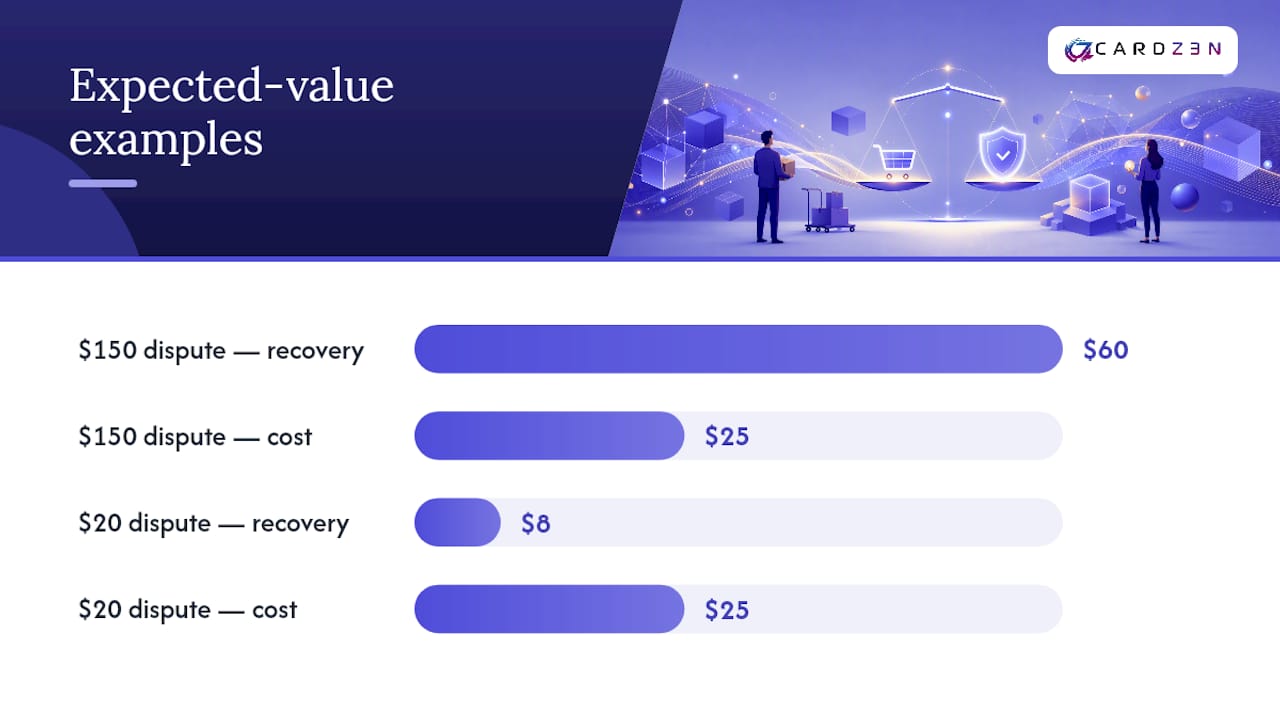
Not every chargeback deserves a fight, and the decision doesn’t need to be a judgment call. Run the math instead.
Expected recovery equals the disputed amount multiplied by your estimated win rate for that specific reason code. Expected cost equals your representment fee plus staff labor plus any escalation risk if the case moves to arbitration. File when expected recovery clears expected cost by a comfortable margin; concede when it doesn’t.
Vendors sometimes advertise headline win rates using favorable denominators, which can make representment services look more effective than they are for your specific mix of reason codes. Build your own win-rate table instead of borrowing someone else’s marketing number.
For very small disputes where the math doesn’t clear, it’s often cheaper to absorb the loss and redirect that labor toward prevention, or to look at whether cash-flow tools like a business line of credit make more sense than chasing marginal recoveries.
The rebuttal cover page carries more weight than merchants usually give it. Open with the reason code you’re rebutting and a single-line statement of your argument, then follow with a numbered index of exhibits so the reviewer knows exactly what to expect before they start reading.
Structure the packet around a few rules that consistently improve outcomes:
Merchants who index exhibits clearly and open with the reason code tend to see faster, more favorable reviews, largely because issuer staff are working through queues, not reading every case with fresh attention.
Pro Tip: Write your rebuttal cover page as if the reviewer has ten seconds to decide whether your case is worth a closer look. If they can’t find your strongest evidence in that time, you’ve already lost ground.
Winning a representment case returns the disputed funds to you and closes the case; losing means you keep the chargeback fee on top of the original loss, and it counts against your chargeback ratio either way while the case was open.
Most losses come down to process, not weak facts. Late submission is the single biggest one, followed by sending evidence that doesn’t match what the reason code actually requires, and poorly labeled exhibits that bury the proof a reviewer needs.
Track win rate by reason code and average time to respond as your two core metrics; both point directly at where your process is leaking cases.
Pro Tip: Preserve delivery confirmation and device metadata at the point of sale, not after a dispute lands. Evidence gathered after the fact is weaker and sometimes unavailable entirely.
Handling representment internally works for merchants with low dispute volume and a team member who can own the process consistently. Volume changes that math fast. CARDZ3N’s chargeback management and dispute prevention service, run through its ChargebackZ3N division, builds the evidence-collection and submission workflow into the merchant account itself, coordinating directly with acquirers and gateways so exhibits move without manual handoffs. For high-volume or high-risk merchants, that coordination often matters more than any single rebuttal letter.
Most representment advice online treats every dispute as worth fighting, which is backward. The math in this guide should convince you that a meaningful share of chargebacks are not worth contesting, and pretending otherwise burns labor on cases with negative expected value.
The bigger gap in conventional advice is reason-code specificity. Too many guides treat evidence as a generic pile of proof rather than a checklist tied to the exact code on your notice. Merchants who win consistently are the ones who stopped sending everything and started sending exactly what the code requires, indexed and labeled so a reviewer can verify it in seconds.
Prioritize your own win-rate tracking by reason code before anything else. Vendor-quoted win rates and industry averages tell you nothing about your specific product, your specific customers, or your specific documentation gaps. The merchants who improve fastest are the ones measuring their own numbers, not borrowing someone else’s.
— Joshua Benedetti
Handling representment case by case works until volume or complexity outpaces your team, and that’s exactly where a managed provider earns its cost. CARDZ3N’s high-risk merchant account and payment processing services fold dispute handling into the underwriting relationship itself, so evidence collection, gateway coordination, and acquirer submission run through one accountable workflow instead of scattered across support tickets and spreadsheets. That matters most for merchants in high-chargeback categories, subscription billing, card-not-present sales, regulated goods, where reason-code specificity and submission speed determine whether representment pays off at all. If your dispute volume has outgrown ad hoc handling, A managed representment service team can review your current setup and outline what a managed representment workflow would look like for your account. Start by requesting a review through the high-risk merchant account page linked above.
Chargeback representment is the process where a merchant re-presents a disputed transaction to the issuer with evidence that directly rebuts the reason code the cardholder’s bank cited.
It means the merchant has formally responded to the dispute with documentation, and the issuer will review that evidence to decide whether the funds return to the merchant or stay with the cardholder.
Merchants typically have 20 to 45 days after notification to submit evidence, while the cardholder’s original filing window can extend up to about 120 days from the transaction date, so exact deadlines should always be confirmed with your acquirer.
A payment representment is the same process as chargeback representment: a merchant’s formal, evidence-backed response to a disputed charge, submitted through the acquirer to the card network for review. Some providers manage this process end to end for merchants who process high volumes of disputes.
Every merchant's processing setup is different, so the right answer depends on your industry, sales channels, average ticket size and chargeback history. CARDZ3N's payments specialists review those details with you and match your business with the right sponsor bank, gateway and risk tools, whether you sell online, in store, by invoice or on a recurring subscription.
We work with merchants across the USA, Canada, the UK and the EU, including high-risk, B2B and fast-growing businesses that traditional processors often turn away. If you would like a second opinion on your current rates, contract terms or approval options, contact our team for a free, no-obligation processing review.
Joshua Benedetti is the CEO of CARDZ3N, a Las Vegas-based merchant services provider specializing in high-risk payment processing and B2B payment technology.
Joshua Benedetti on LinkedInCARDZ3N Inc is headquartered in Las Vegas, Nevada, and provides merchant services to businesses that traditional processors turn away. Backed by top-tier sponsor banks and processors, CARDZ3N combines institutional stability with the speed of a specialized team that understands high-risk industries. Services include high-risk account underwriting and placement, gateway solutions across the major gateway platforms, POS integrations, ACH and check processing, chargeback prevention through ChargebackZ3N, and business lending and working capital. Its AerospacePay division serves OEMs, MROs, FBOs, and repair stations with B2B and B2G payment processing. CARDZ3N serves merchants in the USA, Canada, the UK, and the EU.
Start protecting your revenue from chargebacks today — schedule your complimentary consultation with CARDZ3N’s dispute management specialists.