

 CARDZ3N — Home
Contact us today for personalized advice and strategic solutions tailored to your goals.

Call us
+1 (702)-623-3528




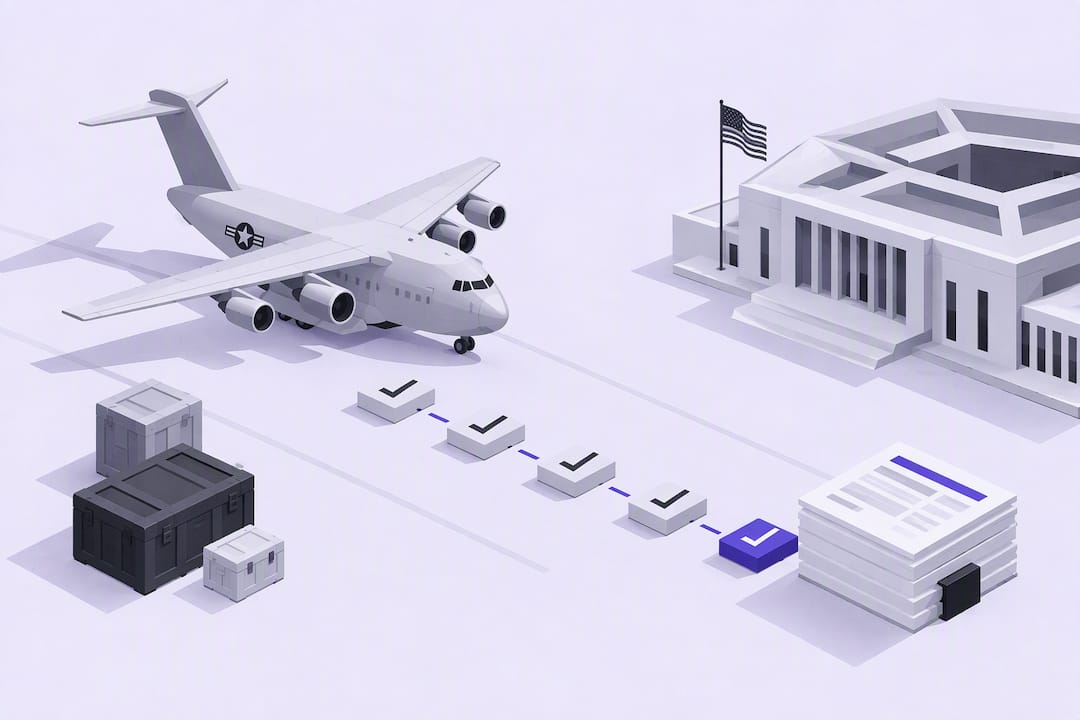





Aerospace and defense merchants need five things in place before they can bill the government or large B2B customers reliably: government purchase card (GPC) and GSA SmartPay acceptance, WAWF enrollment for DoD invoices, export control and sanctions screening, complete underwriting documentation, and Level 2/3 data support with PCI DSS controls where card volume warrants them. Miss any one, and payments stall at the acceptance or underwriting stage, not at the bank.
Contractors holding Multiple Award Schedule (MAS) orders are generally required to accept the government purchase card as a method of payment, and the GSA SmartPay vendor guide lays out how BIN identification, account types, and tax treatment work for merchants. The GPC can also be inserted into other contract types under FAR Subpart 32.11, which governs electronic funds transfer and purchase card clauses, including FAR 52.232-36, and spells out the contracting officer’s responsibilities when GPC is selected as the payment method.
Account type matters for tax handling. Centrally Billed Accounts (CBA) and Individually Billed Accounts (IBA) carry different tax exemption rules, and SmartPay’s Tax Advantage guidance explains what a merchant needs to capture on the receipt to apply exemptions correctly. Getting this wrong at the point of sale creates reconciliation headaches weeks later.
A clean reconciliation process depends on capturing the right fields at the transaction, not reconstructing them afterward:
GSA SmartPay guidance also discourages routing government purchase-card transactions through third-party consumer processors unless the merchant has an established purchase history, since identity and reconciliation on statements are a recurring audit focus.
DFARS Subpart 232.70 requires most DoD contractors to submit payment requests and receiving reports electronically, and the Wide Area Workflow (WAWF) system is the accepted route in nearly all cases under clause 252.232-7003. Submission failures are usually administrative, a wrong DoDAAC or a missing Purchase Card Receiving Report (PCRR), rather than a technical mismatch between systems.
When a contract is paid using a government purchase card, the DFARS PGI and AFARS guidance require the contractor to submit a PCRR in WAWF using the CRCARD code, which routes the transaction correctly for acceptance and payment.
A practical sequence keeps invoices from bouncing:
Underwriters evaluating an aerospace or defense merchant account want to see the paperwork that proves the business is real, government-facing, and predictable in ticket size. That means a CAGE code, active SAM registration, articles of incorporation, sample contracts or purchase orders, and roughly a month of purchasing-card volume history if available. Projected average and maximum ticket sizes matter too, since defense parts and MRO invoices often run far higher than a typical B2B transaction.
Beyond paperwork, the processing stack itself needs specific capabilities:
Merchant category code (MCC) selection also affects whether GPC transactions are accepted at all; some MCCs are restricted under SmartPay rules, and remapping to an accurate, accepted code is often the fix rather than switching processors entirely.
Pro Tip: Gather your CAGE code, SAM registration status, and three recent purchase orders before your first underwriting call, since incomplete documentation is the most common cause of approval delays.
Export control classification changes payment risk before a card is ever swiped. Transactions tied to items or technical data covered by International Traffic in Arms Regulations (ITAR) or the Export Administration Regulations (EAR) can require license verification, and BIS guidance on the EAR explains how Entity List and Military End User (MEU) List restrictions can block a transaction outright regardless of payment method.
Sanctions exposure runs in parallel. OFAC’s compliance framework stresses that financial institutions and merchants face enforcement risk when they process transactions involving blocked persons or jurisdictions, even unknowingly, which is why the OFAC sanctions compliance framework recommends risk-based screening and documented escalation procedures rather than a one-time check.
Workable controls for aerospace merchants include:
A detailed walkthrough of how ITAR and EAR-aware payment workflows function in practice is useful reading before you finalize screening procedures with your processor.
Aircraft-on-ground (AOG) situations demand payment infrastructure that does not wait in a queue. A part or repair needed to return an aircraft to service often carries a five- or six-figure invoice and a deadline measured in hours, not days.
Three operational features separate processors that can handle this from those that cannot:
Large-ticket B2G invoices need the same PO-to-payment matching, plus a dispute process that recognizes government contract terms rather than treating every chargeback like a consumer complaint.
Cross-border aerospace supply chains add currency complexity. Settling in multiple currencies through one consolidated merchant relationship, rather than opening a separate account per currency, keeps reporting consistent and avoids reconciling five sets of statements against one general ledger. Our Prominence Bank partner’s multi-currency account infrastructure illustrates the kind of bank-level rail support that makes consolidated settlement practical for cross-border defense suppliers.
Pro Tip: If your aerospace business handles AOG orders more than occasionally, ask any prospective processor for their actual expedited settlement timeline in writing, not a general assurance.
Meeting every item above with a generalist processor usually means stitching together separate vendors for underwriting, ITAR/EAR screening, and Level 2/3 reporting. We built our AerospacePay division specifically to cover aerospace and defense merchants under one underwriting and compliance process.
In practice, that means:
A clearer underwriting conversation, consolidated reconciliation, and transparent reserve terms are what we aim to deliver once your documentation is in order. Our high-risk underwriting and account placement process is outlined on our high-risk merchant account page.
Payment processing staff rarely need a personal security clearance, since the clearance requirement attaches to the contract and the facility, not the finance department handling invoices. Clearance requirements are set contract by contract under the National Industrial Security Program, and they typically apply to personnel with access to classified information, drawings, or facilities, not to the accounts payable or merchant services team reconciling a purchase-card statement.
That said, aerospace and defense finance teams still face background screening tied to the sensitivity of what they process. Export-controlled technical data referenced in an invoice, even something as routine as a part description, can trigger access restrictions if the underlying information is ITAR-controlled. Practical steps include:
The practical takeaway: payment processing itself is rarely the clearance-triggering function, but the data sitting next to it in your contract files often is. Treat payment records with the same handling discipline you apply to the underlying technical documentation.
The Federal Acquisition Regulation governs far more than how a contract is awarded; it also dictates how payments on that contract must move. FAR Subpart 32.11 covers electronic funds transfer requirements, third-party payment arrangements, and the clauses a contracting officer must include when the government purchase card is the designated payment method.
Two compliance threads matter most for payment processing specifically. First, contracting officers are required to insert specific payment clauses, such as 52.232-36 for GPC use, and contractors are expected to follow the exact terms those clauses set, including reporting obligations tied to the Federal Procurement Data System (FPDS). Skipping that reporting step is a compliance gap even if the payment itself clears without issue.
Second, FAR’s electronic funds transfer rules interact directly with DFARS invoicing requirements. A contractor can be fully FAR-compliant on payment method and still fail DFARS electronic submission requirements if invoices are not routed through WAWF correctly. Treat FAR and DFARS payment compliance as one connected checklist rather than two separate reviews: a solicitation’s payment clause tells you how you’re allowed to get paid, and WAWF tells you how that payment request actually gets submitted and accepted.
Contractors new to government work often assume FAR compliance is handled entirely by the contracts department. In practice, finance and billing teams need enough FAR literacy to recognize which clauses apply to their specific payment method and flag gaps before an invoice is rejected.

Approval timelines for aerospace and defense merchant accounts depend almost entirely on how complete your documentation is when you apply, not on the underwriting bank’s internal speed. A typical path looks like this:
First, gather foundational documents: CAGE code, active SAM registration, articles of incorporation, beneficial ownership information, and a sample of actual contracts or purchase orders. Missing SAM registration status is one of the most common reasons an aerospace application stalls before underwriting even begins.
Second, document your transaction profile: expected monthly volume, average ticket size, maximum single-transaction size (critical for AOG scenarios), and whether transactions will involve government purchase cards, standard B2B invoicing, or both.
Third, flag export control exposure up front. If any portion of your business touches ITAR or EAR-controlled items, say so during underwriting rather than after boarding. Processors that handle aerospace regularly will ask about this directly; if a processor does not ask, that is itself a signal they may not be prepared for your risk profile.
Fourth, confirm technical integration needs: ERP connections, Level 2/3 data requirements, and whether you need WAWF-compatible invoicing support alongside card acceptance.
Once documentation is complete and consistent, underwriting review for a well-prepared aerospace file moves considerably faster than one with missing SAM data or undisclosed export exposure, since most delays come from back-and-forth requests for missing items rather than the review itself.

Aerospace and defense payment processing costs break down into a few predictable categories, though exact figures vary by processor, risk profile, and transaction mix. Interchange and processing fees apply per transaction, and Level 2/3 data submission can reduce interchange costs on qualifying B2B and B2G card transactions compared to standard consumer-rate processing.
Reserve structures are where aerospace merchants most often get surprised. Large average ticket sizes and occasional AOG spikes can lead underwriters to hold a rolling or capped reserve against future chargebacks or disputes, particularly during the first several months of processing history. Reserve terms differ by processor and by how established your purchasing-card or invoicing history is at the time of application.
Additional cost considerations specific to this sector include:
We state our reserve structures and pricing on a quote basis rather than leaving them vague, since aerospace merchants evaluating a new processor need to model cash flow around real reserve terms, not estimates discovered after boarding.
Disputes on government contract payments rarely resemble a consumer chargeback, and treating them the same way is a common mistake. A government purchase-card dispute often traces back to a documentation mismatch, a PO reference that does not match the receiving report, or a receiving report that was never properly closed out, rather than genuine fraud.
Effective chargeback management for B2G transactions starts with prevention: accurate PO matching at the point of sale, Level 2/3 data that mirrors the contract terms exactly, and WAWF documentation that stays synchronized with what was actually invoiced. When a dispute does arise, representment on a government contract dispute typically requires the underlying contract, the purchase order, the receiving report, and proof of delivery or service completion, organized and ready to submit quickly.
Our chargeback prevention guidance covers the broader tactics that apply here, and our dedicated chargeback management and dispute representment service is built to assemble that documentation package rather than leaving a finance team to chase it down mid-dispute.
The practical lesson: the aerospace merchants with the fewest dispute headaches are the ones whose PO matching and WAWF submissions were accurate from the start, since clean documentation prevents most disputes before they’re ever filed.
ERP integration covers accounting, but aerospace and defense contractors typically run on a layer of government-specific systems that sit alongside the ERP, and payment processing needs to talk to those systems too. Beyond WAWF for invoicing, contractors commonly interact with systems tracking contract modifications, delivery schedules, and acceptance status, all of which affect when and how a payment request should be submitted.
A payment that is technically accepted in WAWF but conflicts with an unprocessed contract modification will still generate a dispute later. Keeping your payment processing data (PO numbers, line-item detail, receiving report references) synchronized with whatever contract management system your contracting officer’s office uses reduces that friction substantially.
Practical integration priorities include:
Our B2B and B2G payment processing services are built with this reference-matching discipline in mind, since aerospace and defense billing depends on consistency across systems far more than on any single platform’s features.
If you’re starting from scratch, documentation comes before workflow. Get your CAGE code, SAM registration, and sample contracts organized before you touch WAWF setup or GPC acceptance, because underwriters and government systems both reject incomplete files faster than they reject compliant ones. Export control screening should be built in from day one, not retrofitted after your first flagged transaction.
Speed matters once compliance is solid, not before. A specialized processor that already understands CAGE codes and PCRR coding will move faster than a generalist relearning aerospace rules on your account.
— Joshua Benedetti
Specialized payment processing for aerospace and defense billing requires ITAR and EAR-aware onboarding, Level 2/3 data support for large-ticket B2G invoices, GPC and WAWF-compatible workflows, and AOG-ready settlement features.
Before reaching out, have your CAGE code, SAM registration status, sample purchase orders, and projected transaction volume ready. Complete documentation allows underwriting teams to provide real reserve structures and pricing quotes rather than placeholder estimates. Start with our B2B and B2G payment processing page to see how ACH, virtual terminal, and GPC-compatible processing fit together, or review our high-risk merchant account services if your business has faced friction with a previous processor.
Payment processors handling aerospace and defense transactions generally need PCI DSS controls appropriate to their transaction volume, with Level 1 requirements applying to the highest-volume merchants under PCI Security Standards Council guidance. They also need sanctions and export-control screening capability when transactions touch ITAR or EAR-controlled items, since processing a restricted transaction carries its own compliance exposure.
Becoming a payment processor involves sponsor bank relationships, PCI DSS certification, and underwriting infrastructure capable of evaluating merchant risk, none of which a typical aerospace or defense business needs to build itself. Most aerospace and defense businesses instead need a merchant account through an established processor rather than becoming a processor themselves.
There is no single authoritative ranking of payment processors for aerospace and defense specifically, since suitability depends on export-control readiness, WAWF compatibility, and underwriting approach for high-ticket B2G transactions. The more useful question is whether a given processor can document its PCI DSS compliance, its handling of Level 2/3 data, and its experience with government purchase card and WAWF workflows.
Every merchant's processing setup is different, so the right answer depends on your industry, sales channels, average ticket size and chargeback history. CARDZ3N's payments specialists review those details with you and match your business with the right sponsor bank, gateway and risk tools, whether you sell online, in store, by invoice or on a recurring subscription.
We work with merchants across the USA, Canada, the UK and the EU, including high-risk, B2B and fast-growing businesses that traditional processors often turn away. If you would like a second opinion on your current rates, contract terms or approval options, contact our team for a free, no-obligation processing review.
Joshua Benedetti is the CEO of CARDZ3N, a Las Vegas-based merchant services provider specializing in high-risk payment processing and B2B payment technology.
Joshua Benedetti on LinkedInCARDZ3N Inc is headquartered in Las Vegas, Nevada, and provides merchant services to businesses that traditional processors turn away. Backed by top-tier sponsor banks and processors, CARDZ3N combines institutional stability with the speed of a specialized team that understands high-risk industries. Services include high-risk account underwriting and placement, gateway solutions across the major gateway platforms, POS integrations, ACH and check processing, chargeback prevention through ChargebackZ3N, and business lending and working capital. Its AerospacePay division serves OEMs, MROs, FBOs, and repair stations with B2B and B2G payment processing. CARDZ3N serves merchants in the USA, Canada, the UK, and the EU.
Start protecting your revenue from chargebacks today — schedule your complimentary consultation with CARDZ3N’s dispute management specialists.