

 CARDZ3N — Home
Contact us today for personalized advice and strategic solutions tailored to your goals.

Call us
+1 (702)-623-3528









You prevent most chargebacks with five moves: a billing descriptor customers recognize, checkout authentication like 3D Secure on higher-risk orders, capture timing that matches fulfillment, immediate tracking and receipts, and clear renewal disclosures on recurring plans. Each disputed transaction costs a business about $128 once you count fees, labor, and lost merchandise, so fixing these five levers before disputes happen beats fighting them one at a time.
Start with the fixes that require no new technology, then layer in tools as volume justifies them.
Automation works well for repetitive, low-dollar decisions. Manual review still wins on ambiguous, high-value, or first-time-buyer orders where context matters more than speed.
CVV and AVS matching are your floor, not your ceiling. They catch obvious mismatches but miss stolen credentials used with correct billing data. Layer in 3D Secure for high-ticket orders and international cards. It shifts liability to the issuing bank on most fraud-related disputes and gives you a documented authentication event to cite later.
Machine-learning scoring and velocity checks catch patterns humans miss, like ten orders from different emails hitting the same shipping address in an hour. The mistake merchants make here is stacking too many rule sets on top of each other. Overlapping filters compound false declines, and a rejected legitimate customer costs you more in lifetime value than the fraud you avoided.
Pro Tip: Store authentication and device data by payment reference at the moment of sale, not after a dispute lands. Reconstructing it later from support tickets and shipping logs costs you the representment window.
A shocking share of “fraud” chargebacks are just customers who didn’t recognize a charge. Fixing your billing descriptor, receipts, and fulfillment reliability together addresses most of the avoidable dispute volume, and it costs nothing beyond a configuration change.
Your receipt should do the recognition work your descriptor can’t fit in 22 characters:
Non-delivery and “item not as described” chargebacks live or die on documentation you should already have. The problem is usually retrieval, not existence.
Pairing recognizable descriptors with dependable fulfillment and calibrated fraud screening closes most of the gap between “disputed” and “documented.”
Recurring billing generates a disproportionate share of “I didn’t authorize this” disputes, almost all of them from customers who forgot they signed up.
CARDZ3N’s subscription billing case study walks through how one merchant applied these exact renewal disclosures to push chargebacks under 1%.
Every dispute arrives with a reason code, and that code tells you what to do next. Skip the instinct to dump every document you have into a response. Issuers want evidence that directly answers the stated reason, not a folder of everything.
At roughly $128 per incident once you count fees and labor, a merchant fighting weak cases on principle is usually losing money twice.
Run a monthly reason-code review with payments, ops, support, and finance in the room together. One team alone can’t fix a problem that spans checkout, fulfillment, and billing.
Treating prevention as a loop, not a one-time setup, is what separates merchants who steadily lower their ratio from ones who fight the same dispute types every quarter.
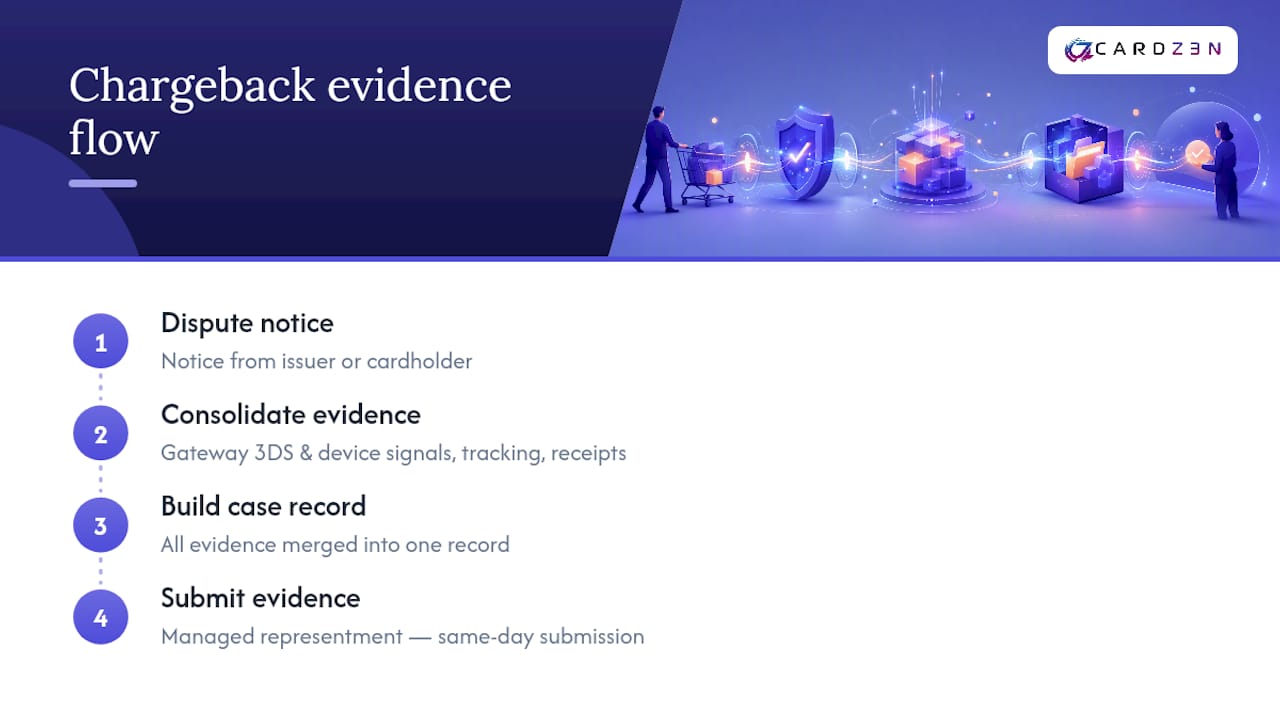
CARDZ3N’s chargeback management and dispute prevention services pair gateway-level fraud screening with managed representment, which shortens the gap between a dispute notice and a submitted evidence package. Merchants who integrate authentication data, tracking, and receipts into one system stop rebuilding evidence from scratch on every case. In practice, an integrated gateway that already logs 3DS results and device signals turns a multi-hour evidence hunt into a same-day submission.
Low-volume sellers should favor speed over sophistication: refund suspicious orders fast and review anything unusual by hand. You don’t have the volume to justify machine-learning tuning yet, and refunds are cheaper than disputes.
High-volume merchants should invest in ML scoring, alert networks, and automated evidence capture, because manual review doesn’t scale past a few hundred orders a day. Every added fraud rule trades some legitimate revenue for protection. Know that tradeoff before you flip the switch.
— Joshua Benedetti
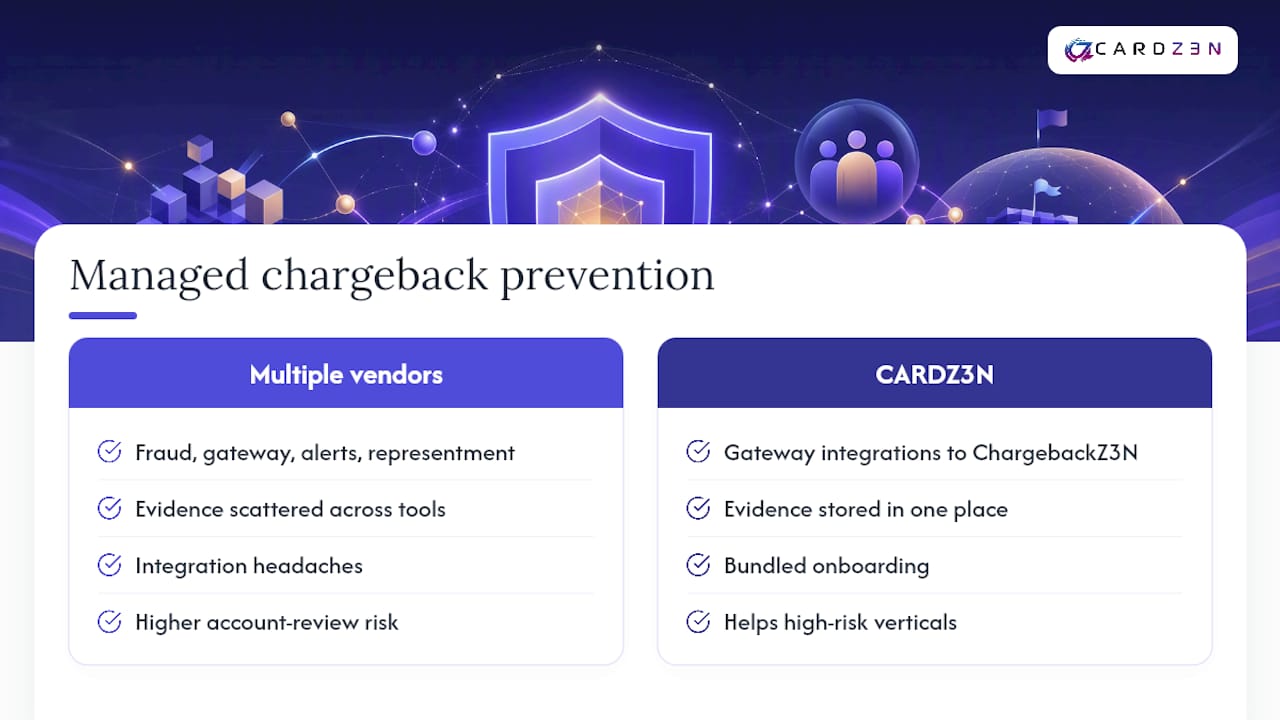
Most merchants end up stitching together a fraud scoring tool, a gateway, an alert network, and a separate representment service, and paying for integration headaches along the way. CARDZ3N built its chargeback prevention around a different model: gateway integrations through NMI, Fluidpay, Authorize.Net, USAePay, and Valor PayTech feed directly into the ChargebackZ3N division, so authentication data, device signals, and fulfillment evidence live in one place instead of four. That matters most for high-risk verticals, where a single unresolved dispute pattern can put a merchant account on review.
If your dispute rate is climbing or your current processor is short on evidence tools, start with CARDZ3N’s high-risk merchant account page to see how account underwriting, gateway setup, and chargeback management get bundled into one onboarding process.
A chargeback is a forced reversal of a card payment, initiated by the customer’s bank rather than the merchant, usually triggered by a fraud claim, a billing dispute, or a service complaint.
Filing a false chargeback claim can constitute fraud in some jurisdictions, but criminal prosecution is rare and reserved for large-scale or repeated fraudulent disputes rather than isolated cases.
Yes, and for good reason: beyond the roughly $128 average cost per incident in fees and lost goods, too many disputes can push a merchant account into review or termination by the processor.
Match your evidence to the specific reason code the issuer cited, whether that’s an authentication result, tracking and delivery proof, or a refund confirmation, and submit a concise narrative rather than a document dump. Services like CARDZ3N’s chargeback management program handle this representment process directly for merchants who lack the internal bandwidth to track deadlines by reason code.
Every merchant's processing setup is different, so the right answer depends on your industry, sales channels, average ticket size and chargeback history. CARDZ3N's payments specialists review those details with you and match your business with the right sponsor bank, gateway and risk tools, whether you sell online, in store, by invoice or on a recurring subscription.
We work with merchants across the USA, Canada, the UK and the EU, including high-risk, B2B and fast-growing businesses that traditional processors often turn away. If you would like a second opinion on your current rates, contract terms or approval options, contact our team for a free, no-obligation processing review.
Joshua Benedetti is the CEO of CARDZ3N, a Las Vegas-based merchant services provider specializing in high-risk payment processing and B2B payment technology.
Joshua Benedetti on LinkedInCARDZ3N Inc is headquartered in Las Vegas, Nevada, and provides merchant services to businesses that traditional processors turn away. Backed by top-tier sponsor banks and processors, CARDZ3N combines institutional stability with the speed of a specialized team that understands high-risk industries. Services include high-risk account underwriting and placement, gateway solutions across the major gateway platforms, POS integrations, ACH and check processing, chargeback prevention through ChargebackZ3N, and business lending and working capital. Its AerospacePay division serves OEMs, MROs, FBOs, and repair stations with B2B and B2G payment processing. CARDZ3N serves merchants in the USA, Canada, the UK, and the EU.
Start protecting your revenue from chargebacks today — schedule your complimentary consultation with CARDZ3N’s dispute management specialists.