

 CARDZ3N — Home
Contact us today for personalized advice and strategic solutions tailored to your goals.

Call us
+1 (702)-623-3528






Published by CARDZ3N | Las Vegas, NV | cardz3n.com/services-aerospacepay
Standard acquiring banks want low average tickets, predictable chargeback rates, and minimal regulatory exposure. Aerospace and defense fails all three tests.
A single MRO engine overhaul invoice can exceed $250,000. Banks comfortable with a $50 SaaS transaction get nervous about card-not-present aerospace payments at that scale. One disputed charge can erase months of interchange revenue.
Government milestone payments carry NET-30, NET-45, or NET-60 terms per standard Defense Finance and Accounting Service (DFAS) contractor disbursement procedures. Banks must hold reserves against those exposure windows.
Every international aerospace transaction requires screening against Treasury's OFAC Specially Designated Nationals list before it can clear. Banks without that infrastructure simply decline the business.
Once an item appears on the U.S. Munitions List (USML) under ITAR or the Commerce Control List (CCL) under EAR, the associated financial transaction carries regulatory weight. Most banks would rather not touch it.
OFAC has explicitly identified aviation as a high-risk sector. A Paul, Weiss analysis of the OFAC enforcement action against Apollo Aviation notes that OFAC "described [aviation] as a high-risk industry from a U.S. sanctions compliance perspective" and that obligations extend beyond the initial point of sale. Payment processors need active counterparty monitoring, not a one-time onboarding check.
The result: mainstream acquiring banks decline aerospace merchants outright, impose excessive rolling reserves, or freeze accounts the moment a compliance keyword surfaces. Processing this vertical correctly requires a partner who has already built the infrastructure for it.
Most processors have heard of ITAR. Few understand it well enough to underwrite aerospace merchants without reflexively declining them.
Administered by the U.S. State Department's Directorate of Defense Trade Controls (DDTC), ITAR governs defense articles, services, and technical data on the United States Munitions List (USML). Companies that manufacture, export, or broker defense articles must register with DDTC — annual fees start at $2,250 for most small businesses.
Violations carry criminal penalties up to $1 million per violation and 10 years imprisonment. Civil penalties reach $500,000 per violation plus revocation of export privileges, per UC Merced export compliance data.
The U.S. Department of Commerce, Bureau of Industry and Security (BIS) administers EAR. EAR covers "dual-use" items. These are goods with both civilian and military or WMD-related uses, plus military items not controlled under ITAR. Items not on the Commerce Control List are designated EAR99. They are generally exportable without a license, unless the destination is embargoed.
EAR violations: $50,000–$1 million per violation or five times the export value, plus up to 20 years imprisonment.
A processor with an ITAR-aware merchant agreement knows that accepting payment for a defense article does not make it a co-exporter. But it does mean screening before settlement for prohibited end-users, embargoed countries, and sanctioned parties. International transactions need checks against OFAC's SDN list, the BIS Denied Persons List, and the State Department's Debarred Parties list.
Domestic DoD payments processed through SAM.gov-registered accounts carry lower sanctions risk, but the processor still needs to support ACH/EFT infrastructure per FAR Subpart 32.11.
A processor doesn't file export licenses. But a processor that handles ITAR/EAR-adjacent merchants needs agreements that acknowledge the regulatory environment. It also needs underwriters who won't freeze accounts because an invoice description contains the word "avionics."
A domestic MRO facility billing foreign air carriers processes large-ticket, multi-currency invoices for international counterparties. The Grand View Research aircraft MRO market report sized this sector at $90.85 billion in 2024. It projects the sector to reach $120.96 billion by 2030.
Every foreign airline counterparty must be screened against the OFAC SDN list. As the Apollo Aviation enforcement action illustrates, that screening can't stop at point of sale. The processor needs real-time sanctions screening and multi-currency settlement. It also needs a merchant agreement that explicitly addresses international counterparty risk.
A manufacturer selling advanced sensors or electronic assemblies to both commercial OEMs and military primes crosses the ITAR/EAR boundary on the same product line.
The processor needs high-value B2B invoicing, NET payment terms, and level-2/level-3 line-item data. That data reduces interchange fees by up to 40% on government purchasing cards. The processor also needs a merchant agreement that doesn't terminate the account the moment a DoD transaction description appears.
Federal contracts route payments through ACH/EFT per 31 U.S.C. 3332 as implemented in FAR Subpart 32.11. DFAS procedures specify no payment until material acceptance is recorded.
The processor must support CAGE code identification. The CAGE code is a five-character DLA-assigned identifier that every federal contractor must hold. The processor must also support SAP/QuickBooks integration for contract accounting. Finally, it needs a SAM.gov-compliant banking setup.
An FAA-certificated flight school accepting tuition from foreign national students processes recurring, multi-currency, card-not-present payments from geographically diverse counterparties. Standard processors flag this profile immediately.
The school needs multi-currency support and recurring billing for extended programs. It also needs an account manager who knows that "foreign national student" doesn't equal "sanctions risk." That manager should also have the OFAC tools to verify the difference.
Verify all ten before signing:
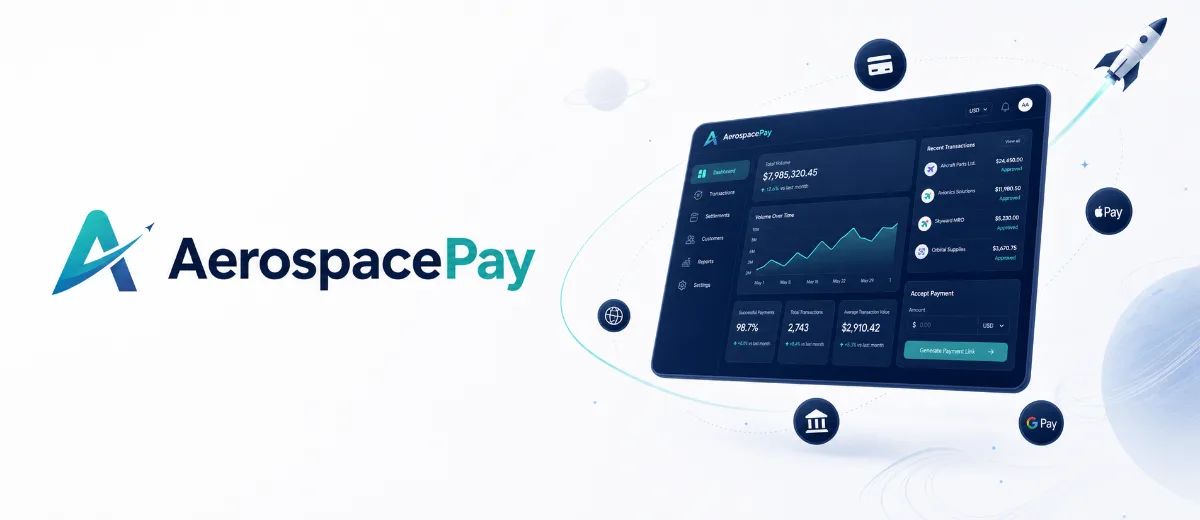
AerospacePay — operated by CARDZ3N, Las Vegas — is the only payment platform specifically engineered for aviation, aerospace, and defense businesses. Resolve Pay's 2026 ranking of B2B payment platforms for aerospace and defense manufacturing placed AerospacePay second overall — first among processors purpose-built for the vertical.
Every other platform on that list is a horizontal B2B tool adapted to aerospace. AerospacePay started here.
Key platform capabilities:
CARDZ3N launched AerospacePay in March 2019. It combines aerospace/defense industry experience with payment processing expertise. The goal was to close a gap every other processor had been ignoring.
That vertical focus also means no minimum processing history is required. A startup that just received its first prime contract qualifies under the same underwriting framework as a twenty-year MRO operation.
Payment processors and merchants don't need ITAR registration solely for processing a financial transaction. ITAR registration is required for companies that manufacture, export, or broker items on the USML.
If your business does any of those things, DDTC registration is required before you operate. Your processor also needs a merchant agreement that doesn't treat that licensed activity as a violation.
No. DoD payments route through EFT/ACH under FAR Subpart 32.11. They require current SAM.gov registration and CAGE code documentation. They often involve milestone billing structures that general merchant accounts don't support. Standard processors will also flag large B2G transactions without specific high-risk underwriting approval.
Large average transaction sizes, international counterparties requiring OFAC screening, dual-use goods creating regulatory uncertainty, and long payment cycles that extend reserve exposure. Most acquiring banks classify aerospace and defense as restricted and decline automatically — regardless of actual business quality.
ITAR (administered by State Department DDTC) controls items designed for military applications on the USML: fighter aircraft, missile systems, controlled munitions. EAR (administered by Commerce Department BIS) controls dual-use items — advanced sensors, electronics, encryption — with both civilian and military applications. Violations under both regimes carry penalties up to $1 million per violation and criminal imprisonment.
Yes. AerospacePay supports multi-currency processing and international payment flows. Examples include MRO invoices to foreign carriers, cross-border subcontractor payments, and parts orders from international OEMs. This includes counterparty screening against OFAC and relevant sanctions lists.
Prepared applicants with a complete document package typically receive approval in 3–7 business days. AerospacePay uses human underwriters with aerospace industry context rather than algorithms. That means fewer false rejections on the first pass. It also means faster paths through review for complex cases.
Baseline: EIN confirmation, articles of incorporation, and government-issued ID for all 25%+ owners. You also need 3–6 months of bank statements, prior processing statements if applicable, and a compliant website.
Aerospace-specific additions may include a CAGE code registration and a SAM.gov printout (for DoD contractors). They may also include an ITAR registration certificate if applicable, FAA certificates (repair station, Part 141/142), and a brief description of your export compliance program.
Maybe a standard processor has declined your account, frozen your funds, or terminated you. If this happened because your business involves defense contracts, aviation MRO, or export-controlled technology, you're not a compliance problem. You're in a vertical that most processors never understood.
AerospacePay by CARDZ3N was built for this. It offers IMPAC/GSA government card support, 24/7 AOG emergency processing, and OFAC-aware compliance. It also offers multi-currency settlement and level-2/level-3 B2G interchange optimization. Its account managers speak the language before you have to teach it to them.
No minimum processing history. Startups and established primes processed on the same underwriting framework.
Questions first? Call us: +1 (702) 623-3528
CARDZ3N | High-Risk Payment Experts for Businesses Worldwide | Las Vegas, NV | +1 (702) 623-3528 | cardz3n.com
Sources: DDTC — Understand the ITAR | BIS — EAR Part 730 | OFAC Sanctions List Service | OFAC Consolidated FAQs | Paul, Weiss — OFAC v. Apollo Aviation | Go-to-Market Solutions — ITAR Registration for Defense Contractors | UC Merced — Export Violation Penalties | University of Pittsburgh Research Security — EAR Dual-Use Items | DLA — CAGE Code Program | SAM.gov — Entity Registration | FAR Subpart 32.11 — Electronic Funds Transfer | DFAS — Contractor and Vendor Payment Booklet | Level-3processing.com — Fees for Government Contractors | Checkout.com — Level 2 and Level 3 Data | Grand View Research — Aircraft MRO Market | Resolve Pay — Best B2B Payment Platforms for Aerospace & Defense | CARDZ3N — AerospacePay Launch | CARDZ3N — AerospacePay Platform | GSA — Register Your Business (SAM.gov) | GovCon Chamber — CAGE Code | Protiviti — Sanctions Risk Assessment, Defense & Aerospace
Every merchant's processing setup is different, so the right answer depends on your industry, sales channels, average ticket size and chargeback history. CARDZ3N's payments specialists review those details with you and match your business with the right sponsor bank, gateway and risk tools, whether you sell online, in store, by invoice or on a recurring subscription.
We work with merchants across the USA, Canada, the UK and the EU, including high-risk, B2B and fast-growing businesses that traditional processors often turn away. If you would like a second opinion on your current rates, contract terms or approval options, contact our team for a free, no-obligation processing review.
Joshua Benedetti is the CEO of CARDZ3N, a Las Vegas-based merchant services provider specializing in high-risk payment processing and B2B payment technology.
Joshua Benedetti on LinkedInCARDZ3N Inc is headquartered in Las Vegas, Nevada, and provides merchant services to businesses that traditional processors turn away. Backed by top-tier sponsor banks and processors, CARDZ3N combines institutional stability with the speed of a specialized team that understands high-risk industries. Services include high-risk account underwriting and placement, gateway solutions across the major gateway platforms, POS integrations, ACH and check processing, chargeback prevention through ChargebackZ3N, and business lending and working capital. Its AerospacePay division serves OEMs, MROs, FBOs, and repair stations with B2B and B2G payment processing. CARDZ3N serves merchants in the USA, Canada, the UK, and the EU.
Start protecting your revenue from chargebacks today — schedule your complimentary consultation with CARDZ3N’s dispute management specialists.