
 CARDZ3N — Home
Contact us today for personalized advice and strategic solutions tailored to your goals.

Call us
+1 (702)-623-3528









Interchange-plus pricing separates three cost layers on every transaction: the interchange fee your card issuer collects, the network assessment, and your processor’s markup. It typically saves merchants money once monthly volume clears roughly $50,000 to $80,000, especially with a debit-heavy card mix. If you’re under that threshold, run a sample calculation on a recent statement before switching.
Every card transaction under interchange-plus pricing shows three distinct charges instead of one blended number. That transparency is the entire point of the model, and it’s why finance teams increasingly ask processors to itemize statements this way rather than accept a flat percentage.
The processor passes through the exact interchange fee and network assessment, then adds its own markup on top, stated separately. Here’s what each layer actually is:
Interchange itself moves with card mix and channel, but the assessment sits fixed regardless of who processes your transactions.
The formula is straightforward once you see it laid out: interchange + assessment + processor markup = your total cost per transaction, expressed as a percentage plus a flat per-transaction fee.
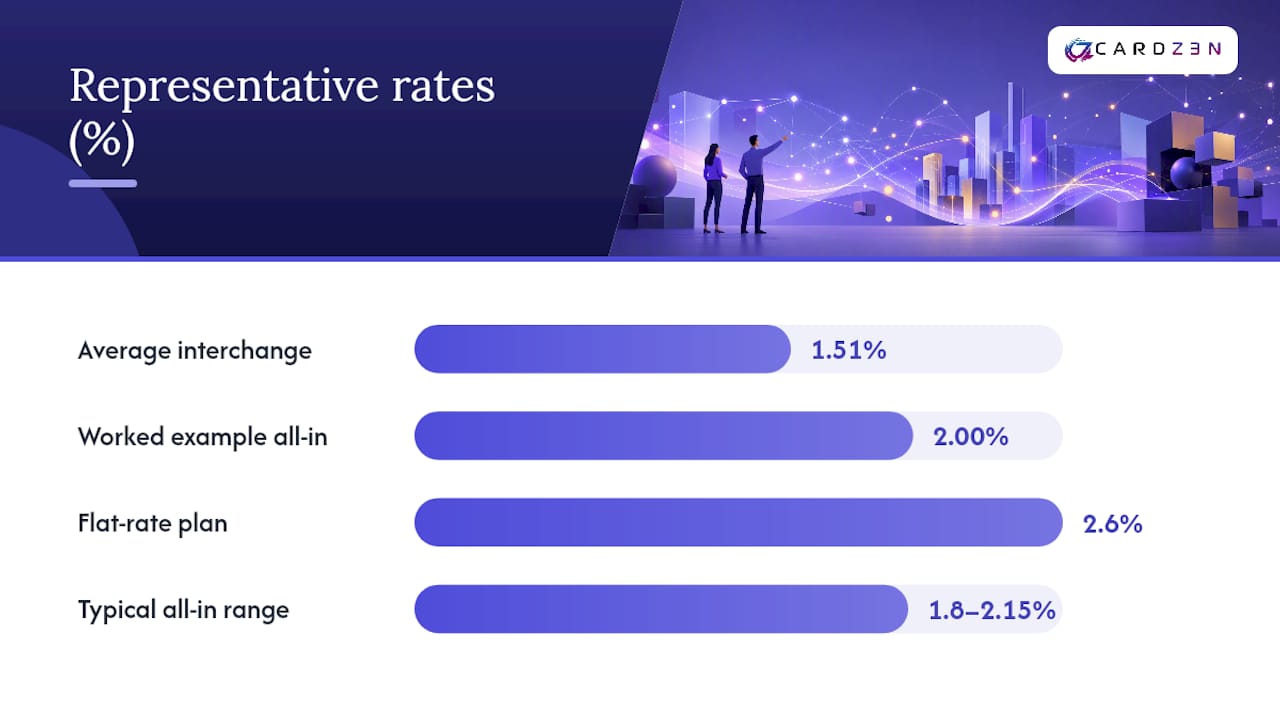
Here’s a worked example using the average U.S. credit card interchange rate of roughly 1.51%, a Visa assessment near 0.14%, and a modest processor markup:
Pro Tip: Ask your processor to run this exact calculation against your last three months of statements, broken out by card type. If they resist, that’s a signal the markup is buried somewhere you can’t see it.
Scale that up and the gap becomes real money. At $100,000 in monthly volume with an all-in rate near 2.0%, versus a flat-rate plan charging 2.6%, you’re looking at roughly $600 in monthly savings. At $300,000 a month, that same 0.6-point spread runs closer to $1,800 a month, which is why average interchange sitting near 1.51% with conservative markups tends to land the all-in rate between 1.8% and 2.15%.
Flat-rate pricing bundles all three cost layers into one number, and that simplicity has real value for the right merchant. Blended pricing is faster to set up, easier to budget against, and forgiving if you don’t have a finance team parsing statements line by line.
Interchange-plus flips that trade-off toward transparency and, usually, lower cost at scale:
The crossover point isn’t really about preference. It’s about whether your volume is high enough to make the itemization worth tracking.
Most merchants hit a real break-even point above a certain monthly card volume threshold, though card mix shifts that number meaningfully in either direction.
At $100,000 per month, switching to interchange-plus from a flat-rate plan commonly saves merchants between $300 and $700 monthly, depending on markup spread and card mix.
Consider the volume tiers directly:
A debit-heavy transaction mix shortens the break-even timeline considerably. Regulated debit interchange caps sit far below premium rewards-card rates, so merchants leaning on debit volume see the benefit of interchange-plus pricing show up faster than those processing a lot of rewards and corporate cards.
Processor markups for standard-risk merchants typically run within a moderate range over interchange and assessments, with volume discounts kicking in for merchants processing several hundred thousand dollars a month or more.
High-risk merchants generally face higher processor markups reflecting additional underwriting and chargeback risks, reflecting the underwriting risk, chargeback monitoring, and reserve requirements that come with the territory. CARDZ3N’s work with high-risk merchant accounts consistently shows this spread holds regardless of industry, once chargeback history and processing volume are factored into underwriting.
Beyond the headline markup number, verify these contract terms before signing anything:
Compare the full contract, not just the headline rate.*
A downgrade happens when a transaction fails to meet the qualification criteria for its lowest available interchange tier, and the issuer bumps it to a higher rate. Interchange-plus statements make these downgrades visible line by line, which is precisely why merchants who switch models often discover cost leaks they never knew existed under blended pricing.
The most common triggers, and how to fix each one:
Your operations manager or bookkeeper should own batch timing, while whoever manages your payment gateway should own AVS and MCC accuracy.
A short procurement checklist saves you from discovering contract surprises three months into a relationship. Before you commit to any interchange-plus provider, request the following:
Requesting a recent statement is the fastest way to catch inflated markup claims before you’re locked into a contract. If a provider can’t produce one, treat that as a red flag rather than an oversight. For merchants also weighing PCI scope questions during this evaluation, a practical PCI compliance guide is a useful companion reference.
Interchange-plus accounts are structured around high-risk underwriting, gateway integrations through NMI, Fluidpay, and Authorize.Net, and chargeback prevention services. Subscription merchants, high-volume e-commerce, and regulated B2B sellers typically see the clearest savings once volume and chargeback history are factored into the markup.
The math behind interchange-plus isn’t complicated, but merchants consistently misjudge the two variables that matter most: their actual card mix and their willingness to read a statement line by line. Conventional advice tends to frame the flat-rate versus interchange-plus decision purely as a volume threshold, and volume matters, but it’s not the whole story.
A merchant processing $60,000 a month in mostly debit transactions can outperform a merchant processing $150,000 a month in premium rewards cards, simply because debit interchange caps sit so much lower. Card mix deserves more attention than it gets in most pricing conversations, and finance teams that only ask “how much do we process” are missing half the picture.

The other blind spot is downgrades. Merchants assume their effective rate is fixed once they negotiate a markup, then never check whether AVS, batch timing, or keyed entries are quietly pushing transactions into higher interchange tiers. That’s not a pricing problem. It’s an operations problem wearing a pricing costume, and it’s fixable in a week once someone actually looks.
Prioritize the statement audit before the markup negotiation. You can’t negotiate what you haven’t measured.
— Joshua Benedetti
Some providers specialize in harder cases: high-risk merchant accounts that most processors turn away, paired with gateway integrations and chargeback prevention built to keep your effective rate honest over time. When comparing interchange-plus offers, the real advantage can be working with underwriters who understand chargeback ratios, reserve structures, and compliance requirements for regulated industries, to avoid paying a premium to educate a generalist processor.
To get started, send CARDZ3N your last three months of processing statements, your average monthly volume, your merchant category code, and your primary concern, whether that’s cost, chargebacks, or approval odds. An underwriting team can map out what an itemized interchange-plus structure would actually look like for your account. Start with the high-risk merchant account and payment processing page to see the services that apply to your situation.
The interchange rates, assessment figures, and break-even benchmarks cited above draw on Stripe’s explainer on interchange-plus pricing, TheFinRate’s merchant cost analysis, Helcim’s breakdown of interchange-plus savings, and CoreCommerce’s 2026 merchant guide on account types and underwriting timelines.
“Interchange plus plus” typically refers to a three-part pricing structure that separates interchange, assessment fees, and processor markup as distinct line items, functionally the same as standard interchange-plus, though some processors use the double-plus label to emphasize itemized assessment fees separately from markup.
Average U.S. credit card interchange runs around 1.51%, though the exact rate depends on card type, transaction channel, and merchant category, with debit transactions typically costing far less than premium rewards cards.
Interchange fees cover the cost and risk borne by card-issuing banks, and higher rates apply to premium rewards cards and card-not-present transactions owing to elevated risk and benefits.
You can’t eliminate interchange fees entirely since they’re set by card networks, but you can avoid unnecessary downgrades by capturing AVS and CVV data, using chip readers instead of keying in cards, and settling batches within 24 hours.
It depends on volume and card mix; merchants processing under $50,000 a month often find the added statement complexity isn’t worth the marginal savings, while those above that threshold, especially with debit-heavy sales, usually come out ahead.
Every merchant's processing setup is different, so the right answer depends on your industry, sales channels, average ticket size and chargeback history. CARDZ3N's payments specialists review those details with you and match your business with the right sponsor bank, gateway and risk tools, whether you sell online, in store, by invoice or on a recurring subscription.
We work with merchants across the USA, Canada, the UK and the EU, including high-risk, B2B and fast-growing businesses that traditional processors often turn away. If you would like a second opinion on your current rates, contract terms or approval options, contact our team for a free, no-obligation processing review.
Joshua Benedetti is the CEO of CARDZ3N, a Las Vegas-based merchant services provider specializing in high-risk payment processing and B2B payment technology.
Joshua Benedetti on LinkedInCARDZ3N Inc is headquartered in Las Vegas, Nevada, and provides merchant services to businesses that traditional processors turn away. Backed by top-tier sponsor banks and processors, CARDZ3N combines institutional stability with the speed of a specialized team that understands high-risk industries. Services include high-risk account underwriting and placement, gateway solutions across the major gateway platforms, POS integrations, ACH and check processing, chargeback prevention through ChargebackZ3N, and business lending and working capital. Its AerospacePay division serves OEMs, MROs, FBOs, and repair stations with B2B and B2G payment processing. CARDZ3N serves merchants in the USA, Canada, the UK, and the EU.
Start protecting your revenue from chargebacks today — schedule your complimentary consultation with CARDZ3N’s dispute management specialists.