
 CARDZ3N — Home
Contact us today for personalized advice and strategic solutions tailored to your goals.

Call us
+1 (702)-623-3528


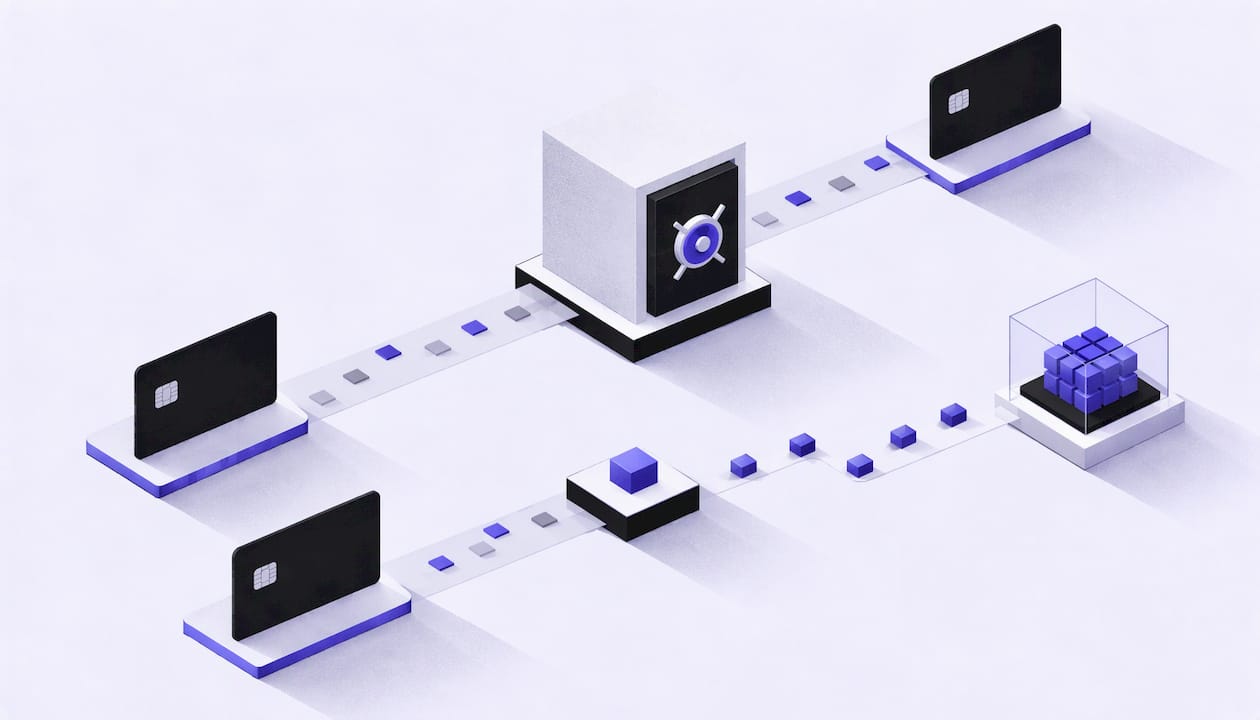




Encryption makes card data unreadable to anyone without the key. Tokenization removes the card number from your systems and puts a surrogate value in its place. For a merchant, the practical difference is this: encrypted card data can be turned back into the real number by anyone holding the key, so it stays a security and compliance burden. A token cannot be turned back by anyone outside the tokenization system, so there is far less for you to defend. Most merchants, and nearly all high-risk and subscription merchants, should use both, each at a different point in the payment flow.
This guide explains how each method works, what each does to your PCI DSS scope, which to use for card-on-file and recurring billing, and what to check in a provider before you rely on either. If you run a business that mainstream processors have declined or frozen, the stakes are higher, because your security posture is part of what a sponsor bank evaluates during underwriting.
| Encryption | Tokenization | |
|---|---|---|
| What it does | Transforms card data into ciphertext using an algorithm and a key | Replaces the card number (PAN) with a surrogate token |
| Reversible? | Yes, by anyone with the key | Only through the tokenization system’s mapping to the vault |
| Where it protects best | Data in transit and data stored where you must keep the real value | Card-on-file, recurring billing, reporting, customer service, analytics |
| What a thief gets from a breach | Ciphertext, which is useless without the key but still regulated data | A token with no usable card value outside your payment environment |
| Effect on PCI DSS scope | Generally does not remove systems from scope | Can shrink the systems that store or touch card data |
The two are not rivals. Visa’s guidance describes them as addressing different points in the payment-data lifecycle and recommends layering them.
Encryption applies a cryptographic algorithm and a secret key to plaintext, producing ciphertext. Anyone with the right key can reverse the process. That reversibility is both the point and the weakness: your systems can decrypt a card number when they need it, and so can an attacker who obtains the key or compromises a system that holds it.
In card payments, encryption shows up in three places:
A common assumption is that encrypted data is out of scope for PCI DSS. The standard says otherwise. Systems that perform encryption, decryption or key management are in scope, and so is encrypted cardholder data that is accessible to an entity holding the decryption key or sitting in the same environment as that key. PCI DSS v4.0.1 states that encryption alone generally does not remove data or environments from scope. It also says that when you use third-party providers, you remain responsible for ensuring account data is protected.
In practice, if your application encrypts cards in its own database, your servers, your key management, your administrators and your backups all stay inside the assessment boundary.
Visa defines tokenization as replacing the PAN with a surrogate token from which the original PAN is computationally infeasible to determine. Unlike ciphertext, a well-built token has no mathematical relationship to the card number. The only link is a mapping table inside the tokenization system, held in a secured card-data vault.
The flow looks like this:
If an attacker steals your database, they get tokens. Those tokens are of little use outside the payment environment that issued them.
The word “token” covers two different things in payments, and mixing them up leads to bad decisions:
For a merchant, the first kind is about shrinking your storage risk. The second is also about how the card is represented to issuers. Ask your provider which one you are getting, and whether it supports both.
With encryption, recovery is a function: key plus ciphertext gives plaintext. With tokenization, recovery is a lookup performed by the vault. This is why stolen encrypted data is a standing risk if keys are ever exposed, while stolen tokens depend on an attacker also getting into the tokenization system itself.
Encrypted PAN usually remains in your database, logs, backups and exports. Tokenized PAN does not. The PCI Security Standards Council’s tokenization guidance recommends replacing stored PAN with tokens where possible, limiting PAN to capture and the card-data vault, and removing PAN from source systems after tokenization.
Visa’s tokenization best practices say properly implemented tokenization can limit cardholder-data storage to the tokenization system and potentially simplify a merchant’s PCI DSS assessment. The word “potentially” matters. This is scope reduction, not automatic exemption.
Tokens can be designed to keep a format that your reporting, customer-service and billing tools expect, so downstream systems keep working without ever handling a real card number. Encrypted values generally require decryption before they can be used, which means those systems must be trusted with keys or with plaintext.
For a merchant, the scope question is usually the deciding one, because scope drives cost, audit time and the number of people and systems you must secure.
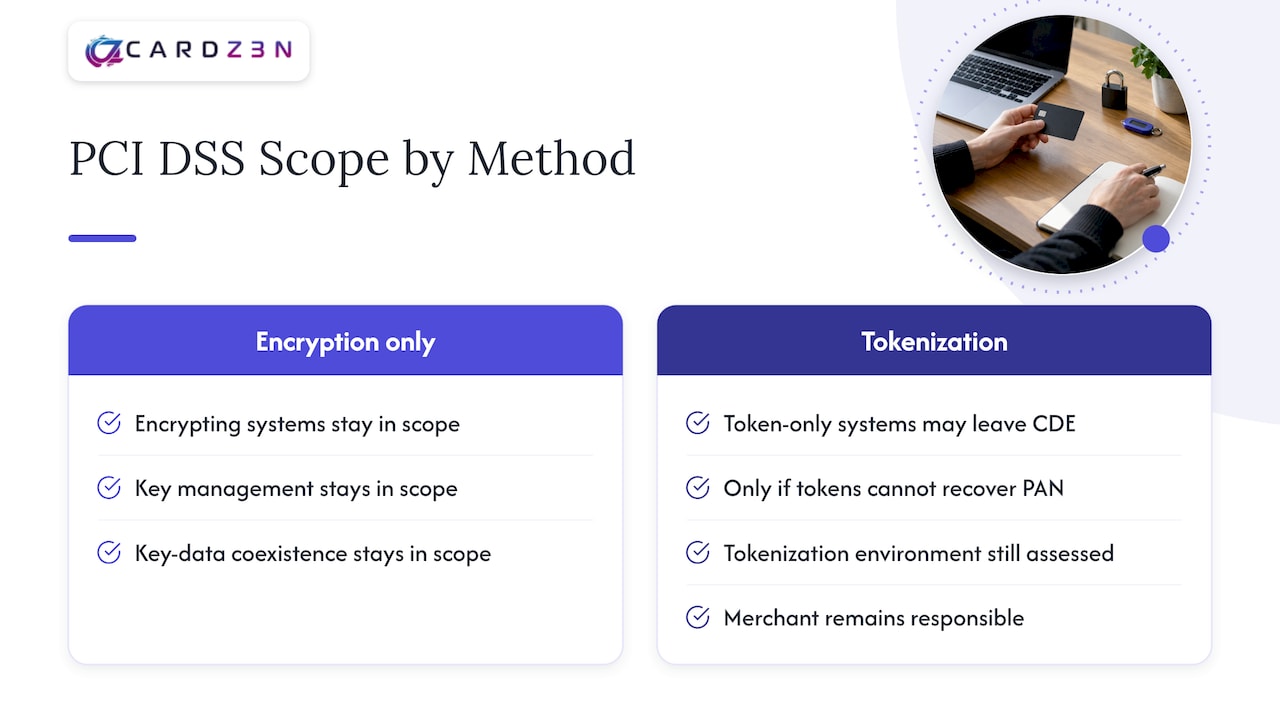
With encryption only. Your encrypting systems, key management and any place the key and the data coexist stay in scope. You also carry the key-management burden: generation, storage, rotation, access control and retirement.
With tokenization. Systems that hold only tokens can fall outside the cardholder data environment, provided the token cannot be used to recover the PAN and the tokenization is implemented correctly. You still have duties. The PCI Council’s guidance says the merchant remains ultimately responsible for proper implementation and operation of its tokenization solution and for validating its tokenization environment in its annual assessment. Depending on how much you outsource, that can include provider due diligence, written responsibility agreements, annual monitoring of the provider’s PCI DSS status, access and retention controls, and log review.
Which questionnaire you file. PCI SSC revised its self-assessment questionnaire guidance in April 2025, correcting e-commerce SAQ guidance and adding SAQ A eligibility criteria. Check the current SAQ instructions and your acquirer’s requirements to see which one applies to your integration. For the wider set of version 4.0 changes, see our guide to PCI DSS 4.0 fixes security teams need and the PCI compliance checklist for B2B merchants.
The right answer depends on what the data is doing at each moment.
| Situation | Best fit | Why |
|---|---|---|
| Card entered at checkout and sent to the gateway | Encryption (TLS), plus hosted fields or a redirect | The real PAN must travel once, so it must be protected in transit |
| Card in person at a terminal | P2PE, paired with tokenization | Limits PAN to a secure device, then replaces it |
| Card-on-file for returning customers | Tokenization | Your systems never need the real number again |
| Subscriptions and recurring billing | Tokenization, ideally with network tokens | Renewals run on the token and keep working when cards are reissued |
| Analytics, reporting, support tools | Tokenization | Teams work with a stand-in value, not live card data |
| Legacy card data you still hold | Remove it, or protect it with strong cryptography | Visa’s guide recommends removing or protecting legacy card data |
| Bank account data for ACH | Encryption and access control, with a provider-held vault where offered | Account numbers are also sensitive and need protection at rest and in transit |
The combined pattern is the one the standards bodies point to. The PCI Council recommends combining an effective tokenization solution with point-to-point encryption, so the PAN is confined to a secure, PTS-approved point-of-interaction device. Visa’s guidance recommends a layered approach and asks entities to consider whether a token can meet their needs instead of retaining sensitive card data.
If you bill on a schedule, tokenization is the foundation. Your billing engine needs to charge the same customer every month, but it never needs to see the card number after the first capture. Tokens also keep renewals running across processor changes only if your provider lets you migrate or reuse them, so ask about portability before you sign. We cover the renewal side in payment tokenization and subscription renewal failures.
If a mainstream processor has shut you down, your next underwriting review will look at how you handle card data, along with chargebacks, refunds and fraud controls. A clean tokenization architecture shortens the list of systems that can leak data, and it helps your story that card data is contained. It does not replace the rest of the file: chargeback ratios, product compliance and business model still drive approval.
Visa’s best practices identify four critical components in any tokenization system: token generation, token-to-PAN mapping, the card-data vault, and cryptographic key management. They call for segmentation, authentication, monitoring, and encryption of the PAN inside the vault. Notice that encryption appears inside tokenization: the vault itself is encrypted, which is another reason the two are complementary.
Use that list to question any provider:
Tokenization protects stored data. It does not stop an attacker who scripts stolen cards through your checkout page, or a skimmer on a payment form. Pair it with fraud controls such as velocity limits, bot defenses and 3DS where it fits. Our guides on card-not-present fraud without hurting checkout and spotting and stopping card testing attacks cover those layers, and our chargeback management service handles prevention and dispute representment.
We build merchant accounts for businesses that mainstream processors reject, freeze or shut down, and we pair underwriting and placement with gateway integrations, POS integrations, recurring and subscription billing, and chargeback prevention through ChargebackZ3N. Our payment gateway and online payment processing services are where card capture, protection and recurring charges come together for your storefront or platform. We work with sponsor banks, and we are transparent about reserve structures and quote-based pricing, so you can plan around real terms. If you need a high-risk account with a security setup your underwriters will accept, start with our high risk merchant account page.
Merchants often ask us whether they should pick tokenization or encryption, as if one cancels the other. We see them as two layers of one design. Encryption protects the card number for the few moments it has to move or be decrypted. Tokenization makes sure that, after that moment, the rest of your business has nothing worth stealing.
For high-risk and subscription merchants, the case is practical. Your recurring revenue depends on being able to charge a card again without holding it, and your approval depends on a bank believing you contain risk. A setup in which tokens run through your billing, support and reporting while the real card data stays inside a protected vault serves both goals.
That is why we treat payment security as part of merchant account design, not an afterthought. We place you with sponsor banks, connect the gateway, set up recurring billing and add chargeback prevention, with reserve and pricing terms stated up front. Security, approval and cash flow are one conversation for us.
Joshua Benedetti
For stored card data, tokenization usually leaves less to protect, because a token cannot be reversed without the vault’s mapping, while encrypted data can be decrypted by anyone with the key. For data in motion, encryption is what protects it. The safest design uses both.
Not automatically. Properly implemented tokenization can reduce the systems that store or process card data and may simplify your assessment, but you remain responsible for validating your tokenization environment and for managing your provider’s compliance status.
Generally no. PCI DSS v4.0.1 treats encrypted cardholder data as in scope when an entity has the decryption key or the data sits in the same environment as the key, and systems that encrypt, decrypt or manage keys are in scope too.
Tokenization for the stored card, with encryption protecting the initial capture and every transmission. Visa’s guidance notes that payment tokens can replace PANs for card-on-file and recurring-payment data.
No. Hashing is a one-way function, and masking hides part of a value on screen or in a report. Tokenization substitutes a surrogate value that your systems can use in place of the card number for transactions through the provider.
Every merchant's processing setup is different, so the right answer depends on your industry, sales channels, average ticket size and chargeback history. CARDZ3N's payments specialists review those details with you and match your business with the right sponsor bank, gateway and risk tools, whether you sell online, in store, by invoice or on a recurring subscription.
We work with merchants across the USA, Canada, the UK and the EU, including high-risk, B2B and fast-growing businesses that traditional processors often turn away. If you would like a second opinion on your current rates, contract terms or approval options, contact our team for a free, no-obligation processing review.
Joshua Benedetti is the CEO of CARDZ3N, a Las Vegas-based merchant services provider specializing in high-risk payment processing and B2B payment technology.
Joshua Benedetti on LinkedInCARDZ3N Inc is headquartered in Las Vegas, Nevada, and provides merchant services to businesses that traditional processors turn away. Backed by top-tier sponsor banks and processors, CARDZ3N combines institutional stability with the speed of a specialized team that understands high-risk industries. Services include high-risk account underwriting and placement, gateway solutions across the major gateway platforms, POS integrations, ACH and check processing, chargeback prevention through ChargebackZ3N, and business lending and working capital. Its AerospacePay division serves OEMs, MROs, FBOs, and repair stations with B2B and B2G payment processing. CARDZ3N serves merchants in the USA, Canada, the UK, and the EU.
Start protecting your revenue from chargebacks today — schedule your complimentary consultation with CARDZ3N’s dispute management specialists.