


 CARDZ3N — Home
Contact us today for personalized advice and strategic solutions tailored to your goals.

Call us
+1 (702)-623-3528










Card-not-present (CNP) fraud happens when someone uses stolen card details to buy something without the physical card, typically online, by phone, or through a stored subscription. It affects both shoppers who never authorized the charge and merchants left holding the chargeback. The most effective countermeasures pair authentication standards like EMV 3-D Secure with real-time transaction monitoring, not either one alone.
CNP fraud covers any unauthorized transaction where the merchant never physically sees or swipes the card. That includes ecommerce checkouts, phone orders, mail-order billing, and automatic subscription renewals charged to a card on file. A stolen card number used to place a $40 order on a clothing site is CNP fraud. So is a fraudster using a breached card to reactivate a streaming subscription three months after the original owner canceled it.
The distinction from card-present fraud matters because the verification tools differ entirely. A physical retailer can check a signature, chip, or PIN. An online merchant is stuck relying on data points the cardholder types in, which is exactly why fraud rates run higher in CNP channels. Common verification checks include:
None of these checks are foolproof. A fraudster who has stolen full card data, including the CVV, from a data breach can pass every one of them on the first try.
Fraud rarely starts with a single big purchase. It follows a lifecycle, and understanding each stage helps you spot it before the damage compounds.
Beyond straightforward card testing, merchants deal with several related patterns: account takeover (ATO), where a fraudster hijacks an existing customer login instead of creating a new one; new-account fraud, where synthetic or stolen identities open fresh accounts to build trust before striking; and friendly fraud, where a legitimate cardholder disputes a real charge to get a free refund.
Watch for sudden velocity spikes on a single item, AVS or CVV mismatches on repeated attempts, and multiple card numbers tied to one device fingerprint or IP address. Any of those alone might be nothing. Together, they’re a pattern.
Pro Tip: Card testing is the single most actionable early warning sign in CNP fraud. Merchants who throttle or auto-decline suspicious micro-transactions cut off large loss events before they start, because a fraudster who can’t validate a card won’t risk it on a big purchase.
Every CNP scheme starts with stolen data, and it rarely comes from one source. The main pipelines are:
The overlap between these vectors is what makes CNP fraud durable. A single breach can feed phishing campaigns for years, and stuffed credentials often unlock enough personal detail to defeat basic verification questions later.
The financial and operational fallout lands on both sides of the transaction, and rarely in equal measure.
Consumers usually get their money back through card network protections. Merchants almost never do.
CNP fraud isn’t a fringe problem. It’s the dominant fraud channel across mature card markets.
Card payment fraud remains the single largest category of fraudulent transactions by volume, according to joint reporting from the European Banking Authority and European Central Bank, which recorded roughly seventeen million fraudulent card transactions out of over a hundred billion total card transactions in 2024. Fraud rates were consistently higher on transactions where strong customer authentication was not applied.
The U.S. tells a related story. The shift to EMV chip cards largely locked down in-person counterfeit fraud, and fraud simply migrated to the channel that lacked an equivalent physical safeguard. A Federal Reserve Bank of Boston brief documents this shift and points to risk-based authentication and transaction monitoring as the primary levers for pulling losses back down. Card testing and stolen-credential purchases account for a large share of that CNP fraud value, which is why the earliest stage of the attack lifecycle deserves the most attention from anyone building a defense.
No single tool closes every gap, but a layered approach closes most of them without wrecking your checkout conversion.
Strong customer authentication. EMV 3-D Secure adds a verification step, like a one-time code or biometric prompt, for transactions that look risky. Visa’s own guidance notes that strong authentication can cut ecommerce fraud significantly while actually improving approval rates, because issuers trust authenticated transactions more. The key is applying it selectively. Forcing every customer through extra verification kills conversion; reserving it for flagged transactions keeps friction where it belongs.
Tokenization. Replacing a stored card number with a merchant-specific token means a breach of your database doesn’t hand attackers usable card data. Network tokenization takes this further: tokens tied to a specific network often can’t be reused elsewhere even if stolen, which guts the resale value of breached data.
Transaction monitoring and device fingerprinting. Real-time rules that flag velocity spikes, mismatched shipping and billing addresses, or multiple cards on one device catch fraud before it settles. Device fingerprinting adds another signal layer by tracking browser and hardware characteristics that persist even when a fraudster changes IP addresses.
Machine learning models. Modern fraud detection increasingly leans on ML and behavioral analytics layered on top of static rules. Peer-reviewed research on intelligent fraud detection systems shows these models materially improve detection accuracy, but they require careful tuning. Poorly deployed models generate false positives that decline legitimate customers just as often as they catch fraudsters. Methods like anomaly detection can flag unusual purchasing patterns that rule-based systems miss entirely.
Fulfillment controls. Verify shipping addresses against billing data, cap how many high-value digital goods (gift cards, game credits) a new account can buy in a short window, and require additional review on orders shipping to freight forwarders, a common fraud pattern for high-value electronics.
Here’s the practical priority order for most merchants:
Pro Tip: Set a rule that flags more than a handful of small-dollar authorizations from the same device or IP within a short window for manual review or automatic decline. Blocking micro-tests at the door, a core piece of chargeback prevention strategy, reduces the high-value fraud that follows.
The fixes differ depending on which side of the transaction you’re on, but both sides have concrete moves available today.
If you’re a consumer:
If you run a small business:
If you suspect fraud, act fast and document everything. Contact your card issuer or bank first to freeze the account. Report the incident to the Federal Trade Commission at IdentityTheft.gov, and file a police report if a merchant or bank requires one for a formal dispute. Save transaction records, correspondence, and any phishing messages that may have led to the compromise. That documentation speeds up both the bank’s investigation and any law enforcement follow-up.
Not every fraud tool or claim in this space is worth your budget. A few standards and resources have earned their reputation.
The common thread across every credible standard here is layering. None of them work as a standalone silver bullet, and vendors who claim theirs does deserve a skeptical second look.
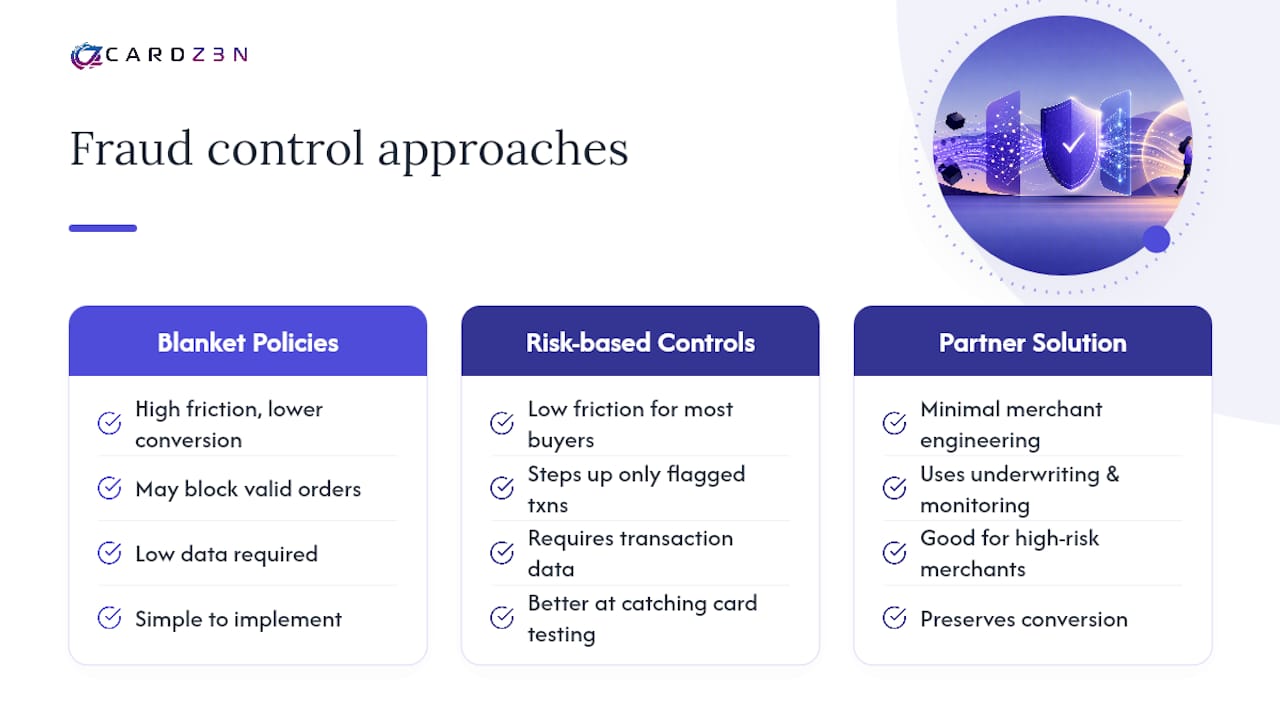
Most merchants know card testing exists. Few build a rule to catch it, because a handful of $1 authorizations doesn’t look urgent until the $2,000 order clears three days later using the same validated card. That gap between knowing and doing is where many CNP losses actually originate.
The harder trade-off is friction versus conversion. Risk-based controls that step up verification only on flagged transactions solve this better than blanket policies, but they demand data most small merchants don’t have time to build alone. That’s exactly where high-risk merchants and chargeback-heavy verticals benefit from a partner who already has the underwriting and monitoring infrastructure in place.
— Joshua Benedetti
Merchants in chargeback-prone or high-risk categories often hit a wall with mainstream processors long before they’ve solved their fraud problem. Standard platforms tend to freeze or terminate accounts the moment dispute ratios climb, instead of helping merchants fix the underlying pattern. CARDZ3N takes the opposite approach: underwriting built for high-risk and high-chargeback verticals, paired with chargeback prevention services designed to catch disputes before they escalate rather than react after the fact. Some services include gateway integrations with fraud filtering built in, so merchants don’t need to stitch together separate tools for authentication, tokenization, and monitoring. If your business has been declined, flagged, or dropped by a mainstream processor over CNP fraud exposure, CARDZ3N’s high-risk merchant account services are built specifically for that situation. Reach out to get a quote-based assessment of what your processing setup actually needs.
Any online checkout, phone order, or automatic subscription renewal charged to a stored card qualifies. A fraudster buying electronics on a retail website using a stolen card number, without ever holding the physical card, is a textbook example.
Local police can take a report, but most debit card fraud investigations are led by the card issuer or bank, especially for smaller-dollar cases. Larger or multi-victim schemes are more likely to draw dedicated law enforcement or federal attention.
They obtained your card number, expiration date, and CVV through a data breach, phishing scam, skimming device, or malware, then used those details directly at an online or phone checkout that never required the physical card.
Card fraud can be charged as a felony in most U.S. states once the dollar amount crosses a statutory threshold, though exact thresholds and charges vary by state and by whether the case involves interstate activity that triggers federal jurisdiction.
Blocking card testing early and applying risk-based authentication only to flagged transactions cuts both fraud losses and chargeback volume. Merchants managing high dispute ratios often turn to dedicated chargeback management services to build that monitoring without slowing down legitimate customers.
Every merchant's processing setup is different, so the right answer depends on your industry, sales channels, average ticket size and chargeback history. CARDZ3N's payments specialists review those details with you and match your business with the right sponsor bank, gateway and risk tools, whether you sell online, in store, by invoice or on a recurring subscription.
We work with merchants across the USA, Canada, the UK and the EU, including high-risk, B2B and fast-growing businesses that traditional processors often turn away. If you would like a second opinion on your current rates, contract terms or approval options, contact our team for a free, no-obligation processing review.
Joshua Benedetti is the CEO of CARDZ3N, a Las Vegas-based merchant services provider specializing in high-risk payment processing and B2B payment technology.
Joshua Benedetti on LinkedInCARDZ3N Inc is headquartered in Las Vegas, Nevada, and provides merchant services to businesses that traditional processors turn away. Backed by top-tier sponsor banks and processors, CARDZ3N combines institutional stability with the speed of a specialized team that understands high-risk industries. Services include high-risk account underwriting and placement, gateway solutions across the major gateway platforms, POS integrations, ACH and check processing, chargeback prevention through ChargebackZ3N, and business lending and working capital. Its AerospacePay division serves OEMs, MROs, FBOs, and repair stations with B2B and B2G payment processing. CARDZ3N serves merchants in the USA, Canada, the UK, and the EU.
Start protecting your revenue from chargebacks today — schedule your complimentary consultation with CARDZ3N’s dispute management specialists.