

 CARDZ3N — Home
Contact us today for personalized advice and strategic solutions tailored to your goals.

Call us
+1 (702)-623-3528









Start by scoping your Cardholder Data Environment and confirming which validation path applies: SAQ or Report on Compliance. That single step cuts your compliance workload more than any other decision you’ll make. From there, assign control owners, begin evidence collection, and note that PCI DSS v4.0.1’s mandatory controls, including multi-factor authentication for every path into the CDE, took effect March 31, 2025. If you haven’t implemented MFA everywhere yet, that’s your first fire drill.
Before diving into the requirement-by-requirement breakdown, here’s what to tackle first. These items carry the most weight in an actual assessment and, not coincidentally, the most risk if you skip them.
Segmentation work, MFA rollout across legacy systems, and patching critical vulnerabilities eat the most time and budget. Budget for these first; everything else moves faster once the CDE is smaller and better isolated.
Pro Tip: Start evidence collection before you start remediation. Export current firewall configs, pull your existing scan history, and schedule your next ASV scan immediately. Assessors move faster when you arrive with a paper trail already in motion instead of building it from scratch during the audit window.
PCI DSS is the security standard that governs anyone who stores, processes, or transmits payment card data, from a five-person e-commerce shop to a Level 1 processor handling millions of transactions annually. It applies to merchants and service providers alike, and your acquiring bank enforces it as a condition of keeping your merchant account open.
The version in force right now is PCI DSS v4.0.1, and a critical detail trips up more merchants than anything else in this article: a large set of controls that were originally listed as “future dated” became mandatory on March 31, 2025. If your last assessment predates that shift, you are not currently compliant with the active standard, regardless of what your last Attestation of Compliance says.
Four changes matter more than the rest:
The script integrity rule deserves a second look because it quietly reclassifies merchants. If you can’t justify why a third-party script sits on your payment page, or you can’t detect when it changes, you may lose eligibility for the simpler SAQ A form and get pushed into a more demanding validation path. Marketing teams add tracking pixels without looping in security; under v4.0.1, that habit has compliance consequences.
None of this is optional cleanup. Your acquirer and your processor both have visibility into your compliance status, and a lapsed AOC creates real friction on account renewals, rate reviews, and dispute handling. Treat the March 2025 deadline as already behind you, because it is, and audit your environment against these four changes before you do anything else.
The 12 PCI DSS requirements organize into six control objectives. Working through them in order, with concrete evidence targets attached to each, is the fastest way to build an audit-ready file instead of a pile of loose documentation.
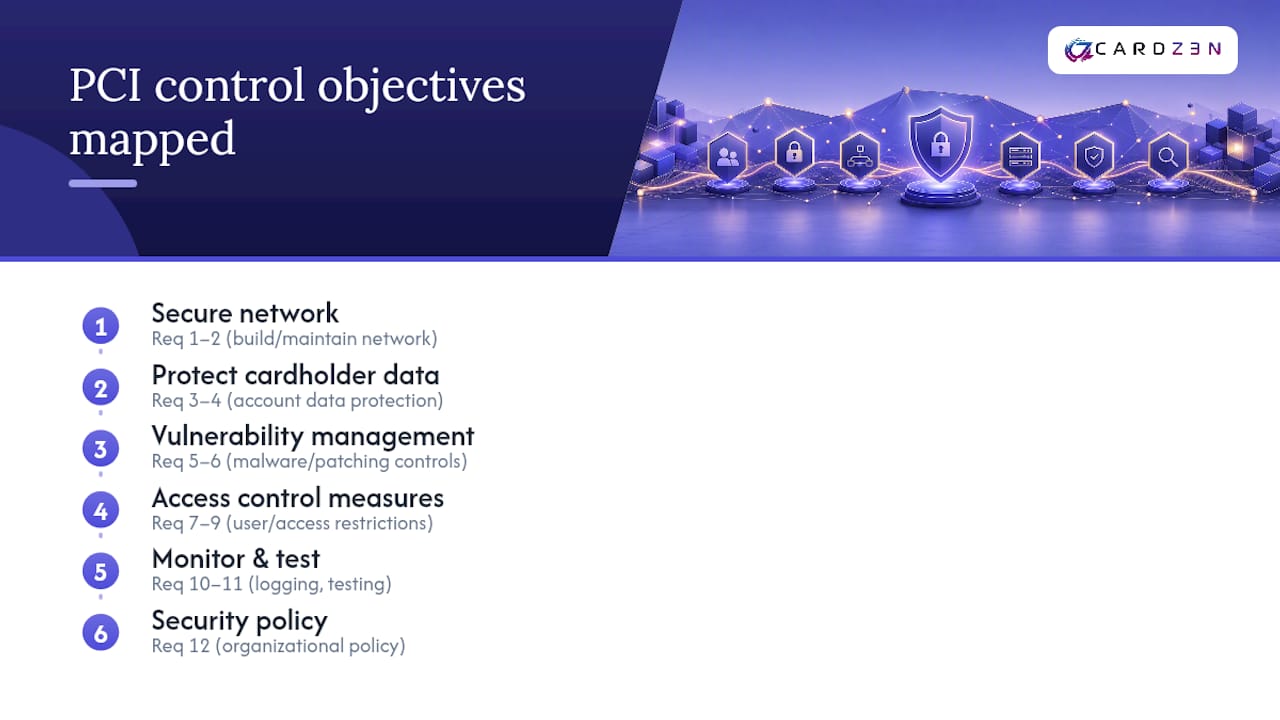
Requirement 1 covers network security controls: firewalls, routers, and any device that filters traffic into or out of the CDE. Evidence auditors want to see includes current network diagrams, firewall rule reviews (documented at least every six months), and a clear justification for every open port.
Requirement 2 addresses secure configurations, meaning no vendor-default passwords, no unnecessary services running on in-scope systems, and hardened configuration standards applied consistently. This is the single most common early-stage audit finding: a POS terminal, a wireless router, or a legacy database still using the password it shipped with. Pull an inventory of every in-scope device and manually confirm credentials before an assessor does it for you.
Requirement 3 governs stored cardholder data: don’t store the full PAN unless there’s a business reason, mask it on display, and encrypt what you do retain using strong cryptography with documented key management procedures. Requirement 4 covers data in transit, meaning current TLS configurations (no legacy SSL or early TLS) for any transmission of cardholder data across open, public networks.
Common finding here: cardholder data lingering in log files, email archives, or spreadsheet exports that nobody remembered existed. A data discovery scan across file shares and databases, not just your production payment systems, catches this before an assessor does.
Requirement 5 requires anti-malware protection on applicable systems, with logs proving the software stays updated and active. Requirement 6 covers secure development and patch management: critical vulnerabilities patched promptly, custom code reviewed for security flaws before deployment, and, under v4.0.1’s new provisions, that script inventory and integrity monitoring for payment pages mentioned earlier.
Minimum frequency expectations: critical patches applied per your defined risk ranking (many organizations target 30 days for critical-severity items), and payment page script reviews conducted on a schedule you can defend to an assessor.
Requirement 7 restricts access to cardholder data based on business need to know, meaning role-based access with documented justification, reviewed periodically. Requirement 8 governs authentication, and this is where MFA lives. Under v4.0.1, MFA is required for all access into the CDE, not just remote or administrative access as earlier versions specified. Requirement 9 covers physical security: restricted access to server rooms, visitor logs, and controls preventing unauthorized physical access to systems that handle cardholder data.
The MFA expansion is worth flagging on its own. Enumerate every access path into your CDE, including service accounts, API integrations, and database clients, because assessors will test whether MFA genuinely covers all of them, not just the obvious ones like VPN logins.
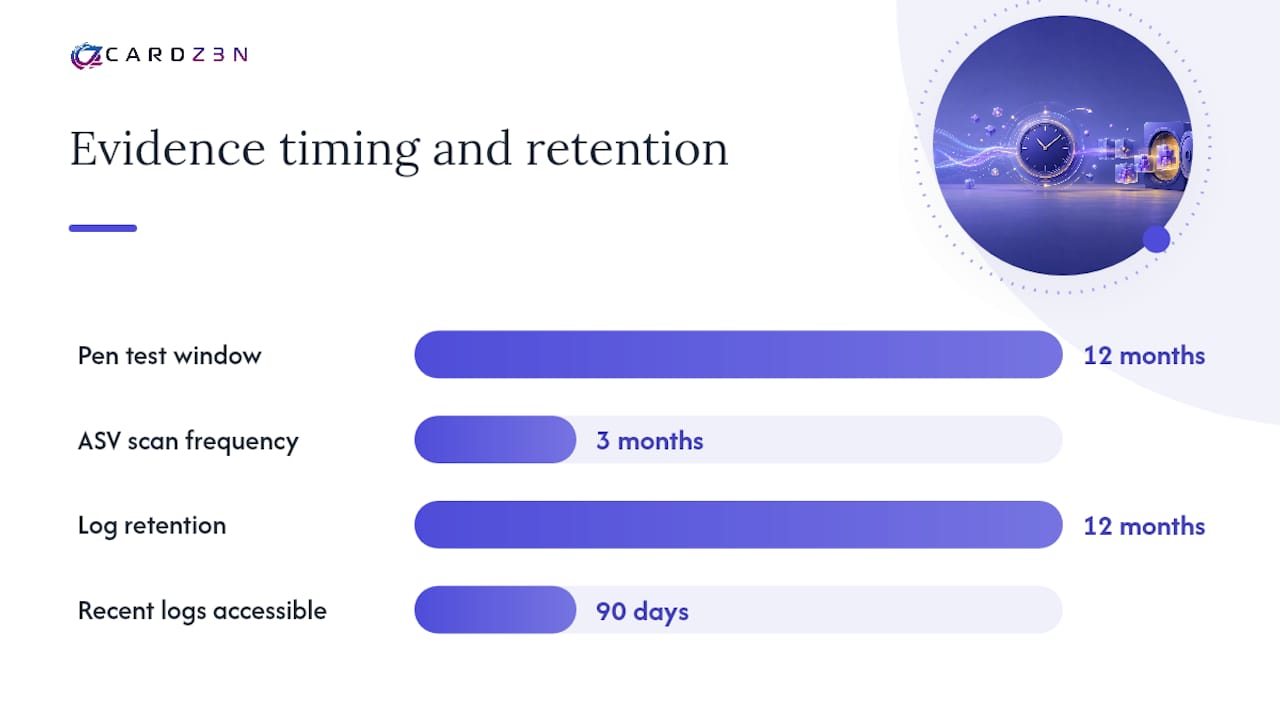
Requirement 10 requires logging and monitoring of all access to system components and cardholder data, with automated mechanisms flagging anomalies daily under the new v4.0.1 language. Requirement 11 covers testing: quarterly external vulnerability scans through an Approved Scanning Vendor when your environment requires it, annual penetration testing, and segmentation testing to confirm your CDE boundary actually holds.
Evidence auditors expect: scan reports showing passing results (or a documented remediation and rescan cycle for anything that failed), a penetration test report from the last twelve months, and log retention proving at least a year of history with the most recent 90 days immediately accessible for analysis.
Requirement 12 ties everything together: a documented security policy reviewed annually, a formal risk assessment process, incident response planning tested at least yearly, and a service provider management program with contractual acknowledgment of PCI responsibilities from every vendor touching your CDE.
A checklist workbook that maps the 12 requirements into discrete line items, complete with status and evidence columns, gives compliance teams a working document instead of a mental checklist. Trackers like Venvera’s free PCI DSS Excel checklist map dozens of individual tasks against each requirement, which turns a 12-item overview into something you can actually assign and track week to week.
If you’re triaging where to start, segmentation comes first. A tighter CDE boundary means fewer systems in scope for every requirement that follows, which lowers both audit cost and remediation burden across the board. After segmentation, MFA rollout and patching known critical vulnerabilities are typically the next-highest-cost, highest-risk items on the list.
Get scoping wrong and everything downstream, cost, timeline, and audit outcome, gets wrong with it. Practitioners consistently flag CDE scoping mistakes as the single most expensive category of PCI errors, usually because merchants either drag unrelated systems into scope (inflating cost and audit time) or miss connected systems entirely (creating a genuine security and compliance gap).
Once scope is defined, the validation path follows from your merchant level and how you accept payments. Merchant levels run from Level 1 (over 6 million transactions annually) down to Level 4, and Level 1 merchants generally require an annual on-site assessment performed by a Qualified Security Assessor, resulting in a full Report on Compliance. Lower-volume merchants typically self-assess using the SAQ that matches their environment.
Here’s how the common SAQ types break down in practice:
Misclassifying yourself into an SAQ that’s too lenient for your actual environment is not a paperwork error; it’s a compliance failure your acquirer discovers eventually, usually during a breach investigation or a routine account review, at the worst possible time.
Pro Tip: Get your SAQ classification confirmed in writing by your acquirer before you start filling out the form. A five-minute email now beats a disputed classification after an incident, when your validation history suddenly matters a great deal.
Passing an assessment comes down to producing the right artifacts, not just running the right controls. Build this evidence package as you go rather than scrambling to assemble it in the final weeks before your assessment window closes.
Quarterly ASV scans through a PCI-approved scanning vendor apply to merchants and service providers with internet-facing systems in their CDE. That’s distinct from internal vulnerability scanning, which you run yourself (authenticated, from inside the network) on a schedule matched to your risk profile, and from penetration testing, which simulates an actual attacker attempting to breach your defenses rather than just enumerating known vulnerabilities.
Daily log review is no longer a “nice to have” under v4.0.1; automated mechanisms need to flag anomalies as they happen; not get discovered during a monthly report review. Retention expectations call for at least a year of log history, with the most recent 90 days readily accessible for active investigation. A centralized SIEM, rather than logs scattered across individual servers and firewalls, is what makes both the daily review requirement and the retention requirement practical to actually meet instead of technically true on paper.
Schedule your ASV scan and penetration test early in your project timeline, not near your deadline. Remediation and rescan cycles eat time, and a failed scan two weeks before your audit deadline creates exactly the kind of pressure that leads to shortcuts.
A checklist you complete once a year and shelve isn’t compliance, it’s a snapshot that expires the moment your environment changes. The organizations that pass assessments with minimal remediation treat every control as an owned, monitored, continuously verified process.
Start by assigning a named owner to every control category: someone accountable for firewall rule reviews, someone else for access reviews, someone for log monitoring. Diffuse ownership is how controls quietly lapse between audits without anyone noticing until the next assessment surfaces the gap.
Build a recurring cadence around the controls that decay fastest:
Automation is where most of the time savings live. Continuous vulnerability scanning, centralized logging with automated anomaly flags, and evidence collection pipelines that export configuration snapshots on a schedule all reduce the manual burden that causes compliance to slip between audit cycles. Ticketing integration matters more than it sounds: when a scan finding or access review flag automatically opens a tracked remediation ticket, nothing falls through simply because nobody remembered to follow up.
Third-party management deserves its own process, not an afterthought. Build a responsibility matrix that states plainly which controls you own and which your service providers own, then request evidence, not just a signed attestation, from each vendor touching your CDE. A gateway provider or hosting company’s own compliance lapse becomes your problem the moment their systems touch your cardholder data.
Pro Tip: Keep a living evidence repository, not a folder you populate the week before an audit. Configuration exports, scan reports, and access review logs dated and filed as they happen turn a stressful annual scramble into a quarterly housekeeping task.
Most PCI failures we see aren’t caused by malice or negligence. They’re caused by scope creep nobody tracked and controls that worked fine on day one but were never revisited. CARDZ3N works with high-risk and B2B merchants every day on the underwriting and processing side, and the pattern is consistent: businesses that reduce their CDE footprint through tokenization and gateway-level scope reduction spend far less time and money on every assessment that follows.
Our gateway integrations with providers like NMI, Fluidpay, Authorize.Net, USAePay, and Valor PayTech are built specifically to keep raw cardholder data off your servers wherever possible, which is the fastest legitimate way to shrink your compliance obligations without cutting corners on security.
Whether you need managed support or can handle this internally usually comes down to complexity. If you’re running a single hosted checkout with one processor, DIY is entirely reasonable. If you’re juggling multiple service providers, high transaction volumes, or a payment stack that touches aerospace, B2B, or other high-compliance sectors, the coordination overhead alone often justifies bringing in a partner who’s mapped these requirements before.
— Joshua Benedetti
Skip vendor “certificates” that aren’t official PCI SSC documents; they carry no validation weight with your acquirer. Start with the PCI Security Standards Council document library for current SAQ forms, ROC templates, and the official lists of QSAs and ASVs. The older v3.2.1 Quick Reference Guide still helps as background on how the 12 requirements map to testing procedures, but validate against current v4.0.1 forms only. For hands-on tracking, a mapped PCI checklist PDF or spreadsheet, like Venvera’s free workbook, turns the requirement list into assignable, trackable tasks during remediation.
Yes, if you qualify for a self-assessment questionnaire rather than a full Report on Compliance. Most Level 2 through Level 4 merchants complete an SAQ internally, though Level 1 merchants generally need an annual assessment from a Qualified Security Assessor.
The four merchant levels are based on annual transaction volume, with Level 1 covering merchants processing over 6 million transactions per year and requiring a QSA-led Report on Compliance. Levels 2 through 4 cover progressively smaller transaction volumes and typically use a self-assessment questionnaire matched to their payment environment.
Confirm your validation path with your acquirer, complete the matching SAQ or ROC, and gather the required evidence: passing ASV scan attestations if applicable, a current penetration test report, and a signed Attestation of Compliance. Compliance isn’t a status you check once; it’s a set of controls you verify continuously and document at each assessment cycle.
A set of previously future-dated controls became mandatory on March 31, 2025, most notably multi-factor authentication for all access into the Cardholder Data Environment, script inventory and integrity monitoring for payment pages, and automated daily log review.
SAQ A applies to merchants who fully outsource payment processing with no direct handling of cardholder data on their own systems, typically a hosted checkout page. SAQ A-EP applies when your website influences the payment process, such as through an iframe or script that affects the payment page, without directly receiving cardholder data.
Every merchant's processing setup is different, so the right answer depends on your industry, sales channels, average ticket size and chargeback history. CARDZ3N's payments specialists review those details with you and match your business with the right sponsor bank, gateway and risk tools, whether you sell online, in store, by invoice or on a recurring subscription.
We work with merchants across the USA, Canada, the UK and the EU, including high-risk, B2B and fast-growing businesses that traditional processors often turn away. If you would like a second opinion on your current rates, contract terms or approval options, contact our team for a free, no-obligation processing review.
Joshua Benedetti is the CEO of CARDZ3N, a Las Vegas-based merchant services provider specializing in high-risk payment processing and B2B payment technology.
Joshua Benedetti on LinkedInCARDZ3N Inc is headquartered in Las Vegas, Nevada, and provides merchant services to businesses that traditional processors turn away. Backed by top-tier sponsor banks and processors, CARDZ3N combines institutional stability with the speed of a specialized team that understands high-risk industries. Services include high-risk account underwriting and placement, gateway solutions across the major gateway platforms, POS integrations, ACH and check processing, chargeback prevention through ChargebackZ3N, and business lending and working capital. Its AerospacePay division serves OEMs, MROs, FBOs, and repair stations with B2B and B2G payment processing. CARDZ3N serves merchants in the USA, Canada, the UK, and the EU.
Start protecting your revenue from chargebacks today — schedule your complimentary consultation with CARDZ3N’s dispute management specialists.