

 CARDZ3N — Home
Contact us today for personalized advice and strategic solutions tailored to your goals.

Call us
+1 (702)-623-3528










Under Visa’s Claims Resolution framework, VCR governs nearly every dispute you receive, sorting it into one of four families (10.x, 11.x, 12.x, or 13.x) and pushing toward resolution within 31 days. Your two immediate actions are checking your acquirer’s actual return-by deadline and assembling evidence that targets the specific reason code, not a generic receipt pile.
VCR replaced a slower, multi-step dispute process with one designed to close most cases in 31 days or less, down from legacy cycles that often ran past 100 days. This compression changes how you operate: there’s less room for delay once a case lands in your queue.
Three parties move through every cycle:
VCR added Associated Transactions checks to automatically block disputes or resolve them early when Visa’s system finds matching prior credits or reversals, according to Visa’s VCR explanatory documentation. Your acquirer, not Visa directly, usually sets the deadline you actually have to hit, so knowing your processor’s internal window matters as much as knowing the network rule.
Visa consolidated what used to be 22 separate legacy reason codes into four dispute families, which makes triage faster once you know what each family expects from you.
A common misunderstanding is treating all four families the same way, submitting the same bundle of evidence regardless of reason code. A 13.2 “not received” claim needs carrier proof of delivery to the cardholder’s address, not an order confirmation email, which carries no delivery proof at all.
Pro Tip: Pull the reason code first, then build your evidence packet backward from what that specific code requires, rather than attaching every document you have on file.
VCR’s 31-day target replaced a process that frequently stretched past 100 days, but that target describes the full dispute lifecycle, not your personal response window. Visa sets outer network limits (commonly cited at 120 days for certain fraud-related timeframes and 75 days in other contexts), but your acquirer’s internal review time eats into that window before the case even reaches you.
Response deadlines vary by acquirer, and missing your processor’s window typically results in an automatic loss, regardless of how strong your evidence is.
| Stage | Typical window | What it means for you |
|---|---|---|
| Visa/network outer limit | Up to 120 days from transaction (varies by dispute type) | The absolute ceiling issuers work within |
| Acquirer review buffer | Several days to weeks, varies by processor | Time your acquirer needs before your submission deadline |
| Your practical response cutoff | Return-by date minus acquirer buffer | The real deadline you must hit |
Calculate your internal cutoff by subtracting your acquirer’s stated review time from the return-by date on the notification, then log that date the moment a case arrives.
Compelling evidence directly refutes the cardholder’s specific claim. A generic transaction receipt rarely qualifies because it proves a sale happened, not that the specific dispute allegation is false.
Visa’s own guidance notes that merchants most often lose disputes due to slow or insufficiently specific responses at the initial notification stage, not a lack of evidence itself. That means speed and relevance both matter more than volume.
Formatting matters too: scans need to be legible, timestamps need to be visible, and order IDs or last four digits on your evidence need to match the disputed transaction exactly. A packet with mismatched reference numbers gets rejected before anyone reads the narrative.
Pro Tip: Build a one-page narrative template per reason-code family now, so you’re filling in details under deadline pressure instead of drafting from scratch.
This sequence works whether you’re handling one dispute a month or dozens a week. The difference at volume is mostly automation: a ticketing system that auto-tags the reason code and starts a countdown timer saves the manual lookup step that costs merchants the most time.
Most prevention tactics cost little to implement and compound over time.
Associated Transactions functionality can close a dispute automatically when it finds a matching prior credit, but only if your refund system generates a clean, linked record in the first place.
Not every dispute is worth fighting. Weigh four factors before deciding: evidence strength, dollar value, how often this reason code recurs for you, and the staff time a representment actually costs.
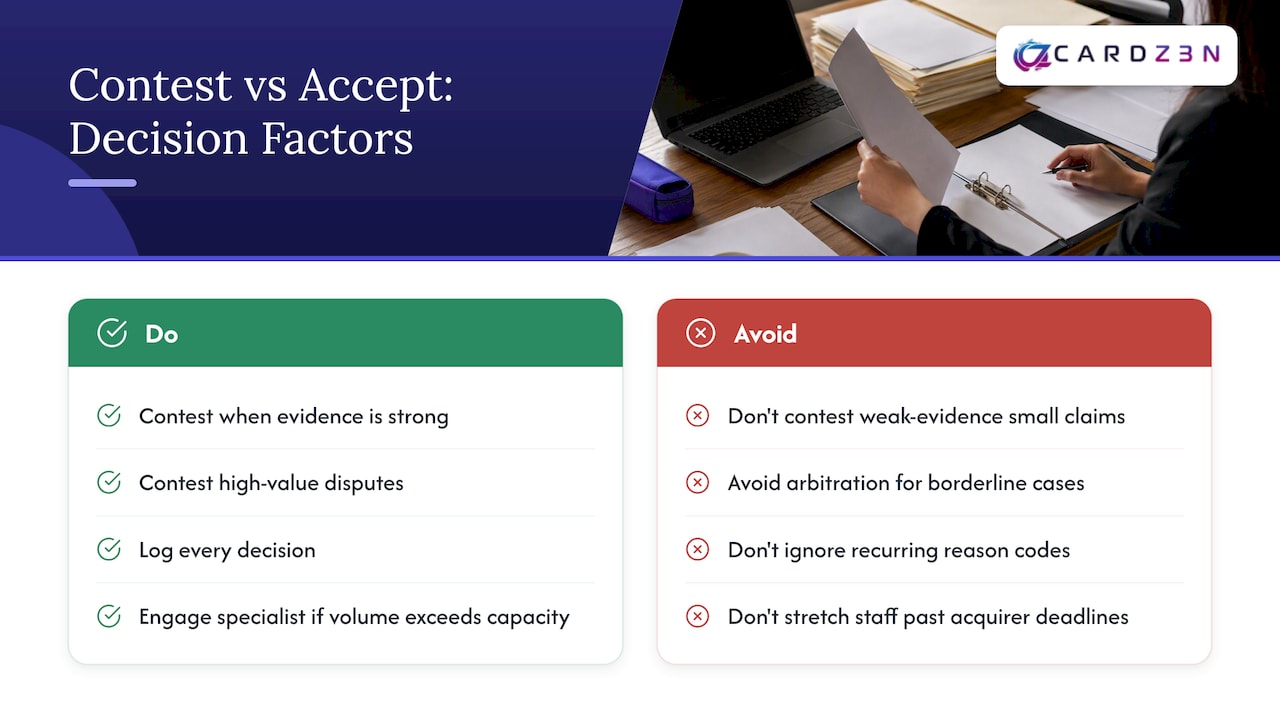
When evidence is thin or the dispute amount is small, accepting the claim can be the more economical choice, since representment effort and potential arbitration exposure can exceed the value of a weak case. Arbitration in particular carries real fees on top of the disputed amount, so escalating a borderline case rarely pays off.
Document every decision, win or loss, and feed the pattern back into prevention. A recurring 13.1 loss tied to one product usually points to a fulfillment gap, not a fraud problem. Once dispute volume outgrows what your team can triage within acquirer deadlines, that’s the point to consider a specialist chargeback management service rather than stretching internal staff thinner.
Speed and evidence relevance matter more than evidence volume. The merchants who win consistently aren’t the ones with the thickest files, they’re the ones who match the right document to the right reason code before the acquirer deadline passes.
Eight things to put in place this week: a reason-code lookup reference, an acquirer deadline calculator, a document template per dispute family, a designated response owner, a single audit-trail file per case, a monthly dispute-rate review, a refund-to-credit matching process, and a tracked set of core metrics.
Track three KPIs going forward: representment win rate, overall dispute rate, and average response time from notification to submission.
— Joshua Benedetti
When dispute volume climbs past what one person can triage before acquirer deadlines hit, a managed program closes that gap. Our chargeback management, prevention, and dispute representment service handles evidence collection, reason-code mapping, and representment submission on your behalf, with transparent, quote-based pricing instead of the vague reserve terms common across high-risk processing.
This kind of support tends to make the most sense for high-volume merchants, subscription billing models, and businesses in high-risk verticals where dispute rates run above average. If that describes your operation, our merchant services team can walk through what a managed program would look like for your transaction volume.
Cardholders file disputes under one of four Visa families: fraud (unauthorized use), authorization errors, processing errors like duplicate charges, or consumer disputes such as goods not received or not as described. The specific reason code assigned determines what evidence a merchant needs to contest it.
Visa does not publish a single universal arbitration fee that applies to every merchant; fees vary by acquirer and case type. Because accurate current fee schedules come from your own acquirer agreement, check with your processor before assuming a standard rate applies to your account.
This question typically applies to cardholders, not merchants, since merchants respond to disputes rather than file them. A cardholder who repeatedly disputes legitimate charges risks losing dispute privileges with their issuer over time.
There’s no single universal Visa deadline that applies to every case; your actual response window depends on your acquirer’s processing time, which sits inside Visa’s broader network limits. Calculate your internal cutoff by subtracting your acquirer’s review buffer from the return-by date listed on the dispute notification.
Every merchant's processing setup is different, so the right answer depends on your industry, sales channels, average ticket size and chargeback history. CARDZ3N's payments specialists review those details with you and match your business with the right sponsor bank, gateway and risk tools, whether you sell online, in store, by invoice or on a recurring subscription.
We work with merchants across the USA, Canada, the UK and the EU, including high-risk, B2B and fast-growing businesses that traditional processors often turn away. If you would like a second opinion on your current rates, contract terms or approval options, contact our team for a free, no-obligation processing review.
Joshua Benedetti is the CEO of CARDZ3N, a Las Vegas-based merchant services provider specializing in high-risk payment processing and B2B payment technology.
Joshua Benedetti on LinkedInCARDZ3N Inc is headquartered in Las Vegas, Nevada, and provides merchant services to businesses that traditional processors turn away. Backed by top-tier sponsor banks and processors, CARDZ3N combines institutional stability with the speed of a specialized team that understands high-risk industries. Services include high-risk account underwriting and placement, gateway solutions across the major gateway platforms, POS integrations, ACH and check processing, chargeback prevention through ChargebackZ3N, and business lending and working capital. Its AerospacePay division serves OEMs, MROs, FBOs, and repair stations with B2B and B2G payment processing. CARDZ3N serves merchants in the USA, Canada, the UK, and the EU.
Start protecting your revenue from chargebacks today — schedule your complimentary consultation with CARDZ3N’s dispute management specialists.