


 CARDZ3N — Home
Contact us today for personalized advice and strategic solutions tailored to your goals.

Call us
+1 (702)-623-3528







Rapid Dispute Resolution (RDR) is a Visa pre-dispute service that lets you decide in advance, by rule, which incoming disputes get refunded automatically before they turn into chargebacks. A cardholder files with the issuer, the decision engine checks the case against your ruleset, and eligible disputes are settled without a formal chargeback ever being logged against your account. You pay a per-resolution fee plus the refund, so the question is not whether RDR works but which disputes you should let it close.
This guide covers the mechanics, the eligibility window, the cost math, the effect on your ratios under Visa’s current monitoring program, and how to build rules that protect revenue instead of giving it away.
RDR sits between the issuer and your acquirer inside Visa’s dispute infrastructure. Visa says an RDR-resolved transaction should not be treated as a dispute, counted in the dispute ratio, or billed as a dispute in processing systems, and the service was folded into Visa Resolve Online (VROL) in 2021, according to the Verifee glossary.
In practice the flow looks like this:
The distinction matters. RDR is a decision tool, not a defense tool. It does not fight a dispute for you, it concedes the ones you told it to concede, and it does so before fees, time limits and ratio damage accrue.
Eligibility is bounded by two things: the dispute must be filed inside the cardholder’s dispute window, and it must fall into a category your rules target.
Cardholders generally have up to 120 days from the original transaction date, or from the expected delivery date, to file with their issuing bank, and RDR can only intercept disputes filed within that window. Conditions that rules commonly address include fraud codes such as 10.4 (other fraud, card-absent environment) and service-related codes such as 13.1 (merchandise or services not received), per LegalClarity’s overview of Visa RDR.
Two practical boundaries follow:
If you want the full lifecycle of a Visa case once it does become a chargeback, our guide to Visa chargeback rules, evidence and deadlines covers each stage.
RDR is not free. Merchants pay a per-alert fee each time the system resolves a dispute, plus the refunded amount. Industry pricing for these alerts generally lands around $15 to $20 per resolved dispute, with volume discounts and plan structures varying by provider, according to LegalClarity.
The useful comparison is not RDR fee against zero. It is RDR fee against what the same dispute would cost as a chargeback:
| Cost element | Auto-resolved by RDR | Standard chargeback |
|---|---|---|
| Refund or lost sale | Yes, full amount | Yes, if you lose |
| Per-event fee | RDR alert fee | Chargeback fee from your processor |
| Staff time for evidence | None | Hours per case |
| Counts in your dispute ratio | Excluded, subject to timing | Yes |
| Chance to win | None (conceded) | Depends on evidence |
The last row is the one most articles skip. A conceded dispute is a guaranteed loss of the sale. A represented dispute is a gamble you may win. That tradeoff drives everything in the rule-building section below. For a breakdown of the per-dispute fees processors typically add, see our piece on how merchants lose $128 to chargeback fees.
The reporting effect is the main reason high-volume and high-risk merchants adopt RDR. Under Visa’s VAMP ratio formula, pre-dispute-resolved disputes are excluded from the ratio, subject to extract timing. A related TC40 fraud report is not automatically excluded, per the Payments & Risk network programs reference.
Read that carefully, because it separates two exposures:
So RDR is strongest against non-fraud disputes and low-value disputes, and it is a partial answer for fraud-coded volume. If fraud is where your ratio is exposed, you need prevention upstream (3DS2, velocity rules, address and CVV checks) in addition to refunds downstream. Our walkthrough of the Visa VAMP program thresholds and what merchants must do explains how the ratio is built and where the lines sit.
The default instinct is to auto-refund everything RDR will accept. That is usually wrong. Merchants who win a high percentage of chargebacks through representment should run the numbers carefully, because auto-refunding disputes you would have won means surrendering revenue you could have kept, as LegalClarity notes.
A workable method uses your own dispute history:
Suppose a subscription merchant sees 200 disputes a month on orders averaging $40. It wins 20% when it represents, and each case takes 30 minutes of staff time. Fighting recovers roughly 40 sales, or $1,600. Auto-resolving all 200 at a $15 alert fee costs $3,000 in alert fees and forfeits the $1,600 it would have recovered, on top of refunding the orders.
Now narrow the rule to the 120 disputes with no usable evidence, where the win rate is near zero. Fees on those are $1,800, and you avoid the staff time on 120 cases and keep the ratio in check, while the 80 evidence-backed disputes still go through representment. The figures here are illustrative arithmetic, not benchmarks. Substitute your own.
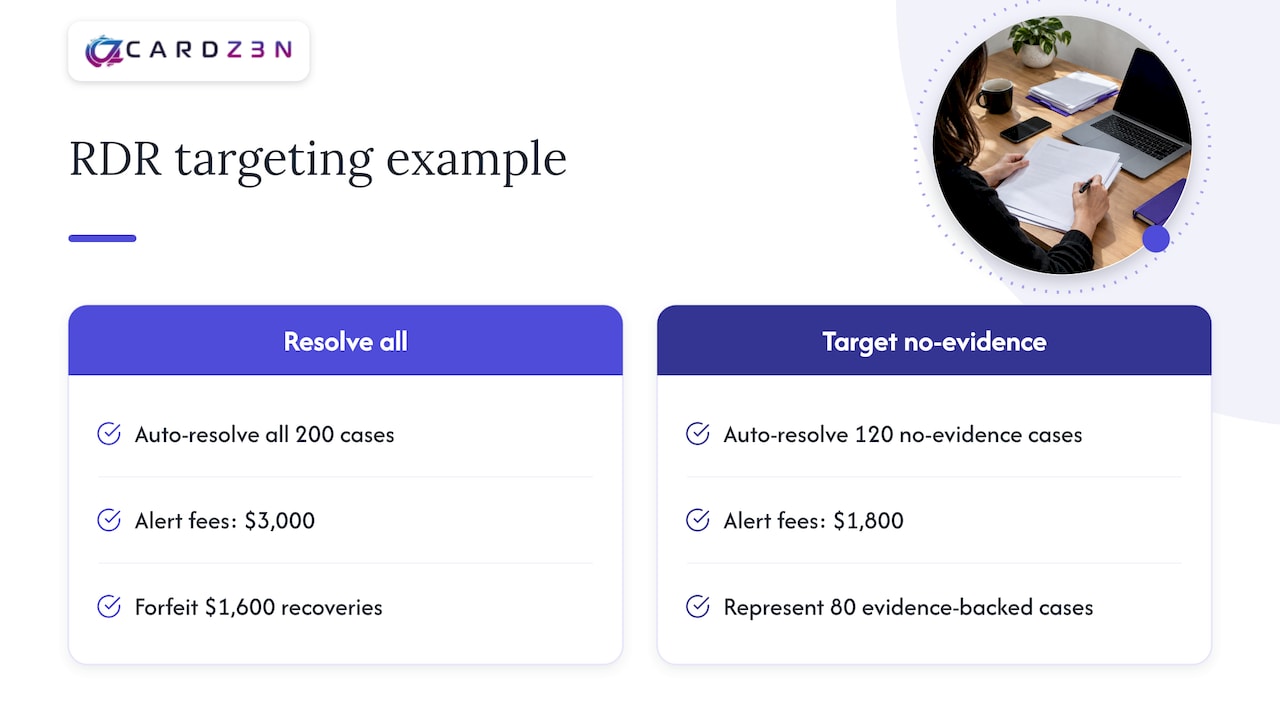
Because the alert fee approaches the value of a small order, the break-even logic changes with ticket size. For orders around the alert fee or below, conceding costs about as much as the sale itself, so evidence quality matters more than speed.
These are three different tools, and strong programs use all three.
| Approach | Best for | Weakness |
|---|---|---|
| RDR auto-refund | Disputes you would lose or that are not worth contesting | Gives up winnable revenue if rules are loose |
| Representment | Disputes with clear evidence of delivery, authorization or use | Takes time, win rates vary by reason code |
| Proactive refund | Customer contact before a dispute is filed | Only works if the customer asks you first |
A refund issued through your own channel before the dispute is filed is almost always cheaper than any dispute outcome. Know when to void and when to refund, since a void before settlement avoids interchange entirely: our guide to void versus refund rules covers the timing. If you also bill business customers by invoice and want to understand how bank-based invoice payments are handled, this explanation of payment via bank invoices shows one such flow. Those payments sit outside the card dispute system altogether.
When a dispute does proceed to a chargeback, the quality of your file decides the outcome. See how to win chargeback representment cases for evidence structure by reason code.
You generally do not connect to Visa directly. Enrollment runs through your acquirer, processor or a dispute-management provider that has access to the Visa service, and the exact intake differs by provider. The sequence is consistent:
For high-risk merchants the order of operations matters. Your merchant account terms, reserve structure and acquirer approval decide which tools you can use at all, so settle that before you tune rules.
Most merchants meet RDR as a rescue: the ratio is climbing, a notice has arrived, and switching everything to auto-refund feels like relief. We see it differently. RDR is a pricing decision about each dispute class, and it works best when it is one layer in a stack that also includes authentication, clear descriptors, fast customer service and disciplined representment.
High-risk merchants feel this most. Subscription, nutraceutical, CBD, adult and MLM programs carry structurally higher dispute rates, and a single threshold breach can put the account at risk. That is why we build chargeback strategy into the merchant account itself, with sponsor bank relationships, transparent reserve terms and ChargebackZ3N for prevention and representment, instead of bolting tools on after the fact.
Our advice is to segment before you automate. Concede what you would lose anyway, fight what you can win, and prevent what you can see coming. Done in that order, the ratio improves and revenue holds.
Joshua Benedetti
If you process high-risk volume and need a merchant account that supports dispute management from day one, our team handles underwriting, placement and ongoing chargeback support. Learn about our high-risk merchant accounts or see how chargeback management, prevention and dispute representment works alongside processing. Pricing is quote-based, and we are open about reserve structures so you can plan cash flow before you sign.
Visa Rapid Dispute Resolution is an automated service that refunds eligible disputes based on rules you set, before they become chargebacks. The cardholder gets their money back quickly and the case is closed. You pay a per-resolution fee in addition to the refund.
No. Visa says an RDR-resolved transaction should not be treated as a dispute or counted in the dispute ratio, per Verifee’s glossary. Fraud reports (TC40) can still count, so fraud exposure needs separate controls.
Industry pricing for RDR alerts generally runs about $15 to $20 per resolved dispute, with volume pricing varying by provider, according to LegalClarity. Ask your processor for its current fee schedule, since you also refund the transaction amount.
Cardholders generally have up to 120 days from the transaction date or expected delivery date, as LegalClarity explains. RDR can act only on disputes filed within that window.
Usually not. If you win a meaningful share of cases through representment, broad auto-refund rules give up revenue you could keep. Target segments where your win rate is low and the cost of fighting is high.
Every merchant's processing setup is different, so the right answer depends on your industry, sales channels, average ticket size and chargeback history. CARDZ3N's payments specialists review those details with you and match your business with the right sponsor bank, gateway and risk tools, whether you sell online, in store, by invoice or on a recurring subscription.
We work with merchants across the USA, Canada, the UK and the EU, including high-risk, B2B and fast-growing businesses that traditional processors often turn away. If you would like a second opinion on your current rates, contract terms or approval options, contact our team for a free, no-obligation processing review.
Joshua Benedetti is the CEO of CARDZ3N, a Las Vegas-based merchant services provider specializing in high-risk payment processing and B2B payment technology.
Joshua Benedetti on LinkedInCARDZ3N Inc is headquartered in Las Vegas, Nevada, and provides merchant services to businesses that traditional processors turn away. Backed by top-tier sponsor banks and processors, CARDZ3N combines institutional stability with the speed of a specialized team that understands high-risk industries. Services include high-risk account underwriting and placement, gateway solutions across the major gateway platforms, POS integrations, ACH and check processing, chargeback prevention through ChargebackZ3N, and business lending and working capital. Its AerospacePay division serves OEMs, MROs, FBOs, and repair stations with B2B and B2G payment processing. CARDZ3N serves merchants in the USA, Canada, the UK, and the EU.
Start protecting your revenue from chargebacks today — schedule your complimentary consultation with CARDZ3N’s dispute management specialists.