 CARDZ3N — Home
Contact us today for personalized advice and strategic solutions tailored to your goals.

Call us
+1 (702)-623-3528




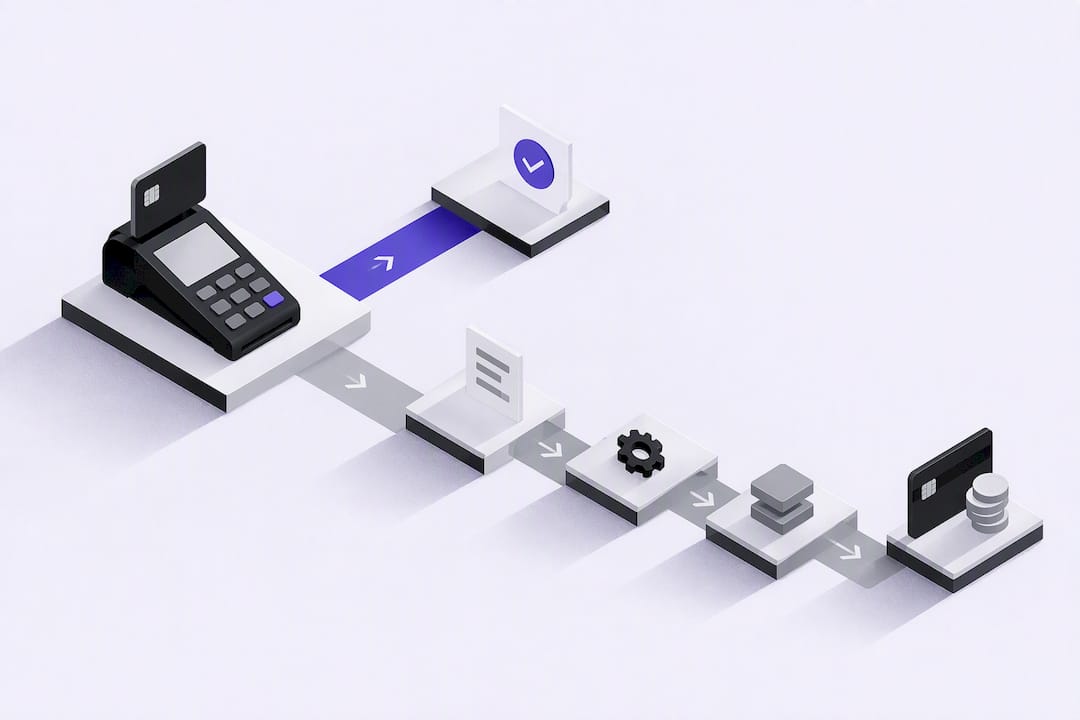





A void cancels an authorization before it settles, so the funds never move; a refund returns money after settlement, once the bank has already released it to you. The rule of thumb is simple: if the transaction has not settled, void it. If it has settled, refund it. Voids are typically faster to process and cheaper for merchants because they sidestep the fees a refund carries.
Every card transaction passes through two states you need to track: authorization and settlement. Authorization is the hold placed on a cardholder’s funds when a purchase is initiated. Settlement is the batch process, usually run once daily, that actually moves money from the issuing bank to your merchant account.
A void, formally an authorization reversal, cancels a transaction while it still sits in that unsettled authorization state. Because the funds were never transferred, a void simply releases the hold and the charge disappears from the customer’s pending activity, often within the same day. A refund is different: it applies after settlement, when funds have already changed hands, and it initiates a new transaction that sends money back to the cardholder. Processors label these actions inconsistently, which causes confusion at the counter:
Knowing which label your processor uses matters more than the terminology itself.
A void that clears cleanly usually vanishes from the cardholder’s pending charges within hours, and almost always inside 24 hours, according to Checkout. A refund takes longer because it is a new, separate transaction: expect 5 to 14 business days to post, depending on the issuer and the rails involved, per the same Checkout.com guidance.
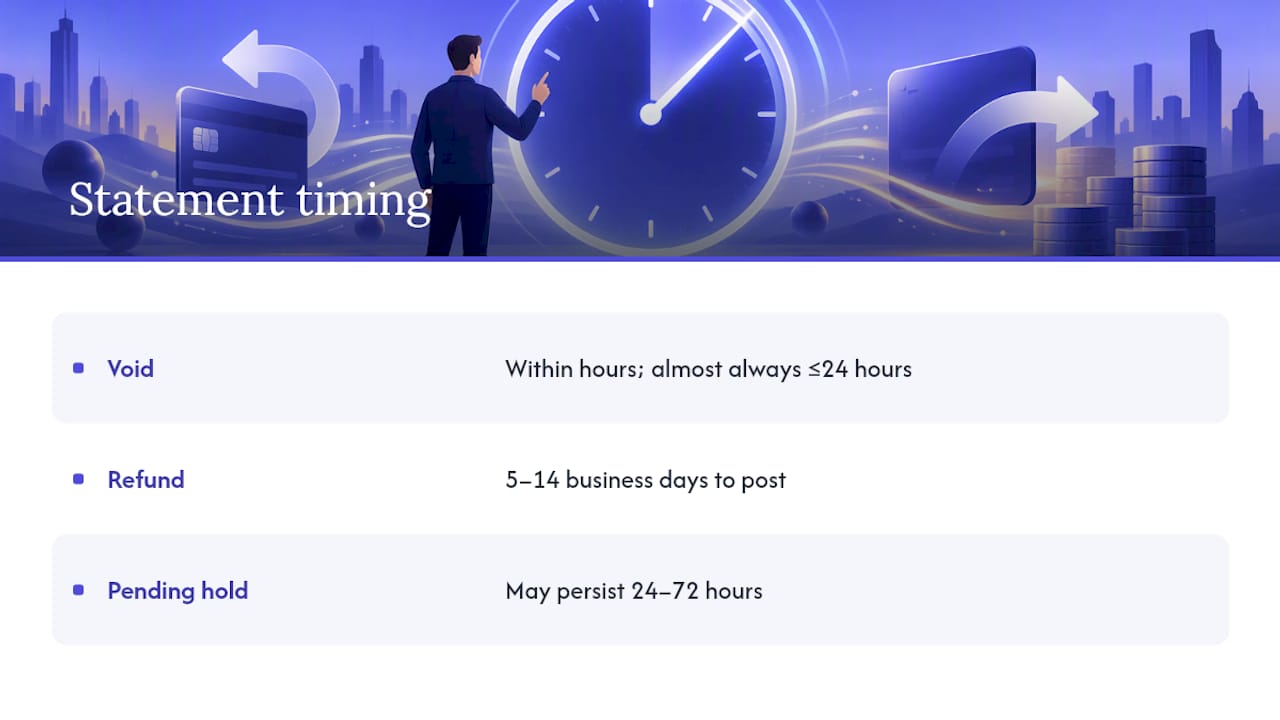
This gap creates a common support headache. A voided charge can still appear as a pending hold for a short window while the issuing bank’s own systems catch up, even though the merchant already submitted the reversal. Telling customers upfront that a pending hold may persist for 24 to 72 hours cuts down on confused calls and chargeback triggers before they start.
The financial difference between the two actions is where merchants often get caught off guard. A clean authorization reversal typically avoids interchange and assessment fees entirely, because the transaction never technically settled. A refund usually does not offer that protection: you already paid the original processing fees when the sale settled, and issuing a refund does not claw those back, according to Chargeflow’s breakdown of refunds versus reversals.
A proactive refund keeps a dispute out of the formal chargeback pipeline, since Chargeflow notes that refunds are merchant-driven while chargebacks are issuer-driven and carry their own dispute mechanics. Refunding a legitimate complaint before the cardholder calls their bank is one of the cheapest ways to protect your chargeback ratio.
Start with one question: has the transaction settled yet? Everything else follows from the answer.
A few scenarios play out constantly at the counter. A duplicate charge caught same-day is almost always a void candidate. A wrong amount entered at checkout, caught before end-of-day batching, is a void too. A customer who cancels an order the same day it was placed often still qualifies for a void, while a cancellation requested after the product has shipped or the service has been delivered almost always requires a refund, since settlement has typically already occurred by then.
One exception trips merchants up regularly: some processors settle transactions in real time rather than in daily batches. If your platform settles immediately, per Checkout.com, voiding is never an option and a refund is the only path, regardless of how quickly you catch the error. Subscription billing models face a similar constraint, since recurring charges often settle fast enough that the void window closes before a merchant notices the problem.
Pro Tip: Check your processor’s batch closing time once and post it where your staff can see it. That single number decides whether a mistake gets voided for free or refunded at a cost.
The mechanics differ depending on where the transaction sits in the settlement cycle.
Pro Tip: Reconcile your batch report daily against your reversal log. Catching an unmatched void within 24 hours is far easier than chasing it a week later.
Late reversals are one of the most common paths to an avoidable chargeback. If a merchant delays a void past the batch close, or mishandles a refund request, the customer often disputes the charge with their bank instead of waiting, which converts a simple correction into a formal chargeback with its own fees and ratio impact. Refunding proactively when a complaint is legitimate is almost always cheaper than defending a dispute later, both in fees and in the time it costs your team.
If a refund is declined or the original card has been replaced, contact your processor immediately. Most gateways offer an alternative credit path, but delays here are exactly the kind of gap that pushes a frustrated customer toward filing a dispute instead. Merchants managing recurring billing see this pattern often, and structured chargeback prevention practices can keep ratios well under the thresholds that trigger network penalties.
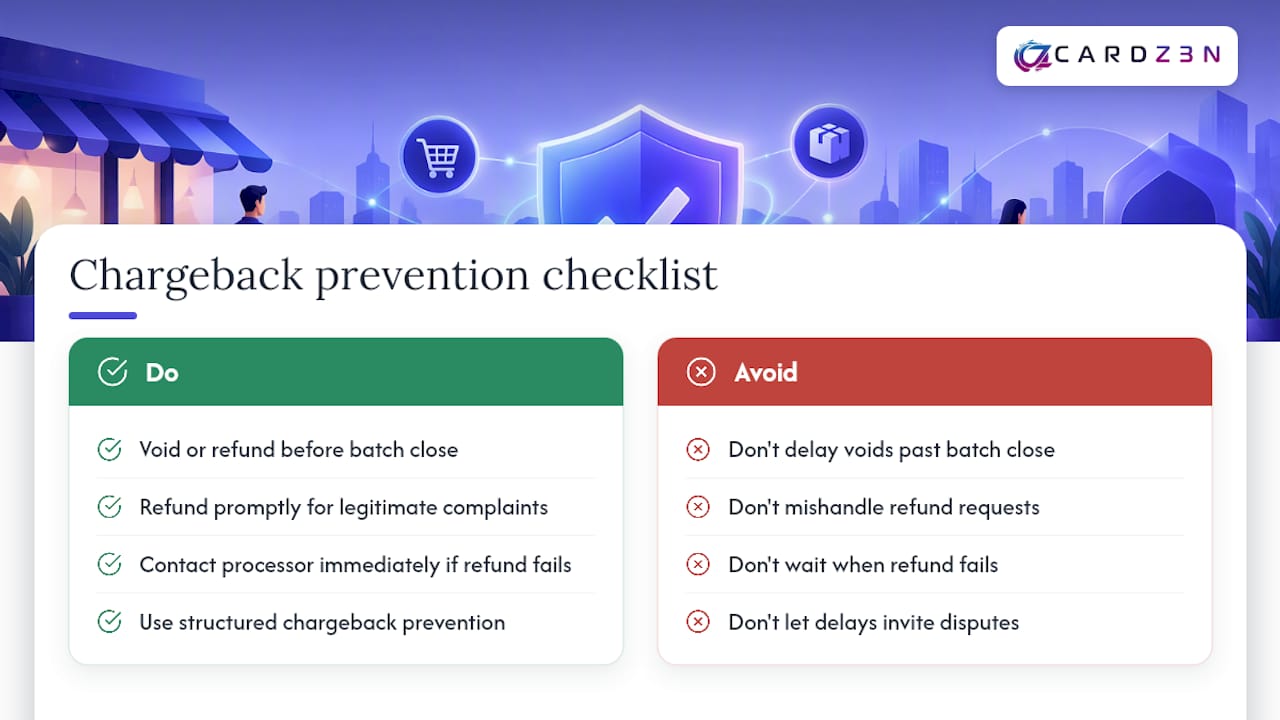
Visa sets the operational bar merchants are expected to meet. Its guidance requires merchants to reverse an authorization within 24 hours once they know a transaction will not be completed, and it outlines the data elements a reversal message needs to process cleanly, according to Visa’s authorization and reversal processing best practices.
Merchants should design detection processes that flag non-completions quickly so reversals are submitted well within the 24 hour window, rather than treating that window as a deadline to work backward from.
Visa periodically updates authorization validity and clearing windows, and staying current on those changes through your processor is the only reliable way to avoid holds that outlive their purpose.
Reduce friction by treating settlement status as the first question, not an afterthought. Train frontline staff to check that status before touching void or refund, since the wrong choice costs fees and time either way. Keep every reversal’s reference data on hand, and escalate to processor support the moment a hold outlasts its expected window instead of waiting it out.
— Joshua Benedetti
If voids routinely fail to match or refunds keep tipping into chargebacks, the problem is often the processing setup underneath, not your staff’s judgment calls. Some payment providers place merchants with sponsor banks built for stable authorization and settlement handling, which matters most for businesses processing high volumes or operating in industries mainstream processors avoid.
Reliable reversal handling starts with the processing relationship behind it. Visit CARDZ3N’s payment services to see how account placement and integration support can cut down on failed voids and avoidable disputes.
Visa’s authorization and reversal processing guidance, Investopedia’s explainer on void transactions, and processor documentation from Toast and PayJunction informed this guide.
No. A void cancels an authorization before settlement so funds never transfer, while a refund returns money after settlement, per Investopedia’s definition of a void transaction. They apply at different points in the payment cycle and cannot be swapped for each other once a batch closes.
Yes, in payment processing, voiding means canceling the authorization before the transaction settles, so the charge is removed rather than reversed after the fact. The hold disappears without any money ever having moved between accounts.
A void does not need a refund at all since the charge never settled, and it typically clears from the customer’s pending activity within hours, almost always inside 24 hours, according to Checkout.com. If the transaction has already settled, you would issue a refund instead, which generally takes 5 to 14 business days to post.
A voided payment means the authorization was canceled before settlement, so the cardholder was never actually charged and no funds moved. It typically happens when a merchant catches an error, like a duplicate charge or wrong amount, before the daily settlement batch closes.
Every merchant's processing setup is different, so the right answer depends on your industry, sales channels, average ticket size and chargeback history. CARDZ3N's payments specialists review those details with you and match your business with the right sponsor bank, gateway and risk tools, whether you sell online, in store, by invoice or on a recurring subscription.
We work with merchants across the USA, Canada, the UK and the EU, including high-risk, B2B and fast-growing businesses that traditional processors often turn away. If you would like a second opinion on your current rates, contract terms or approval options, contact our team for a free, no-obligation processing review.
Joshua Benedetti is the CEO of CARDZ3N, a Las Vegas-based merchant services provider specializing in high-risk payment processing and B2B payment technology.
Joshua Benedetti on LinkedInCARDZ3N Inc is headquartered in Las Vegas, Nevada, and provides merchant services to businesses that traditional processors turn away. Backed by top-tier sponsor banks and processors, CARDZ3N combines institutional stability with the speed of a specialized team that understands high-risk industries. Services include high-risk account underwriting and placement, gateway solutions across the major gateway platforms, POS integrations, ACH and check processing, chargeback prevention through ChargebackZ3N, and business lending and working capital. Its AerospacePay division serves OEMs, MROs, FBOs, and repair stations with B2B and B2G payment processing. CARDZ3N serves merchants in the USA, Canada, the UK, and the EU.
Start protecting your revenue from chargebacks today — schedule your complimentary consultation with CARDZ3N’s dispute management specialists.