
 CARDZ3N — Home
Contact us today for personalized advice and strategic solutions tailored to your goals.

Call us
+1 (702)-623-3528









Most banks require ACH files by one of three FedACH same-day windows: 10:30 a.m. ET, 2:45 p.m. ET, or 4:45 p.m. ET, each tied to a settlement target later that day. The catch is that your bank’s own internal cutoff, not the FedACH schedule, determines your real deadline, and it is almost always earlier. Federal Reserve holidays pause settlement entirely, so a payment effective-dated for a holiday will not post that day regardless of when you submitted it.
The Federal Reserve’s FedACH service, one of the two ACH operators in the United States, runs same-day processing on a fixed clock. Three submission windows exist, each with its own transmission deadline and settlement target. Originators who want money to move within the same business day have to get their files into the operator before the relevant deadline, not before the settlement time itself.
The FedACH Processing Schedule lists the standard structure:
These times matter because they define three separate concepts that get conflated constantly: the transmission deadline (when the operator must receive your file), the target distribution time (when the receiving institution gets notified), and the settlement time (when the money actually moves between institutions). A file that clears the 2:45 p.m. deadline does not mean funds appear in a receiver’s account at 2:46 p.m. It means the file entered the batch that settles around 5:00 p.m. ET, and what happens after settlement depends on the receiving bank’s own posting process, covered in the next section.
Operating Circular No. 4 defines the ACH banking day as running from 3:00 a.m. ET to 2:59 a.m. ET the next calendar day. That single definition explains a lot of confusion around midnight-adjacent transactions. An item received by the Reserve Banks before the last same-day cutoff on a given banking day settles that day; anything received after the final cutoff rolls to the next banking day automatically, with no same-day option available regardless of intent.
For businesses running payroll, vendor payments, or B2B settlement cycles, the practical takeaway is straightforward: know which window your file needs to clear, and build your internal processing calendar backward from the transmission deadline, not the settlement time. Payroll processors in particular tend to target the 10:30 a.m. window because it gives the most buffer for exception handling before end of business. B2B accounts payable teams moving large vendor payments often use the 2:45 p.m. window since it allows same-day approvals from later morning meetings. The 4:45 p.m. window exists mostly for urgent, late-day corrections and time-sensitive one-off transfers, since it leaves almost no room to fix a rejected file before settlement.
None of these windows function as instant payment rails. NACHA’s own ACH payments fact sheet is explicit that Same Day ACH accelerates batch settlement within a business day. It is not a real-time system, and it still depends on both operators being open and both the ODFI and RDFI participating in same-day processing. A file submitted correctly to FedACH does nothing if the receiving bank has not opted into same-day receipt, though nearly all depository institutions in the United States now do.
The FedACH schedule tells you when the operator processes files. It does not tell you when your bank will actually accept your file for transmission, and that gap is where most missed same-day payments happen.
Every originating depository financial institution, or ODFI, sets its own internal cutoff for accepting ACH files from its business customers. That cutoff has to be earlier than the FedACH transmission deadline, because the bank needs time to validate, batch, and forward files before the operator’s window closes. A bank offering a 2:45 p.m. ET same-day option to FedACH might require your file by 1:30 p.m. ET or earlier just to have room to process it internally.
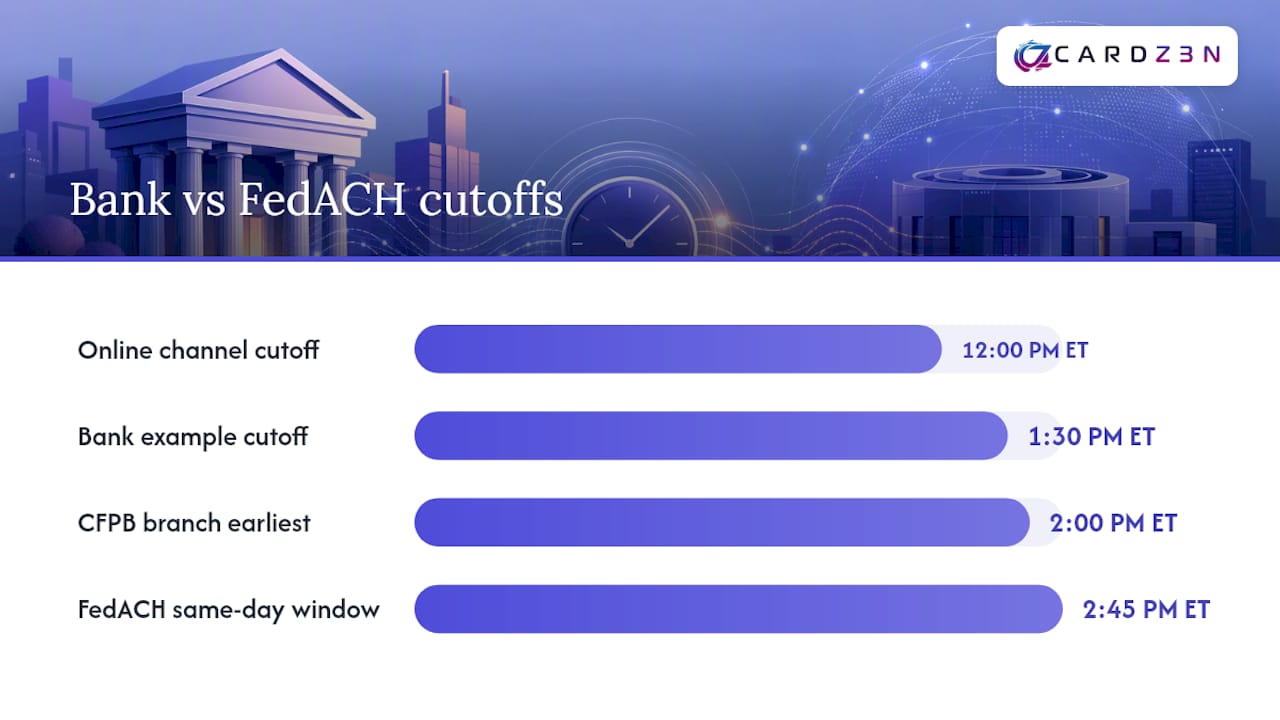
CFPB guidance on funds availability makes a related point that applies just as well to originators as to depositors: banks set their own internal cutoff times by channel, and those cutoffs affect when a transaction is treated as having been made. A branch-based cutoff, the CFPB notes, may be no earlier than 2:00 p.m., while a remote or online channel cutoff may be no earlier than noon. Miss the channel’s cutoff and the transaction is treated as occurring the next business day, no matter what the operator’s own schedule allows.
The order of operations that actually determines your outcome looks like this:
Cutoffs also vary meaningfully by channel within the same bank. A basic online banking ACH origination cutoff is often the earliest option, sometimes several hours ahead of the operator deadline. A dedicated ACH origination or teller-assisted cutoff usually runs later. A direct file-transmission arrangement, where a business sends files host-to-host or through a treasury management platform, frequently gets access to the bank’s latest internal cutoff, closest to the actual FedACH window.
Pro Tip: If same-day timing matters to your business regularly, ask your bank about direct file transmission or treasury-channel origination instead of standard online banking ACH, since those channels typically support the latest cutoffs the bank offers.
NACHA’s operating rules, not just the Fed’s processing calendar, determine whether a payment qualifies for same-day treatment and how quickly the receiving bank has to make funds available.
To be eligible for Same Day ACH, a transaction generally needs to be a credit or debit entry under $1,000,000 (per NACHA’s per-transaction limit framework) submitted within one of the operator’s same-day windows and flagged accordingly. Originators can optionally use the SDHHMM indicator described in NACHA’s Same Day ACH schedules and funds availability guidance to specify intended same-day settlement, giving RDFIs a clearer signal about processing intent.
Funds-availability rules are where same-day and standard ACH diverge most for the person or business receiving the payment:
That September 2026 change matters operationally even for businesses that never use same-day processing. It means standard overnight ACH credits will post to recipients earlier in the morning across a wider set of scenarios than before, which can shift when payroll or vendor payments are actually usable by the recipient, even without paying for same-day service.
Looking further out, NACHA has also approved raising the Same Day ACH per-transaction dollar limit to $10 million, effective September 17, 2027. For businesses currently splitting large payments to stay under the existing per-transaction ceiling, that future increase is worth factoring into 2026 and 2027 treasury planning, since it will let significantly larger single transactions move same day once it takes effect.
The operational implication across all of this: same-day eligibility is not just about hitting a clock. It depends on transaction type, dollar amount, correct same-day flagging, and both institutions’ participation in same-day processing. A file that clears every timing deadline but exceeds the per-transaction limit, or that the RDFI does not process for same-day settlement, will not get same-day treatment no matter how early it was submitted.
Federal Reserve holidays suspend ACH settlement entirely, which means the FedACH operator simply does not process or settle files on those dates. There is no same-day option, no next-day exception, and no way to force settlement through an alternate channel on a day the Reserve Banks are closed for ACH purposes.
This creates two practical problems. First, any file effective-dated for a holiday will not settle that day; it rolls to the next FedACH banking day automatically. Second, and more often overlooked, many banks require earlier internal submission deadlines in the days immediately before a holiday, because their own operations teams need extra buffer to clear volume before the closure. A bank that normally accepts files until 4:00 p.m. for next-day processing might require submission by noon the business day before a holiday weekend.
A few planning habits reduce holiday-related surprises:
This is especially relevant for businesses running recurring subscription billing or B2B vendor terms with contractual payment dates. A due date that happens to fall on a bank holiday needs a documented fallback rule (typically the prior business day) built into your billing calendar, not decided ad hoc when the holiday arrives.
Getting ACH timing right consistently comes down to running the same sequence of checks every time, rather than treating each payment run as a one-off decision.
For businesses moving large-dollar batches, same-day settlement concentrated into a few windows each day can create short-term net debit exposure at the settlement bank level. When that happens, banks typically manage the shortfall through Fedwire funds transfers or intraday funding arrangements rather than delaying the ACH batch itself. Businesses with recurring large-volume ACH activity should ask their bank in advance how it handles intraday funding gaps, rather than discovering the answer during a cash crunch.
Pro Tip: Run a test file through each cutoff window with your bank once a year, since banks periodically adjust internal deadlines without always notifying business customers directly.
Payroll processors, B2B accounts payable teams, and subscription billing operations all benefit from documenting this checklist once and reusing it, rather than re-deriving deadlines for every payment run. For vendor payments tied to B2B and B2G payment cycles, the same sequence applies whether the payment is a one-time disbursement or a recurring contractual obligation.
Most ACH delays trace back to one of a small number of causes, and identifying which one occurred usually points directly to the fix.
When a payment does not post as expected, the fastest path forward is checking the return code your bank provides, since standard NACHA return codes identify the specific reason (account closed, invalid account number, authorization revoked, and so on) rather than leaving you guessing. From there, contact your ODFI to confirm whether the file transmitted successfully and trace it through to the RDFI if needed. For repeated or unexplained delays, escalate to your bank’s treasury or ACH operations desk directly rather than a general customer service line, since operations teams can usually see batch-level detail that front-line support cannot.
Timing risk compounds for merchants already operating in industries mainstream processors avoid. A held or delayed ACH settlement is an inconvenience for a typical retailer; for a high-risk merchant already managing reserve requirements and tighter underwriting scrutiny, it can strain cash flow at exactly the wrong moment.
CARDZ3N’s ACH and eCheck processing capability is built around that reality. Rather than relying on a single banking relationship and hoping its cutoff windows align with a merchant’s needs, CARDZ3N works through underwriting relationships with multiple sponsor banks, which gives originators more flexibility in matching payment runs to available same-day and next-day windows. Gateway integrations connect ACH origination directly into a merchant’s existing payment stack, reducing the manual file-handling steps that often cause missed cutoffs in the first place.
Businesses evaluating any ACH processor, not just CARDZ3N, should ask three specific operational questions before signing on:
Multi-rail contingency planning matters most for merchants with concentrated payment volume, seasonal spikes, or B2B clients on contractual payment terms where a missed settlement date carries real financial consequences.
Most explanations of ACH cutoff times stop at the FedACH schedule and treat it as the whole answer. It is not. The operator schedule sets the outer boundary of what is possible, but for the vast majority of businesses, the binding constraint is their own bank’s internal cutoff, and that number is rarely published anywhere obvious.
The bigger blind spot is treating Same Day ACH as a speed upgrade rather than what it actually is: a scheduled batch window. Businesses that assume same-day means “fast” often get burned by holiday timing, Friday submissions, or per-transaction dollar limits they did not know existed. The reader’s real priority should be process, not speed: know your bank’s actual cutoff by channel, confirm it in writing, and build your payment calendar backward from that number rather than from the Fed’s published windows. Everything else, holidays, exceptions, contingency rails, is easier to manage once that one number is nailed down.
— Joshua Benedetti
Timing problems on ACH usually surface as cash flow problems, and that risk is higher for businesses already flagged as high-risk by mainstream processors. Some processors specialize in merchants that mainstream providers reject, freeze, or shut down, offering underwriting support from sponsor banks and transparent reserve and pricing terms.
If your business needs ACH processing that accounts for real bank cutoffs, holiday scheduling, and contingency planning rather than a one-size-fits-all timeline, request a quote through CARDZ3N’s payment processing page and talk to their team about your specific settlement needs.
For exact cutoff times and settlement targets, the FedACH Processing Schedule is the primary reference, updated directly by the Federal Reserve. Operating Circular No. 4 defines the banking day and settlement rules in formal Reserve Bank language. NACHA’s Same Day ACH schedules and funds availability guidance covers eligibility, indicators, and RDFI obligations. For consumer-facing funds availability questions, the CFPB’s guidance on bank holds explains how institution-level cutoffs affect when a deposit or transfer is treated as made. Businesses planning liquidity around settlement timing may also find general cash-flow planning guidance, such as NoleggioQui’s overview for entrepreneurs, a useful supplementary read.
Yes, ACH cutoff times exist at both the operator level and the bank level. The FedACH Processing Schedule sets same-day windows at 10:30 a.m. ET, 2:45 p.m. ET, and 4:45 p.m. ET, but your bank’s own internal cutoff for accepting files is usually earlier and is the deadline that actually matters.
Cutoff times vary by bank and by the channel used to submit a file, such as online banking, teller-assisted origination, or direct transmission. There is no single nationwide bank cutoff time; you need to confirm the specific deadline with your own bank for each channel you use, since it is set internally rather than by the Federal Reserve.
ACH payments settle at fixed times tied to the operator window used: roughly 1:00 p.m. ET, 5:00 p.m. ET, or 6:00 p.m. ET for same-day files, according to the FedACH Processing Schedule. For Same Day ACH credits, NACHA rules require the receiving bank to make funds available by 5:00 p.m. in its own local time on the settlement date.
Standard, non-same-day ACH transfers typically settle within one to two business days, though the exact timing depends on when the file was submitted relative to bank and operator cutoffs. A rule change effective September 18, 2026 accelerates availability for many standard credit entries by requiring 9:00 a.m. local-time availability more broadly, though weekends and Federal Reserve holidays still add non-processing days that can extend the total wait.
Every merchant's processing setup is different, so the right answer depends on your industry, sales channels, average ticket size and chargeback history. CARDZ3N's payments specialists review those details with you and match your business with the right sponsor bank, gateway and risk tools, whether you sell online, in store, by invoice or on a recurring subscription.
We work with merchants across the USA, Canada, the UK and the EU, including high-risk, B2B and fast-growing businesses that traditional processors often turn away. If you would like a second opinion on your current rates, contract terms or approval options, contact our team for a free, no-obligation processing review.
Joshua Benedetti is the CEO of CARDZ3N, a Las Vegas-based merchant services provider specializing in high-risk payment processing and B2B payment technology.
Joshua Benedetti on LinkedInCARDZ3N Inc is headquartered in Las Vegas, Nevada, and provides merchant services to businesses that traditional processors turn away. Backed by top-tier sponsor banks and processors, CARDZ3N combines institutional stability with the speed of a specialized team that understands high-risk industries. Services include high-risk account underwriting and placement, gateway solutions across the major gateway platforms, POS integrations, ACH and check processing, chargeback prevention through ChargebackZ3N, and business lending and working capital. Its AerospacePay division serves OEMs, MROs, FBOs, and repair stations with B2B and B2G payment processing. CARDZ3N serves merchants in the USA, Canada, the UK, and the EU.
Start protecting your revenue from chargebacks today — schedule your complimentary consultation with CARDZ3N’s dispute management specialists.