
 CARDZ3N — Home
Contact us today for personalized advice and strategic solutions tailored to your goals.

Call us
+1 (702)-623-3528




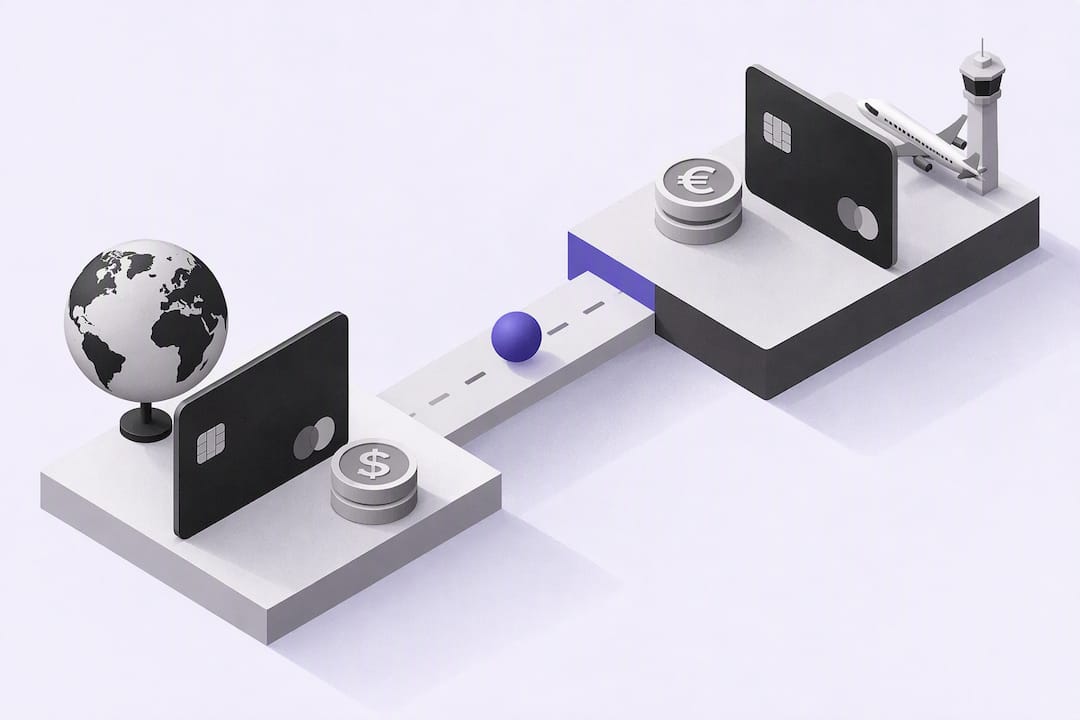





Decline dynamic currency conversion in almost every case. Visa and Mastercard require merchants and ATMs to disclose the exchange rate, the converted amount, and any fees before you confirm the transaction, and both networks require that you get a genuine choice to accept or refuse. That disclosure exists because the merchant, not your card network, sets the markup, and it’s rarely in your favor.
Dynamic currency conversion, often abbreviated DCC and sometimes labeled “cardholder-preferred currency” on a terminal screen, is an optional service that lets you pay in your home currency instead of the local one. A merchant’s payment processor, working through a specialized DCC operator, calculates the conversion and presents it to you at the moment of sale. That’s the key difference from issuer-led conversion: when you decline DCC and pay in local currency, your card’s issuing bank converts the charge later, using its own rate and fee schedule, not a rate set on the spot by the merchant’s acquirer.
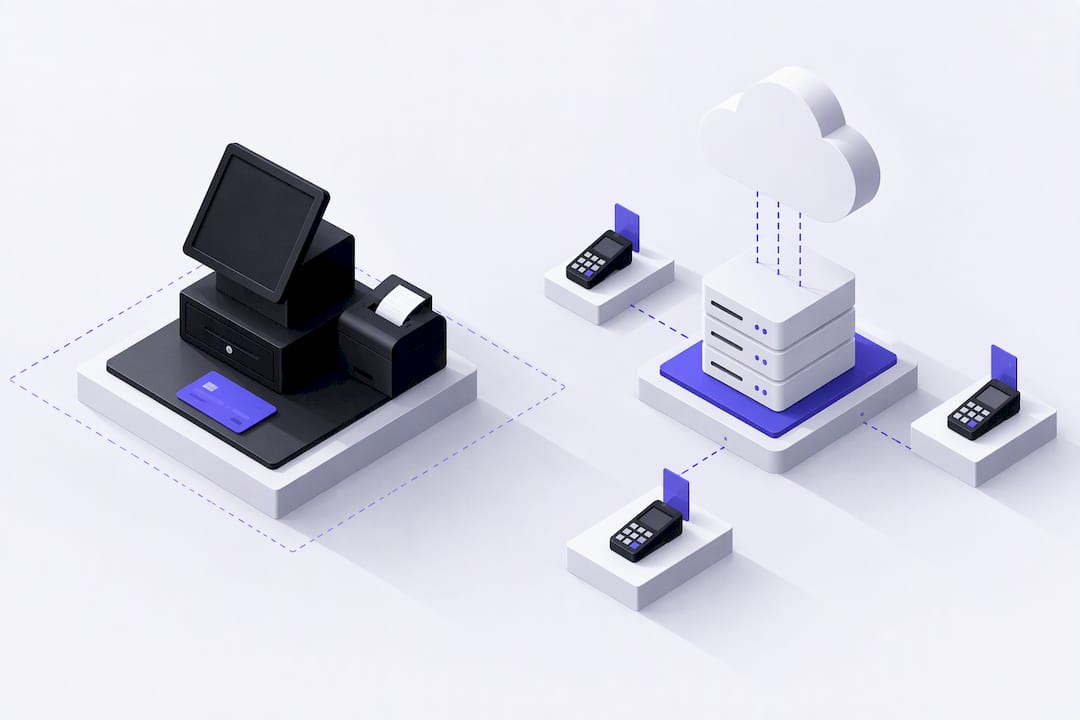
You’ll encounter DCC offers in three settings, and each looks slightly different:
The prompt usually shows two lines: the local-currency amount and the converted amount in your currency, alongside an exchange rate. That’s the moment to pay attention, because the rate quoted there is the one you’re agreeing to lock in.
Five parties touch a DCC transaction, and understanding their roles explains why the rate you see is rarely the best one available. The merchant runs the terminal. The acquiring bank processes the merchant’s transactions. A DCC operator, often a third-party vendor contracted by the acquirer, calculates the conversion rate. The card network (Visa or Mastercard) sets the rules for disclosure and dispute rights. The issuing bank, your own bank, would have handled conversion instead if you’d declined.
The terminal identifies your card as foreign using its Bank Identification Number, the first six to eight digits on the card, which flag the issuing country. That single detection point is also where errors creep in: a card’s BIN reflects country of issue, not necessarily the account’s billing currency, and terminals that rely solely on BIN data can misidentify the correct currency, occasionally triggering an offer to convert into a currency you don’t even hold.
Here’s the settlement sequence once you accept a DCC offer:
That last step matters because it shifts exchange rate risk and margin to the point of sale instead of to your bank days later. If you decline, the sequence is simpler: you’re charged the local amount, and your issuing bank converts it using its own posted rate, usually within a day or two of the transaction date.
A quick example: withdraw the local-currency equivalent of $200 from a foreign ATM. Decline DCC, and your bank converts using its own rate on settlement day. Accept DCC, and the ATM’s operator quotes you a dollar figure on the spot, often built on a less favorable rate than your issuer would apply.
The markup on a DCC transaction is a commercial number, not a network fee. Mastercard’s compliance guidance for merchants confirms that card networks don’t set the DCC markup; that number comes from an agreement between the merchant (or ATM owner) and their acquiring bank or DCC provider, and it functions as a separate profit line for everyone except you.
Because the markup is negotiated at the merchant or acquirer level, the same hotel chain in two different cities can quote two different DCC rates depending on which acquirer processes their card payments. That variability is exactly why the rate you see at a boutique in Rome might differ sharply from the rate at the airport newsstand next door, even for an identical converted amount.
Run the math on a $500 purchase to see how the two paths compare:
That stacking is the part travelers miss: accepting DCC doesn’t exempt you from your issuer’s foreign-transaction fee. It just adds a second charge in front of it. There are edge cases where a quoted DCC rate lands close to parity with what your issuer would have charged, usually when a merchant’s acquirer keeps markups thin to stay competitive, but you have no way to verify that without checking a live exchange rate on your phone before you confirm.
Both networks build consumer protection into DCC by requiring specific disclosures before you can accept a converted charge. Visa’s rules require merchants and ATMs to display the local amount, the converted amount, the exchange rate, and any additional fees, and you must be given an actual choice, not a formality, to decline. Mastercard’s compliance guide adds that merchants and unattended terminals cannot use coercive interface tricks, such as color-biasing one button green and the other red, or presenting DCC as a simple yes/no prompt without showing the rate.
Before you tap or swipe, the screen should show you:
If a merchant or ATM skips these disclosures, or if staff select “yes” on your behalf without asking, you have a documented path to dispute the charge. Visa’s own rule clarifications route these cases through Dispute Condition 12.3, covering incorrect currency, and ATM-specific disputes let the acquirer supply evidence to resolve the claim. Contact your issuer first, describe the missing disclosure or the coercive prompt specifically, and reference the lack of a clear opt-out.
Pro Tip: Photograph the terminal screen before you confirm any DCC prompt. If you later dispute the charge, that image is your strongest evidence that disclosure was missing or unclear.

Decline by default. That’s the standing recommendation from consumer advocates and it holds in the overwhelming majority of situations you’ll face at a terminal or ATM. Run through this checklist when a prompt interrupts your transaction:
Two quick scenarios show how this plays out. Buying a $12 souvenir with a DCC prompt attached barely matters either way. Buying a $1,400 camera at a foreign electronics retailer is a different story: even a small markup percentage compounds into real money, and that’s exactly the transaction where declining and letting your issuer convert almost always wins.
Preparation before you leave does more work than any decision you make at the counter. Choose a credit card with no foreign-transaction fee if you travel internationally more than once a year, since that single feature removes the fee-stacking problem entirely on the issuer side. For frequent multi-country trips, a preloaded multi-currency travel card can also sidestep both DCC prompts and issuer conversion for the currencies you load.
At ATMs, decline every DCC offer, and prefer machines branded by an actual bank over independent, unbranded ATMs in tourist zones, which tend to run the most aggressive DCC markups. Withdraw larger, sensible lump sums rather than small amounts repeatedly, since flat per-withdrawal fees punish frequent small withdrawals far more than the FX cost itself.
At the merchant counter, the fix is verbal and simple:
Pro Tip: Keep a currency-converter app open in the background while you shop. Checking a quoted DCC rate against the live market rate takes seconds and tells you immediately whether the offer is worth taking.
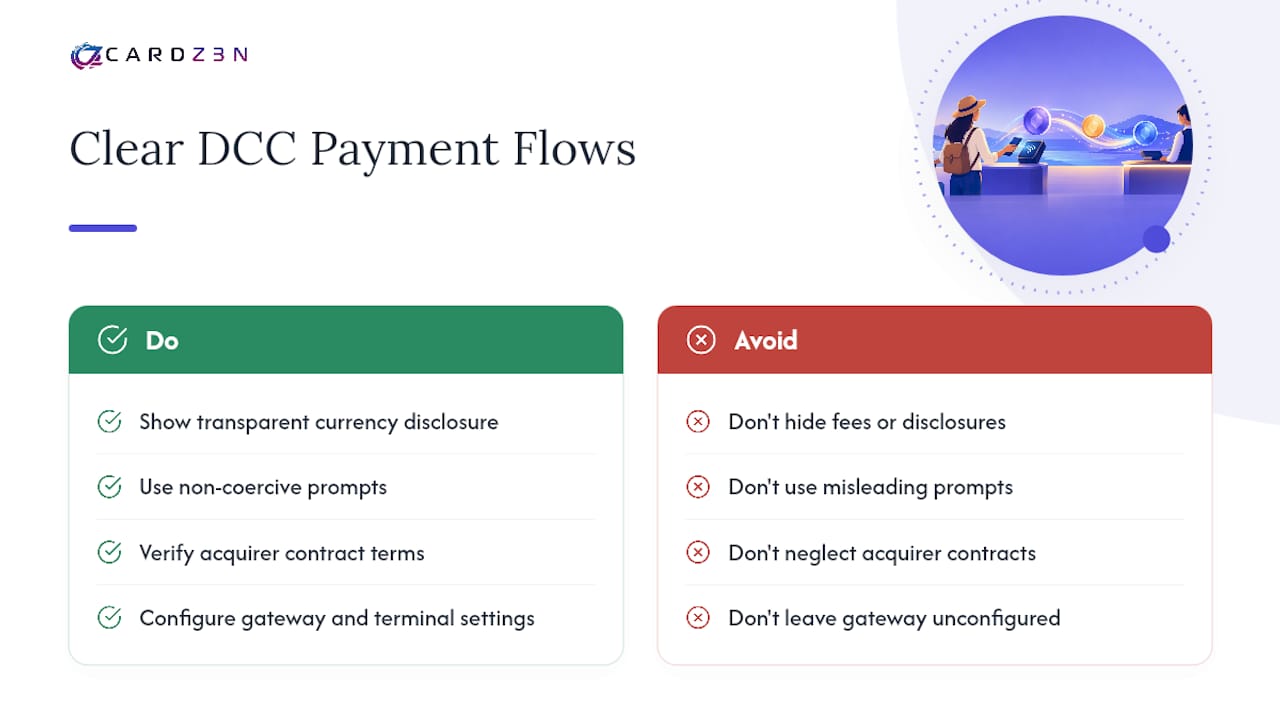
Some payment processors work with merchants across high-risk and regulated industries who depend on getting checkout mechanics right, including how a terminal presents currency choices to a customer. That experience shapes a straightforward view here: DCC disputes usually trace back to a merchant’s terminal configuration or acquirer relationship, not to any inherent flaw in the concept of currency choice at checkout. A merchant who configures DCC transparently, with accurate disclosure and no coercive prompts, protects both the customer and their own chargeback ratio.
The friction travelers experience with unclear DCC prompts mirrors a broader pattern seen in payment processing: merchants who treat disclosure as an afterthought inherit disputes they didn’t need to create. Terminal settings, acquirer contracts, and gateway configuration all determine whether a currency prompt builds trust or generates a complaint.
— Joshua Benedetti
If you’re a merchant reading this because a customer disputed a DCC charge, the underlying issue usually sits in your terminal setup or acquirer agreement, not in the concept of DCC itself. Some providers configure POS solutions and payment gateway integrations so currency prompts display accurate rates and fees the way Visa and Mastercard require, reducing the incorrect-currency disputes that erode chargeback ratios. For merchants running cross-border volume, that can mean fewer Dispute Condition 12.3 claims and cleaner B2B and B2G payment processing for international transactions.
Some payment service providers offer chargeback prevention and dispute representment integrated into merchant accounts, so a currency-disclosure dispute can be resolved with documentation instead of an automatic loss. Talk to payment processing specialists about merchant services built for the transaction complexity your business actually runs.
No, decline it in almost every situation. The markup is set by the merchant’s acquirer or DCC operator rather than your card network, and your issuer’s own conversion typically costs less once you account for foreign-transaction fees that can apply either way.
Dynamic currency conversion is an optional service that converts a foreign purchase into your home currency at the point of sale, rather than leaving that conversion to your card’s issuing bank later. Visa requires merchants to disclose the rate, fees, and both currency amounts before you confirm.
DCC markups are set commercially by the merchant’s acquirer or DCC provider, and reports have documented markups reaching double-digit percentages in problematic cases. Your card’s own foreign-transaction fee, often around 3% on many cards, can still apply on top of that markup.
Decline the transaction if possible, or dispute it with your issuer afterward. Visa’s dispute rules route undisclosed or incorrect currency conversions through Dispute Condition 12.3, and photographing the terminal screen beforehand strengthens your claim.
Yes. Merchants control whether DCC is enabled and how it’s presented through their acquirer and terminal settings, and clear, compliant configuration prevents most disclosure-related disputes. CARDZ3N works with merchants on POS solutions and chargeback prevention to keep currency prompts compliant and disputes low.
Every merchant's processing setup is different, so the right answer depends on your industry, sales channels, average ticket size and chargeback history. CARDZ3N's payments specialists review those details with you and match your business with the right sponsor bank, gateway and risk tools, whether you sell online, in store, by invoice or on a recurring subscription.
We work with merchants across the USA, Canada, the UK and the EU, including high-risk, B2B and fast-growing businesses that traditional processors often turn away. If you would like a second opinion on your current rates, contract terms or approval options, contact our team for a free, no-obligation processing review.
Joshua Benedetti is the CEO of CARDZ3N, a Las Vegas-based merchant services provider specializing in high-risk payment processing and B2B payment technology.
Joshua Benedetti on LinkedInCARDZ3N Inc is headquartered in Las Vegas, Nevada, and provides merchant services to businesses that traditional processors turn away. Backed by top-tier sponsor banks and processors, CARDZ3N combines institutional stability with the speed of a specialized team that understands high-risk industries. Services include high-risk account underwriting and placement, gateway solutions across the major gateway platforms, POS integrations, ACH and check processing, chargeback prevention through ChargebackZ3N, and business lending and working capital. Its AerospacePay division serves OEMs, MROs, FBOs, and repair stations with B2B and B2G payment processing. CARDZ3N serves merchants in the USA, Canada, the UK, and the EU.
Start protecting your revenue from chargebacks today — schedule your complimentary consultation with CARDZ3N’s dispute management specialists.