

 CARDZ3N — Home
Contact us today for personalized advice and strategic solutions tailored to your goals.

Call us
+1 (702)-623-3528










ISV payment integration means embedding payment acceptance directly inside your software product rather than sending merchants to a third-party checkout. Done correctly, it produces a single checkout experience, consolidated reconciliation across all your merchant customers, and a stickier product that’s harder to displace. Vendors typically choose from three broad patterns: hosted redirect, iFrame or embedded checkout, and direct API or tokenized integration, each trading off control against compliance burden.
An ISV payment integration is the layer that lets a software vendor’s platform accept, process, and reconcile payments on behalf of its merchant customers, instead of routing them to an outside processor’s website. The merchant gets a checkout that feels native to the software they already use; the ISV gets a new revenue stream and a reason for merchants to stay.
The business case is straightforward. Embedded checkout tends to convert better because buyers never leave the product. Reconciliation becomes centralized instead of scattered across a payment provider’s separate portal, which cuts the manual accounting work merchants otherwise absorb. Retention improves because ripping out a payment flow that’s woven into daily operations is a much bigger decision than switching a standalone processor.
None of that comes free. Adding payments pulls the ISV into:
The tradeoff is real: more embedded payments usually means more PCI scope and more operational responsibility, not less.
Most ISVs pick from four architectures, and the choice determines both the user experience and how much compliance work lands on the ISV.
Pro Tip: Start with hosted or iFrame checkout for your first release, then graduate to tokenized API flows once you have the underwriting and compliance staffing needed to support it.
A workable ISV payment integration rests on a specific set of capabilities, and skipping any of them tends to surface as a support ticket later.
Treat webhooks as the backbone of the integration rather than a convenience feature. A missed webhook for a failed payment or a chargeback notification is what turns a manageable dispute into a merchant complaint about your platform, not the processor.
Your integration model directly sets your PCI DSS scope. Hosted pages and iFrames that never let cardholder data touch your servers typically qualify for a reduced SAQ A, according to PCI’s e-commerce guidelines, while direct API integrations that process card data in your own environment carry a heavier assessment.
If you operate as a payment facilitator, Visa’s Payment Facilitator Model spells out registration, due diligence, and ongoing monitoring obligations, and makes clear that your sponsoring acquirer is accountable for your performance and compliance. That accountability flows downhill: your acquirer will expect you to run continuous monitoring for fraud and chargeback spikes across your sub-merchants, not just pass a one-time certification.
Acquirers must perform due diligence on payment facilitators and monitor them on an ongoing basis, with accountability for the facilitator’s performance and compliance. Visa Payment Facilitator Model
Operationally, that means quarterly Approved Scanning Vendor scans if you store, process, or transmit card data, written agreements with every third-party processor or gateway you rely on, and a documented merchant acceptance policy that flags high-risk categories before you board them. Tokenize early, touch as little raw card data as possible, and treat monitoring as a permanent line item, not a launch task.
A realistic rollout has four phases, and the timeline depends heavily on which integration model you picked.
Hosted or iFrame integrations typically can go live relatively quickly. Full API or PayFac onboarding, which requires underwriting, contract negotiation, and certification, commonly stretches from several weeks to a few months depending on vertical risk and documentation readiness.
Not every processor is built to support software vendors, and the wrong choice shows up months later as a stalled underwriting file or a merchant who can’t get boarded.
Watch for these red flags: vague or undisclosed reserve requirements, no sandbox environment for testing, webhooks that cover only some event types, and thin documentation that forces you to guess at edge cases. A conference presentation on payment facilitators and PCI DSS notes that banks expect ISVs acting as facilitators to run continuous sub-merchant monitoring, which is a cost you should price into your margin from the start, not discover after launch.
Software vendors serving regulated or high-risk categories often hit a wall with mainstream processors that decline the underwriting file outright. Some specialist providers work with businesses many mainstream processors reject, frozen, or shut down, applying underwriting depth to ISV portfolios that include CBD, adult, firearms, subscription billing, nutraceuticals, vape, medical billing, and nonprofit merchants.
Relevant capabilities for ISV teams include:
A generalist gateway can work when every merchant fits a low-risk template. A specialist partner earns its place once your merchant base includes any vertical mainstream processors avoid.
Payment errors fall into three buckets, and each needs a different response. Network or timeout errors should trigger automatic retries with exponential backoff, never an immediate resubmission that risks a duplicate charge. Business logic errors, insufficient funds, expired cards, or declined transactions, should surface plain-language messages to the merchant’s customer rather than raw processor codes, which are meaningless outside your support team.
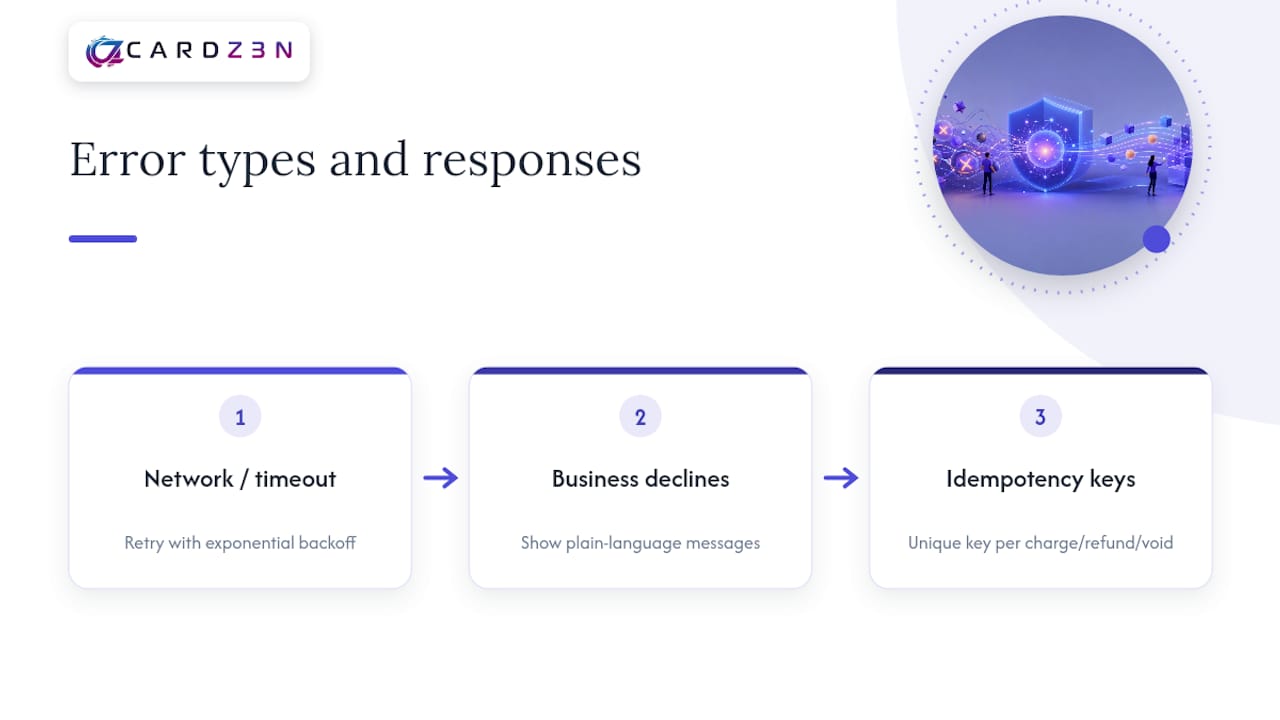
Idempotency keys deserve special attention here. Every charge, refund, and void request should carry a unique key so a retried request after a dropped connection doesn’t create a second transaction. Skipping this is one of the most common causes of duplicate-charge disputes in early-stage ISV integrations.
After launch, build a dashboard that tracks decline rates, webhook delivery failures, and average settlement time by merchant. A spike in declines for one merchant often signals a fraud pattern worth investigating before it becomes a chargeback problem; a spike in webhook failures usually points to an endpoint that changed without updating its signature verification.
Keep a runbook for your support team that maps common processor error codes to plain-language explanations and next steps. When a merchant calls in confused about a failed transaction, the difference between a five-minute resolution and an escalated ticket is usually whether that runbook exists. Log every failed webhook delivery with enough context to replay it manually, since some processors won’t retry indefinitely.
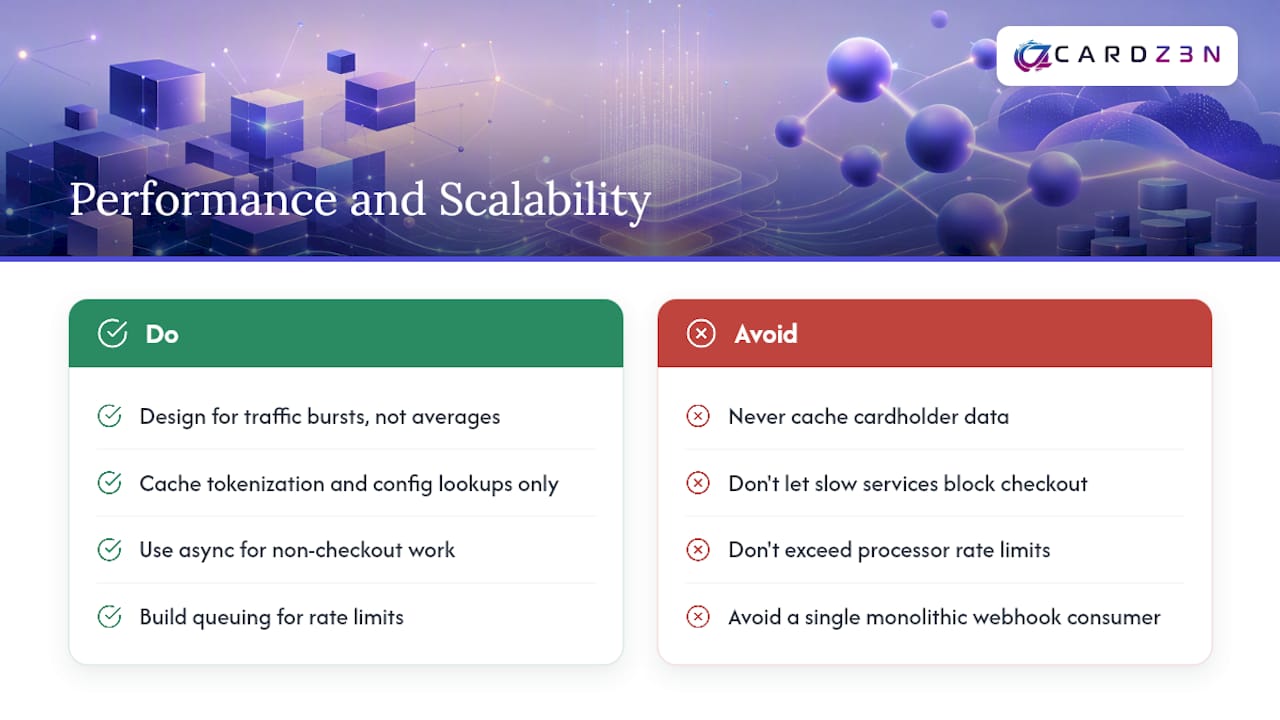
Payment traffic is bursty by nature: a subscription renewal batch, a flash sale, or a single large merchant’s peak season can multiply your normal transaction volume overnight. Design for that variability rather than for your average day.
Cache tokenization and configuration lookups where possible, but never cache anything that resembles cardholder data, even briefly. Use asynchronous processing for anything that isn’t the checkout itself, sending confirmation emails, updating internal reporting, syncing to accounting systems, so a slow downstream service never blocks the customer-facing transaction.
Rate limits matter more than most teams expect until they hit one. Know your processor’s request limits per merchant and per API key, and build queuing logic so a burst of legitimate traffic doesn’t get throttled or dropped. Batch reconciliation jobs and reporting pulls should run on their own schedule, separate from live transaction paths, so a heavy nightly report never competes with a customer trying to check out.
As your merchant count grows, watch for hot spots: a handful of high-volume merchants can dominate your API call budget or database load if you’re not partitioning traffic by merchant. Horizontal scaling of your webhook consumers, rather than a single monolithic handler, keeps one merchant’s traffic spike from delaying every other merchant’s event processing. Load-test your integration against a simulated peak before your first real one arrives.
Payment processors update their APIs more often than most third-party integrations, driven by card network mandates, new fraud tools, and security patches. Treat version management as a permanent maintenance line, not a one-time integration task.
Pin your SDK and API versions explicitly rather than floating on “latest,” and track the processor’s changelog or deprecation notices on a schedule, not reactively when something breaks. Most processors give a deprecation window before retiring an old API version, and missing that window means a scramble to patch production under pressure.
Maintain a staging environment that mirrors production so you can test a new API version against your actual integration before rolling it out. Feature-flag new payment capabilities where possible, so a webhook format change or a new tokenization requirement can roll out to a subset of merchants first.
Document every version your platform supports and communicate upgrade timelines to merchants with enough lead time to test on their side too, especially if they’ve built any custom reporting against your current webhook payloads. A version bump that changes a field name without notice is a common source of merchant-side breakage that has nothing to do with the processor itself.
An embedded checkout has to feel like it belongs to the software around it, not like a foreign object dropped into the page. Match fonts, spacing, and button styles to the host product, and keep the number of fields to the minimum the payment method actually requires.
Error messages need to appear inline, next to the field that caused the problem, rather than as a generic banner at the top of the form. A buyer who sees “card declined” with no further context will usually abandon the purchase; a buyer who sees “your card’s billing zip code doesn’t match” can fix it and finish.
Loading states matter more in payment flows than almost anywhere else in software, because a buyer who isn’t sure whether their card was charged will often hit submit twice. A clear spinner or disabled button state after the first tap prevents that duplicate-submission problem at the source, before it ever reaches your idempotency logic.
Mobile checkout deserves its own testing pass. Autofill support for card numbers and one-time codes, a numeric keyboard for card fields, and a checkout that doesn’t require horizontal scrolling all measurably affect completion rates, even without a specific benchmark to cite. Accessibility matters too: label every field for screen readers and make sure error states are announced, not just shown visually.
PCI DSS governs how you handle cardholder data, but it isn’t the only regulation that touches an ISV payment integration. Data privacy law adds a separate layer of obligation, particularly if any of your merchants or their customers are covered by frameworks like the EU’s GDPR, which governs how personal data, including billing names, addresses, and transaction histories, gets collected, stored, and shared.
If your platform processes payment-adjacent personal data for merchants with customers in the EU or UK, you need a documented legal basis for that processing, clear data retention limits, and a process for handling data subject requests, deletion or access requests, that touches your payment records too. This is separate from and in addition to PCI’s cardholder data rules.
Contract terms with your merchants should spell out who owns dispute data, chargeback records, and transaction history if a merchant leaves your platform, since that data often has both compliance and legal discovery value. Review your merchant terms of service with counsel to confirm they address data breach notification timelines, which vary by jurisdiction and are often stricter than what a general privacy policy anticipates.
None of this replaces PCI DSS compliance. It sits alongside it, and skipping it because “we’re already PCI compliant” is a common and costly assumption.
The failures that show up after launch are rarely exotic. Webhook loss during a deploy, missing idempotency keys that let a retry double-charge a customer, PCI scope creep from a well-meaning feature that starts logging card data “just for debugging,” and monitoring that only catches a problem once a merchant complains.
The fixes are unglamorous but effective: add real observability around every webhook and API call, implement retries with exponential backoff everywhere network calls happen, keep raw card data off your servers entirely by leaning on tokenization, and maintain a written checklist for what merchant documentation you actually need before go-live.
Pro Tip: Run a weekly audit of your webhook delivery success rate. It’s the single fastest way to catch integration decay before a merchant does.
— Joshua Benedetti
A generic gateway works fine until your merchant portfolio includes a vertical it won’t underwrite, or your reserve terms turn out to be a moving target after you’ve already launched. CARDZ3N was built for that gap: transparent, quote-based pricing instead of vague reserve language, and underwriting support for CBD, adult, firearms, subscription billing, nutraceuticals, vape, medical billing, and nonprofit merchants that mainstream processors decline.
For ISVs specifically, that means payment integration support built around gateway connections, chargeback prevention through ChargebackZ3N, and multi-bank underwriting resilience so one declined application doesn’t stall your whole merchant portfolio.
If your platform serves any merchant category a generalist processor hesitates on, get in touch with CARDZ3N to talk through underwriting fit before you commit engineering time to an integration that might not board your merchants anyway.
For teams that want the primary documentation rather than a summary: Visa’s Payment Facilitator Model covers registration and monitoring obligations in full, and the PCI DSS e-commerce guidelines detail how hosted pages, iFrames, and tokenization affect PCI scope and SAQ eligibility.
An ISV, independent software vendor, is a company that builds and sells software to merchants and, in payment processing, adds the ability for that software to accept payments directly rather than sending users elsewhere. This turns the software platform into a payment channel in its own right, with its own compliance and underwriting considerations.
ISVs span practice management software for clinics, point-of-sale platforms for retail, scheduling software for service businesses, and vertical-specific tools like salon or gym management systems, any of which can embed payment acceptance into their core product. The common thread is software built for a specific industry that adds payments as a feature rather than a standalone service.
Payment integration is the process of connecting a software application to a payment processor’s systems so transactions can be authorized, captured, and reconciled without leaving the application. It typically involves an API or SDK, tokenization for security, and webhook handling to keep transaction status current inside the software.
A scheduling platform for medical clinics that lets patients pay their copay directly inside the booking app, instead of being redirected to a separate billing site, is a working example of an ISV. The software vendor in that case has integrated payments as a feature of its core product rather than reselling a third-party checkout link.
Every merchant's processing setup is different, so the right answer depends on your industry, sales channels, average ticket size and chargeback history. CARDZ3N's payments specialists review those details with you and match your business with the right sponsor bank, gateway and risk tools, whether you sell online, in store, by invoice or on a recurring subscription.
We work with merchants across the USA, Canada, the UK and the EU, including high-risk, B2B and fast-growing businesses that traditional processors often turn away. If you would like a second opinion on your current rates, contract terms or approval options, contact our team for a free, no-obligation processing review.
Joshua Benedetti is the CEO of CARDZ3N, a Las Vegas-based merchant services provider specializing in high-risk payment processing and B2B payment technology.
Joshua Benedetti on LinkedInCARDZ3N Inc is headquartered in Las Vegas, Nevada, and provides merchant services to businesses that traditional processors turn away. Backed by top-tier sponsor banks and processors, CARDZ3N combines institutional stability with the speed of a specialized team that understands high-risk industries. Services include high-risk account underwriting and placement, gateway solutions across the major gateway platforms, POS integrations, ACH and check processing, chargeback prevention through ChargebackZ3N, and business lending and working capital. Its AerospacePay division serves OEMs, MROs, FBOs, and repair stations with B2B and B2G payment processing. CARDZ3N serves merchants in the USA, Canada, the UK, and the EU.
Start protecting your revenue from chargebacks today — schedule your complimentary consultation with CARDZ3N’s dispute management specialists.