 CARDZ3N — Home
Contact us today for personalized advice and strategic solutions tailored to your goals.

Call us
+1 (702)-623-3528




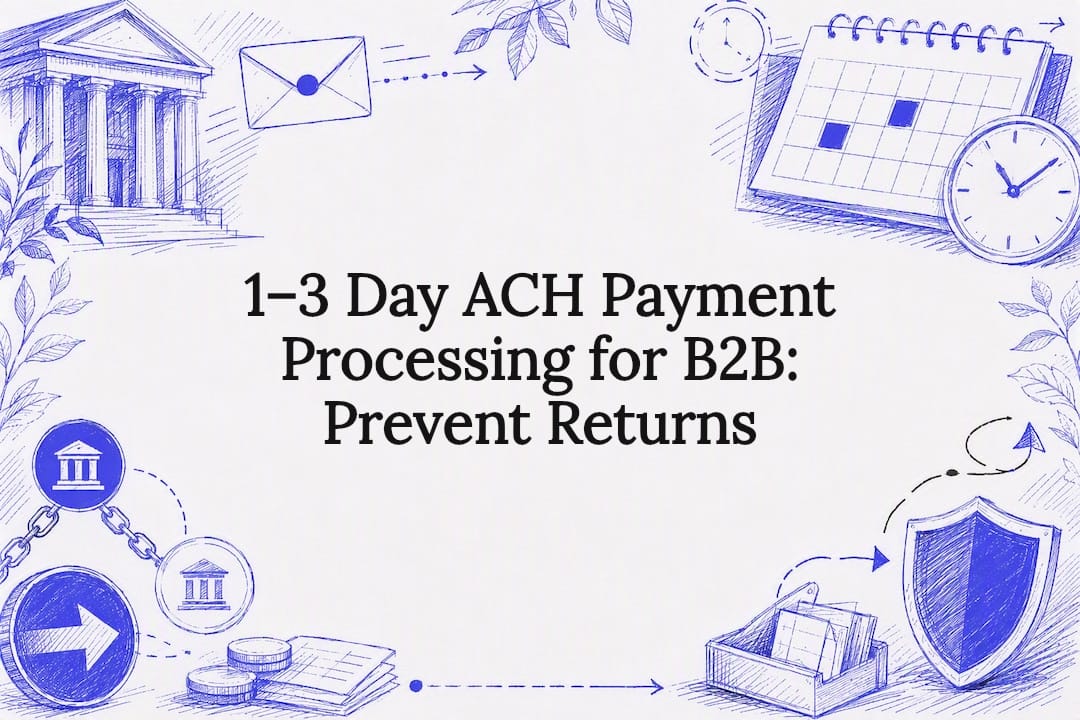





ACH payment processing moves money between bank accounts in batches through the Automated Clearing House network, rather than instantly like a card swipe or wire. For most recurring B2B invoices, payroll runs, and vendor payments, it’s the right tool: it costs far less than a wire and typically settles in a few business days, with Same Day ACH available for time-sensitive transfers within certain limits. The trade-off is reversibility. Returns can surface well after a payment looks final, which makes authorization and reserve controls non-negotiable.
Every ACH transaction moves through a fixed chain of participants, and understanding that chain explains almost everything confusing about timing and risk. The originator initiates the payment, whether that’s a business pulling a customer’s payment or pushing a payroll deposit. That instruction goes to the Originating Depository Financial Institution, or ODFI, which is the originator’s bank. The ODFI batches the file and sends it to an ACH operator.
There are only two ACH operators in the United States: the Federal Reserve’s FedACH system and The Clearing House’s Electronic Payments Network, known as EPN. Both operators sort incoming files and route them to the Receiving Depository Financial Institution, or RDFI, the bank on the other end of the transaction. The RDFI posts the funds to the recipient’s account, and settlement happens between the two banks through the operator.
This is a batch, store-and-forward system, not a real-time one. Files get collected, processed in windows throughout the day, and released on a schedule rather than transaction by transaction, according to Nacha’s developer documentation. That architecture is what makes ACH cheap. It’s also why a transaction showing as “posted” in your dashboard isn’t the end of the story.
Every ACH entry also carries a Standard Entry Class code, or SEC code, that tells the network what kind of transaction it is and what authorization rules apply. The most common codes businesses encounter:
Picking the right SEC code isn’t a formality. It determines your authorization obligations and your exposure if a payment gets disputed.
Standard ACH typically settles within a few business days. That’s the number to plan around for payroll, recurring invoices, and most vendor payments, according to Nacha’s ACH payments fact sheet. But “one to three days” hides a more granular reality: the ACH network processes and settles multiple times within a single banking day, not once at midnight like older mental models suggest.
Same Day ACH pushes eligible payments through on the same banking day, within preset transaction amount limits. That’s a meaningful ceiling increase from ACH’s earlier per-transaction limits, and it’s changed how businesses use the rail for urgent payroll corrections or last-minute vendor payments that don’t justify a wire’s cost.
The Clearing House’s EPN network runs three same-day settlement windows, with cutoffs around 1:00 p.m., 5:00 p.m., and 6:00 p.m. Eastern for intra-EPN submissions, per EPN’s own processing documentation. FedACH runs its own same-day windows on a similar but not identical schedule. The gap between your bank’s or processor’s internal cutoff and the ACH operator’s actual deadline is where most missed-payment problems originate. Your processor might close its submission window hours before the operator’s final cutoff, simply to leave buffer for file processing.
Before you rely on Same Day ACH for anything time-critical, run this checklist:
The decision between ACH and a wire almost always comes down to three variables: how fast you need the money to move, how much you’re willing to pay for that speed, and how much reversal risk you can tolerate.
The practical mapping follows naturally: recurring B2B invoices, payroll, and subscription billing belong on ACH because the cost savings on high-volume, predictable payments outweigh the speed disadvantage. Urgent, high-dollar, one-off payments, especially to a new vendor you don’t have payment history with, belong on a wire, where finality actually protects you from a counterparty who might dispute an ACH debit later.
Many finance teams run both rails simultaneously and even layer in newer options like RTP or FedNow for real-time needs, treating each as purpose-built for different payment shapes rather than picking one system to rule every transaction type.
Pricing for ACH looks simple on a rate sheet and gets complicated fast once you factor in the line items that don’t show up until your first invoice. The core components most processors quote:
The costs that catch businesses off guard live downstream of the rate sheet. Return handling fees apply every time a transaction bounces, and return rates above certain thresholds can trigger monitoring or even account review under Nacha’s rules. Rolling reserves, common for higher-risk accounts, hold back a percentage of processed volume for a set period to cover potential returns. Chargeback-style dispute management, if your provider handles it separately, adds another layer of cost that rarely appears on the initial quote.
Volume and risk profile drive negotiated rates more than almost anything else. A business processing $500,000 a month in low-risk B2B invoices will get meaningfully better per-item pricing than one processing $20,000 a month with a return rate north of 1%.
Pro Tip: Before comparing quotes, model your actual monthly volume against your historical return rate. A slightly higher per-item fee from a provider with faster reserve release often beats a cheaper rate that ties up your cash for 90 days.
Authorization is the single most consequential compliance requirement in ACH processing, and it’s the one businesses treat most casually until something goes wrong. You need documented proof that the account holder authorized the debit, and the form of that proof depends on your SEC code. Nacha rules require originators to be able to produce that proof within 10 days of a request, and failing to do so can result in disputes resolving against you by default, per Nacha’s own developer guidance.
Returns are the other half of the risk equation. A payment that shows as settled in your dashboard hasn’t necessarily cleared for good. Standard unauthorized-transaction returns typically surface within a few business days, but certain return types, including some consumer disputes, can arrive up to 60 days after the original transaction.
Treat a “successful” ACH transaction as provisional, not final, until the return window has fully closed. The batch, store-and-forward architecture that makes ACH cheap is the same architecture that delays finality.
Common return codes worth knowing on sight:
Operational controls that reduce return exposure include real-time account verification before the first debit, standard KYC checks on new payees, tokenized storage of bank details rather than raw account numbers, and rolling reserves sized to your actual historical return rate. Definitive rule text for all of this lives with Nacha, FedACH, and The Clearing House, and it’s worth reading the primary source rather than relying on secondhand summaries.
You have three broad paths into ACH processing, and picking the right one depends on your technical resources and how much operational control you want.
Whichever path you choose, run this preflight checklist before your first live transaction:
Pro Tip: If you’re a high-risk or B2B merchant, ask any prospective processor how they handle return-rate spikes before you sign, not after your first bad month. Reserve policy details matter more than the headline rate.
Standard bank underwriting often assumes a low-risk, low-volume merchant profile that doesn’t fit B2B operations moving large recurring sums or businesses in regulated industries. Cardz3n underwrites and places high-risk merchant accounts specifically for that gap, pairing ACH and eCheck processing with gateway integrations across NMI, Fluidpay, Authorize.Net, USAePay, and Valor PayTech.
That specialization matters because reserve structure and return-rate tolerance for a high-volume B2B account look nothing like a retail merchant’s setup. Underwriting that accounts for your actual transaction pattern, rather than a generic risk template, is what keeps reserves proportional instead of punitive. Cardz3n’s ChargebackZ3N division extends that same risk-focused approach to dispute management, and its API-first integration model lets B2B clients build reconciliation workflows that match their existing accounting systems rather than forcing a rebuild around a vendor’s defaults.
Most guidance on ACH processing treats compliance as paperwork: collect a signature, keep a file, move on. That framing undersells what’s actually happening. Authorization and SEC-code accuracy are the mechanisms that determine who eats the loss when a payment goes bad, and businesses that treat them as boilerplate discover that the hard way, usually during a return dispute they can’t win because their proof doesn’t match their SEC code.
The conventional advice to “just use ACH because it’s cheaper” is incomplete. Cheaper only holds if your return rate stays low and your reserve structure isn’t quietly eating your margin. The businesses that get the most out of ACH are the ones that model their return rate before they negotiate pricing, not after.
If there’s one priority to take from this, it’s sequencing: get your authorization documentation and SEC-code mapping right before you scale volume, not after a return dispute forces the issue. Underwriting built around your actual risk profile, rather than a generic template, is what makes that sequencing possible at scale.
A standard bank often underwrites ACH the same way regardless of whether you’re a low-volume retailer or a B2B operation moving six figures a month in recurring vendor payments, which means your reserve requirements and return-rate tolerance may not fit your business at all. Cardz3n approaches ACH underwriting around your actual transaction pattern instead of a generic template, pairing that with gateway integrations, eCheck processing, and chargeback prevention through ChargebackZ3N.
If your current processor’s reserve policy feels disconnected from your real return rate, or you’re building ACH into a B2B platform and need an underwriting partner who understands high-risk and regulated industries, request a consultation on high-risk merchant processing to see what a risk profile built around your actual volume looks like.
Rate sheets and processor marketing pages simplify ACH rules for readability, but the operative text lives with the network itself. Start with Nacha’s ACH payments fact sheet for timing and Same Day ACH details, Nacha’s developer guide for return codes and authorization requirements, and FedACH’s services documentation for operator-level windows. For implementation help, Cardz3n’s ACH and eCheck banking services page covers integration specifics.
Every merchant's processing setup is different, so the right answer depends on your industry, sales channels, average ticket size and chargeback history. CARDZ3N's payments specialists review those details with you and match your business with the right sponsor bank, gateway and risk tools, whether you sell online, in store, by invoice or on a recurring subscription.
We work with merchants across the USA, Canada, the UK and the EU, including high-risk, B2B and fast-growing businesses that traditional processors often turn away. If you would like a second opinion on your current rates, contract terms or approval options, contact our team for a free, no-obligation processing review.
Joshua Benedetti is the CEO of CARDZ3N, a Las Vegas-based merchant services provider specializing in high-risk payment processing and B2B payment technology.
Joshua Benedetti on LinkedInCARDZ3N Inc is headquartered in Las Vegas, Nevada, and provides merchant services to businesses that traditional processors turn away. Backed by top-tier sponsor banks and processors, CARDZ3N combines institutional stability with the speed of a specialized team that understands high-risk industries. Services include high-risk account underwriting and placement, gateway solutions across the major gateway platforms, POS integrations, ACH and check processing, chargeback prevention through ChargebackZ3N, and business lending and working capital. Its AerospacePay division serves OEMs, MROs, FBOs, and repair stations with B2B and B2G payment processing. CARDZ3N serves merchants in the USA, Canada, the UK, and the EU.
Start protecting your revenue from chargebacks today — schedule your complimentary consultation with CARDZ3N’s dispute management specialists.