


 CARDZ3N — Home
Contact us today for personalized advice and strategic solutions tailored to your goals.

Call us
+1 (702)-623-3528







If you are searching for the Visa Fraud Monitoring Program (VFMP) or the Visa Dispute Monitoring Program (VDMP), the answer is that Visa now runs both inside one program, the Visa Acquirer Monitoring Program (VAMP). According to Visa’s VAMP fact sheet, it consolidates the existing VAMP, VFMP and VDMP into a single global program that monitors fraud, disputes and enumeration. For a U.S. merchant, the number that matters is a combined fraud-and-dispute ratio, and the fact sheet lists the excessive threshold as 150 basis points (1.50%) effective April 1, 2026, down from 220 basis points.
This guide explains what that means for a merchant account, how the ratio is built, how to calculate your own, and what to do before a bad month becomes a program placement. It is written for merchants in categories that processors scrutinize: subscription and MLM billing, CBD and nutraceuticals, vape, adult, telemedicine, gaming, and any business already shut down by a mainstream processor.
For years, Visa ran separate monitoring programs. The fraud program looked at the volume and ratio of fraud reported by issuers. The dispute program looked at the volume and ratio of chargebacks. A merchant could be inside one, both, or neither, and each carried its own remediation process.
Visa has folded those into VAMP. Visa describes the evolved program as streamlining multiple monitoring and remediation processes into one program and one remediation process, with the stated aim of moving the ecosystem from reactive fraud response toward prevention and a lighter administrative burden.
Two practical consequences follow for you:
Older articles that quote VFMP “early warning” and “standard” tiers describe the previous structure. For current thresholds, use the figures below, which come from Visa’s own fact sheet.
According to Visa’s fact sheet, the VAMP ratio is:
(TC40 fraud count + TC15 dispute count) ÷ settled TC05 transaction count
It applies to VisaNet card-not-present transactions, domestic and cross-border. In plain terms:
The formula counts events, not dollars. A $9 subscription charge that is reported as fraud weighs the same as a $900 order. That is why low-ticket, high-volume recurring models feel the ratio faster than their revenue would suggest.
The fact sheet says eligible disputes that are resolved before they become formal disputes, and TC40 fraud that qualifies for Compelling Evidence 3.0 (CE3.0), are excluded from the ratio, subject to the timing of the data extract. CE3.0 is a Visa evidence framework that lets you show prior undisputed transactions by the same cardholder, matched on specific data points, to counter a fraud dispute. In practice, this makes two things worth building into your operation: pre-dispute resolution and clean, matchable transaction data.
Visa defines the enumeration ratio as enumerated approved and declined authorization transactions divided by all approved and declined authorization transactions. It is a separate measure from the fraud-and-dispute ratio and is driven by bot traffic at checkout rather than by customers.
The figures below come from Visa’s fact sheet for U.S. merchants.
| Measure | Excessive threshold (U.S. merchant) | Minimum activity |
|---|---|---|
| Fraud-and-dispute ratio | 220 basis points before April 1, 2026; 150 basis points effective April 1, 2026 | 1,500 fraud and dispute events in a month |
| Enumeration | 20% | 300,000 enumerated transactions |
Two points deserve attention.
First, 150 basis points is 1.50%: 1.5 fraud-or-dispute events per 100 settled card-not-present sales. Many subscription and trial-offer merchants run closer to that line than they realize, particularly when friendly fraud (a cardholder disputing a purchase they actually made) is common.
Second, the monthly minimum matters. Visa explains that a minimum event count focuses monitoring on significant activity rather than ordinary fluctuations. A small merchant can post a high ratio in a month with few sales without reaching 1,500 events. As you grow, that cushion disappears. A merchant processing 100,000 settled transactions a month crosses the minimum at 1.5% by definition, so volume growth quietly moves you from “too small to count” to “fully in scope.”
Thresholds are set by Visa and can be revised, and your acquirer may apply internal limits that are stricter than Visa’s. Confirm the current figures with your processor each time you review your risk posture.
Take a subscription business with 100,000 settled card-not-present Visa transactions in a month. This is an illustrative example, not a client result.
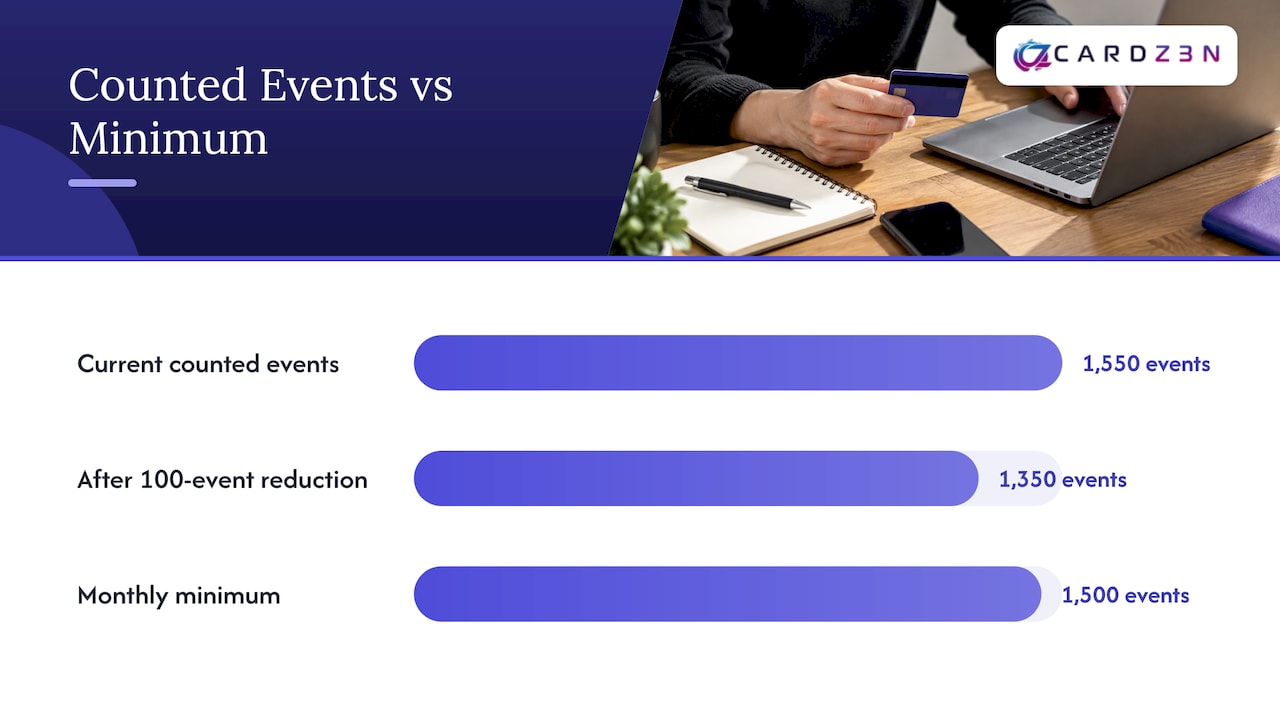
Counted events: 1,100 + 700 − 250 = 1,550. Ratio: 1,550 ÷ 100,000 = 1.55%, or 155 basis points. That is above 150 basis points and above the 1,500 minimum, so the merchant is over the excessive line. Under the old 220-basis-point threshold, the same month would have passed.
Now see what moves the outcome. Resolving another 100 disputes before they become formal disputes, or qualifying another 100 fraud reports for CE3.0, brings the count to 1,350: 135 basis points, and below the 1,500 minimum as well. The margin between a clean month and a monitored month can be a few hundred events, which is why operational controls beat last-minute fixes.
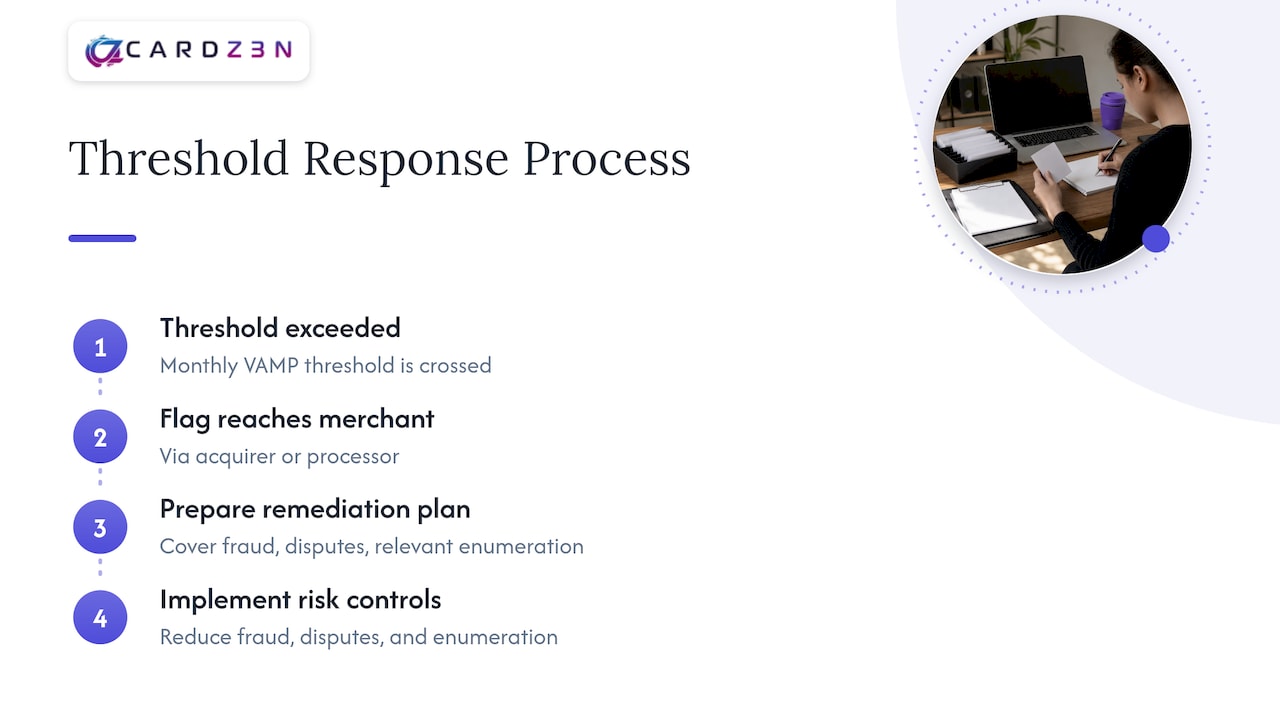
Visa states that entities identified as exceeding monthly VAMP thresholds must implement risk-mitigation control measures. For a merchant, that arrives through your acquirer or processor, who is the party Visa monitors directly. Expect to be asked for a remediation plan covering how you will reduce fraud, disputes and, where relevant, enumeration.
This is the part high-risk merchants should take seriously. A processor that sees a merchant flagged has to answer to its sponsor bank and to Visa, and for merchants already in categories like CBD, nutraceuticals or adult, an unresolved flag is often what precedes a reserve increase, a pricing change or a termination. Visa’s guidance is to contact your acquirer, processor or Visa representative for more information, so the first call should be to the party that holds your merchant account.
Visa evaluates activity monthly, so a monthly self-check is the minimum.
Merchants who operate across several acquiring banks should do this per merchant account, because the monitoring attaches to the account that processed the transactions.
The ratio has two sides: the events on top and the sales on the bottom. Almost all of the useful work is on top.
Because eligible pre-dispute resolutions and qualifying CE3.0 fraud come out of the ratio, a merchant that sets up systems for both will report a lower ratio than one that waits for disputes to arrive. This is the highest-leverage change available to most subscription and ecommerce merchants.
Card testing hits checkout pages, payment forms and gateway endpoints. Rate-limit authorization attempts, add bot detection and CAPTCHA to payment forms, and block repeated low-value declines from the same source. These steps also protect your approval rate, since issuers react to bursts of declines.
Some business models run closer to the 150-basis-point line by nature:
If your processor has already frozen or closed an account over ratios, the next account will be underwritten with the same history in view. Merchants in this position need a provider that reviews risk before boarding and monitors it afterward, which is the case for a high-risk merchant account built for these categories.
Joshua Benedetti writes this section from the view of CARDZ3N, a high-risk payment provider.
The shift to VAMP changes how we advise merchants. When fraud and disputes were measured separately, a merchant could pass one test and ignore the other. Now both feed one number, and that number is judged against a 150-basis-point line. The merchants we see struggle are rarely the ones with a fraud problem alone. They are the ones with no process for the dispute that arrives on day 40 of a subscription, no CE3.0 data in order, and no one watching the trend.
Our approach is to treat the ratio as an operating metric, not a quarterly surprise. We built ChargebackZ3N for chargeback prevention and dispute representment so that fewer events reach the ratio and the ones that do are contested with evidence. We pair that with hands-on underwriting support and multi-bank approval resilience, so a merchant is not dependent on a single acquiring relationship when a program flag appears.
We are also transparent about reserve structures and quote-based pricing. Merchants should know before boarding how a risk event could affect their account, not discover it afterward. If you are close to the line today, the cheapest time to fix it is before your processor has to write you a remediation letter.
Joshua Benedetti
If your ratio is trending toward 150 basis points, or a mainstream processor has already ended your account, our chargeback management, prevention and dispute representment service is designed to reduce the events that feed the ratio. For merchants who need a new home for their processing, our high-risk merchant account placement works with sponsor banks that understand regulated and subscription categories. Our longer guide to Visa VAMP thresholds, fees and what merchants must do goes deeper on the 2026 changes.
Visa has consolidated VFMP, VDMP and the earlier VAMP into one global program named VAMP, per its fact sheet. Fraud, disputes and enumeration are now monitored together. Old VFMP and VDMP thresholds are best treated as history.
Visa’s fact sheet lists an excessive ratio of 220 basis points, reduced to 150 basis points effective April 1, 2026, with a minimum of 1,500 fraud and dispute events in a month. The enumeration thresholds are 20% and 300,000 transactions. Confirm the current figures with your processor, since your acquirer may set stricter internal limits.
No. Visa excludes eligible pre-dispute resolutions and fraud that qualifies for Compelling Evidence 3.0, subject to data-extract timing. The ratio counts events, not dollar amounts, and applies to card-not-present Visa transactions.
Visa directs merchants to their acquirer, processor or Visa representative. Entities that exceed monthly thresholds must implement risk-mitigation control measures, so bring your ratio data and a plan for fraud controls and dispute handling to that conversation.
Every merchant's processing setup is different, so the right answer depends on your industry, sales channels, average ticket size and chargeback history. CARDZ3N's payments specialists review those details with you and match your business with the right sponsor bank, gateway and risk tools, whether you sell online, in store, by invoice or on a recurring subscription.
We work with merchants across the USA, Canada, the UK and the EU, including high-risk, B2B and fast-growing businesses that traditional processors often turn away. If you would like a second opinion on your current rates, contract terms or approval options, contact our team for a free, no-obligation processing review.
Joshua Benedetti is the CEO of CARDZ3N, a Las Vegas-based merchant services provider specializing in high-risk payment processing and B2B payment technology.
Joshua Benedetti on LinkedInCARDZ3N Inc is headquartered in Las Vegas, Nevada, and provides merchant services to businesses that traditional processors turn away. Backed by top-tier sponsor banks and processors, CARDZ3N combines institutional stability with the speed of a specialized team that understands high-risk industries. Services include high-risk account underwriting and placement, gateway solutions across the major gateway platforms, POS integrations, ACH and check processing, chargeback prevention through ChargebackZ3N, and business lending and working capital. Its AerospacePay division serves OEMs, MROs, FBOs, and repair stations with B2B and B2G payment processing. CARDZ3N serves merchants in the USA, Canada, the UK, and the EU.
Start protecting your revenue from chargebacks today — schedule your complimentary consultation with CARDZ3N’s dispute management specialists.