 CARDZ3N — Home
Contact us today for personalized advice and strategic solutions tailored to your goals.

Call us
+1 (702)-623-3528


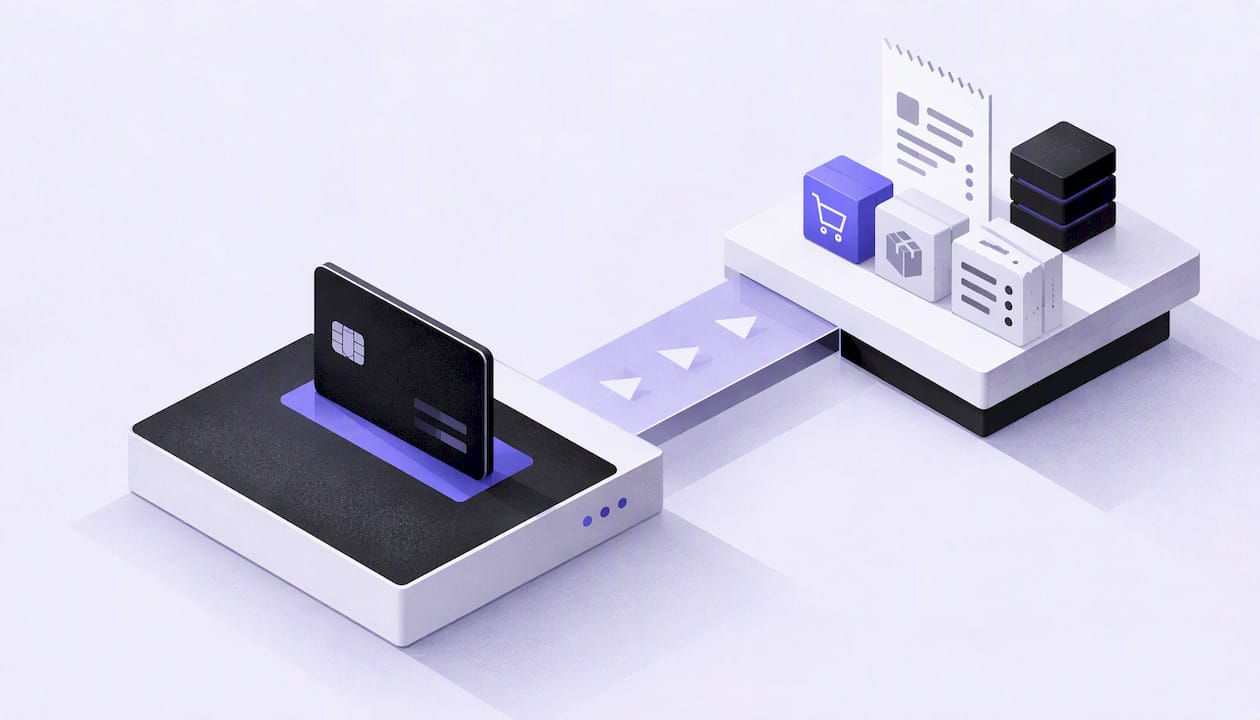




If you already accept Visa and Mastercard online, you can already accept purchasing cards. P-cards run on the same card networks as standard credit cards, so no separate account type is required. What changes is the data you transmit with each transaction, and that data decides whether you pay a qualified commercial interchange rate or the most expensive one available. This guide covers what a P-card is, how to configure online acceptance, which fields matter, what to expect on fees, and where merchants most often lose margin.
A purchasing card is a business charge card issued to an employee so that person can buy goods and services for the employer. Public agencies use them heavily. Connecticut’s state manual describes the P-card as an alternative to petty cash, check requests, low-dollar purchase orders and online purchases, and Oklahoma describes its program as a credit card issued to designated state employees for official-use purchases.
Three traits matter to you as the supplier:
Buyers who hold P-cards tend to favor suppliers that make reconciliation easy. Industry commentary describes proactive P-card support, with detailed data attached, as a competitive advantage with corporate and government buyers. If you also sell to agencies that must follow domestic-sourcing rules, see this explainer on what TAA compliance means for federal procurement, since buyers often check both the product and the payment method.
No. A P-card is processed as a credit card transaction. If your merchant account and gateway accept Visa and Mastercard, a P-card number entered at your checkout or virtual terminal will authorize like any other. The practical questions are different:
Commercial cards qualify for lower interchange when the transaction carries extra information. Without it, the transaction defaults to the highest possible interchange rate and your buyer receives a sparse statement line that forces manual reconciliation.
| Data level | Fields required | Typical use |
|---|---|---|
| Standard | Card number, amount, expiration, AVS/CVV | Consumer-style checkout |
| Level 2 | Customer reference number (often the PO number), tax amount, merchant tax ID | Recurring B2B and government orders with a single total |
| Level 3 | Line-item detail: item name, quantity, unit price, commodity code, shipping costs | Itemized orders, larger tickets, agency buyers |
One practical point: Level 2 is the realistic floor for any B2B checkout. Level 3 takes more engineering because your ecommerce platform or ERP must expose line items, unit-of-measure codes and commodity codes in the payload. We go deeper on the mechanics in how Level 3 data processing lowers card fees on B2B sales.
Standard credit card interchange typically falls between 1.15% and 3.30% depending on network and card type, and commercial cards are especially sensitive to data quality. Your effective rate is interchange plus the processor’s markup plus network assessments, so the same card can cost you very different amounts depending on whether the data was attached. Processors that bundle everything into one flat percentage hide this effect; a breakdown of flat-rate processor fees shows why a blended rate can overcharge a merchant whose volume is mostly commercial cards.
Interchange schedules change, so ask your processor for the current commercial card categories and their rates, and ask for the pricing model in writing. For a plain-language look at how B2B card charges are built, read B2B transaction charges: what they are and how they work.
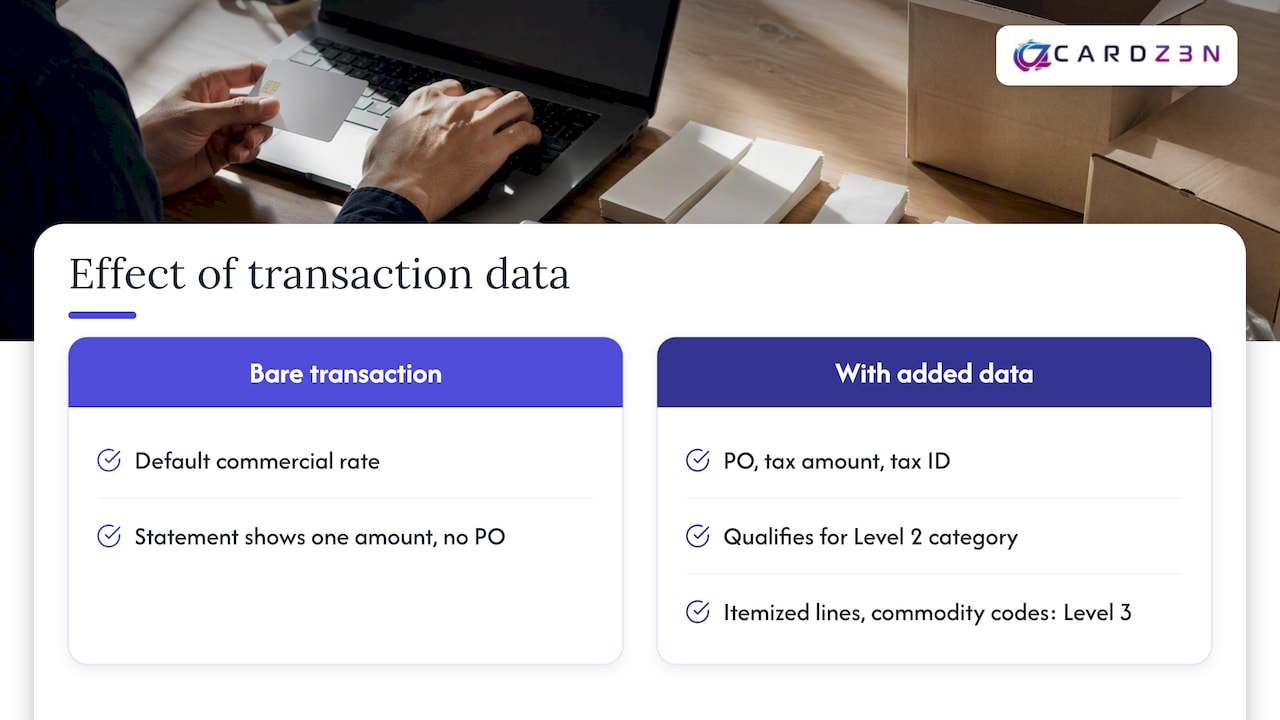
Imagine a supplier selling $4,000 of industrial supplies to a city department that pays by P-card. If the order is sent as a bare consumer-style transaction, it prices at the default commercial rate and the department’s statement shows one amount with no PO number. If the same order carries the PO number, sales tax amount and your tax ID, it can qualify for a Level 2 category, and with itemized lines and commodity codes, a Level 3 one. The exact percentage depends on your processor’s pass-through and the card’s network, so we are not quoting one here. The pattern is what matters: the product and the card are identical, and only the data differs.
Ask your provider three direct questions: Do you support Level 2 and Level 3 on my gateway and integration type? Is my pricing interchange-plus or tiered? What reserve or holdback applies to my account? A processor that answers all three clearly is usually one you can scale with. Our overview of choosing a payment processing provider lists more questions worth asking.
Add optional or required fields for purchase order number, tax-exempt status and a billing contact. For a B2B storefront, a company-account login that pre-fills the tax ID and default PO format removes most manual entry. Where your gateway supports it, pass the fields through the API rather than relying on a free-text notes field, which processors do not read.
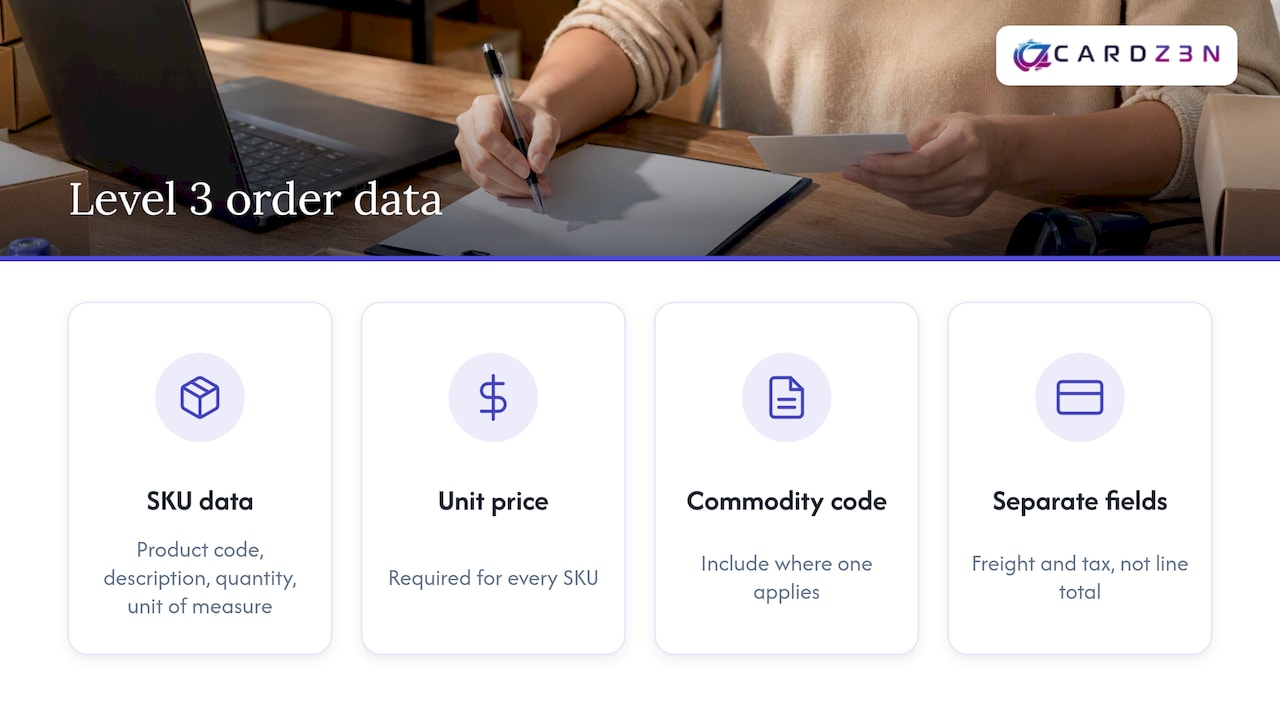
Your catalog needs a product code, description, quantity, unit of measure and unit price for every SKU, plus a commodity code where one applies. Freight and tax must be separate fields, not buried in the line total. Test with a handful of orders and confirm in the processor’s reporting that the transactions were flagged as enhanced data.
Many P-card buyers still send a PO by email. When keying those orders, gather the PO numbers, tax status and itemized data before opening the payment screen; retrieving them mid-transaction can trigger browser timeouts or entry errors that cause failed authorizations. Our B2B and B2G payment processing page covers the virtual terminal and ACH options that sit alongside card acceptance.
Manual reconciliation is a real barrier. Mastercard reports that nearly 42% of suppliers cite it as a top obstacle to accepting cards, and it has made its Receivables Manager tool widely available to address virtual card matching. If your volume justifies it, an integration that bridges your ERP and your acquirer, rather than spreadsheets, is what lets B2B card volume scale.
Accepting P-cards online does not change your security duties, but it raises the stakes because buyers are organizations with procurement and audit teams. Merchants accepting cards online remain responsible for protecting cardholder data, including when a third party handles the payment page. The PCI Security Standards Council states that the standard applies to all entities that store, process, or transmit cardholder data.
Practical steps:
Our PCI compliance checklist for B2B merchants turns this into a working list.
Most merchants think of P-card acceptance as a yes-or-no switch. In our work with B2B and government-facing merchants, we see it differently: the switch is already on, and the real work is data quality. A supplier that sends clean Level 2 and Level 3 fields, uses a gateway built to pass them, and has transparent pricing is in a different cost position from one that accepts the same cards on a blended rate.
We also see a second problem upstream. Merchants in restricted or high-risk categories often get their primary account frozen or closed, and that interruption does more damage with an agency buyer than any fee. Stable processing comes first; optimization comes second. That is why we are open about reserve structures and quote-based pricing, and why we place accounts with sponsor bank support behind them. Ask any provider, us included, to put reserve terms and pricing mechanics in writing before you board.
— Joshua Benedetti
If you sell to businesses or agencies and want a processing setup built around enhanced data, our B2B and B2G payment processing service covers card acceptance with Level 2 and Level 3 data, ACH and eCheck, and a virtual terminal. If your business has been declined or shut down elsewhere, start with our online payment processing and high risk merchant account pages. Pricing is quote-based, so there is no published rate to quote here: request a quote and we will explain the structure before you commit.
No. P-cards use the same Visa and Mastercard networks as other credit cards, so any merchant already accepting those brands can take them. What you need is a gateway and processor that pass Level 2 and Level 3 data and price it properly.
They are the same components as any card sale: interchange, processor markup and network assessments. Interchange on commercial cards depends heavily on the data you submit, so a transaction with a PO number, tax amount and line items can cost less than the identical sale without them. Ask your processor for current rates and the pricing model in writing.
The buyer’s organization, not the individual cardholder, holds the liability in a corporate P-card program. The issuer bills the organization, typically once a month, with all cardholders and totals on one invoice.
Yes, provided your checkout accepts the card and the purchase complies with the buyer’s own policy. Agencies often set category limits, so a decline can come from the program’s controls instead of your system.
Yes. Using a third-party payment page reduces the scope of what you must secure, but you remain responsible for protecting cardholder data and for completing the assessment that fits your integration.
Every merchant's processing setup is different, so the right answer depends on your industry, sales channels, average ticket size and chargeback history. CARDZ3N's payments specialists review those details with you and match your business with the right sponsor bank, gateway and risk tools, whether you sell online, in store, by invoice or on a recurring subscription.
We work with merchants across the USA, Canada, the UK and the EU, including high-risk, B2B and fast-growing businesses that traditional processors often turn away. If you would like a second opinion on your current rates, contract terms or approval options, contact our team for a free, no-obligation processing review.
Joshua Benedetti is the CEO of CARDZ3N, a Las Vegas-based merchant services provider specializing in high-risk payment processing and B2B payment technology.
Joshua Benedetti on LinkedInCARDZ3N Inc is headquartered in Las Vegas, Nevada, and provides merchant services to businesses that traditional processors turn away. Backed by top-tier sponsor banks and processors, CARDZ3N combines institutional stability with the speed of a specialized team that understands high-risk industries. Services include high-risk account underwriting and placement, gateway solutions across the major gateway platforms, POS integrations, ACH and check processing, chargeback prevention through ChargebackZ3N, and business lending and working capital. Its AerospacePay division serves OEMs, MROs, FBOs, and repair stations with B2B and B2G payment processing. CARDZ3N serves merchants in the USA, Canada, the UK, and the EU.
Start protecting your revenue from chargebacks today — schedule your complimentary consultation with CARDZ3N’s dispute management specialists.