


 CARDZ3N — Home
Contact us today for personalized advice and strategic solutions tailored to your goals.

Call us
+1 (702)-623-3528







BANKCARD MTOT DISC is your card processor collecting a month of processing fees from your business bank account in a single ACH debit. It is not a new fee, a penalty, or a separate company billing you. It is a sum: dozens of smaller charges (interchange, assessments, processor markup, monthly and statement fees) added together on a document you may never have opened, then withdrawn at once. According to one merchant fee audit breakdown, the abbreviation reads as Merchant Total Discount, and “BANKCARD” is simply the originator label attached to the ACH withdrawal, not the name of the company you signed with.
This guide explains what each part of the descriptor means, how it differs from MTOT DEP and BTOT DEP, how to verify the amount against your merchant statement, and what to check when the figure looks wrong.
Bank statement descriptors are built for space, not clarity. Break the line into its pieces and it becomes readable:
| Piece | What it signals |
|---|---|
| BANKCARD | The line is a card processing transaction. It is the ACH originator name, not necessarily your processor’s brand. |
| MTOT | Merchant total: an aggregate for your account over a period, rather than a single sale or batch. |
| DISC | Discount, an older banking term for fees charged on card sales. |
| Trailing number (such as 8001 or 8710) | An internal batch or originator identifier. It is not your merchant number. |
One merchant statement guide describes “DISC” as old banking slang for fees and reads MTOT as the merchant’s total sales volume for the month. Sources vary slightly in how they expand the abbreviation (“Merchant Total Discount,” “monthly total discount”), because the descriptor is a processor convention rather than a published standard. The practical meaning is consistent across all of them: a fee total for the period, pulled from your account.
The trailing number deserves a note. Calling your bank about it rarely resolves anything, because your bank simply honored a debit your processor originated. The same audit write-up makes this point: the questions belong with your processor, and the answers live on your merchant statement.
The most common misreading is treating MTOT DISC as one line item you can negotiate away. It is the bottom line of a statement that can include:
The debit amount is the grand total. If you only look at the bank line, you cannot tell which component moved. That is why a $26 debit and a $2,600 debit look equally opaque until you open the statement. Some processors have historically used the aggregated line to make charges harder to notice, which is a reason to reconcile it every month rather than occasionally.
For a fuller walkthrough of what goes into the total, see our credit card processing fees explained page.
These three descriptors often appear together and are easy to confuse. The direction of the money is the quickest way to separate them.
| Descriptor | Direction | What it represents |
|---|---|---|
| MTOT DISC | Money leaving your account | The merchant’s total fees for the period, collected in one movement |
| MTOT DEP | Money arriving | Monthly card sales deposited as a merchant total |
| BTOT DEP | Money arriving | A single batch of card sales, usually one per business day |
This comparison follows the breakdown of the three descriptors: MTOT DISC is the outflow, MTOT DEP is the monthly inflow, and BTOT DEP is the daily batch inflow. Another reference spells out the naming difference: MTOT is “Merchant Total” while BTOT uses “Batch Total”.
If you see mostly BTOT DEP lines during the month and a single MTOT DISC near the start of the next one, that is a normal pattern: you are paid daily on batches, and fees are collected monthly.
Whether you see MTOT DISC at all depends on how your processor settles funds. Under gross settlement, the deposit and the fee appear as separate lines: money in, then fees out. Under net settlement, the fee is already deducted from the deposit, so no separate MTOT DISC line shows up.
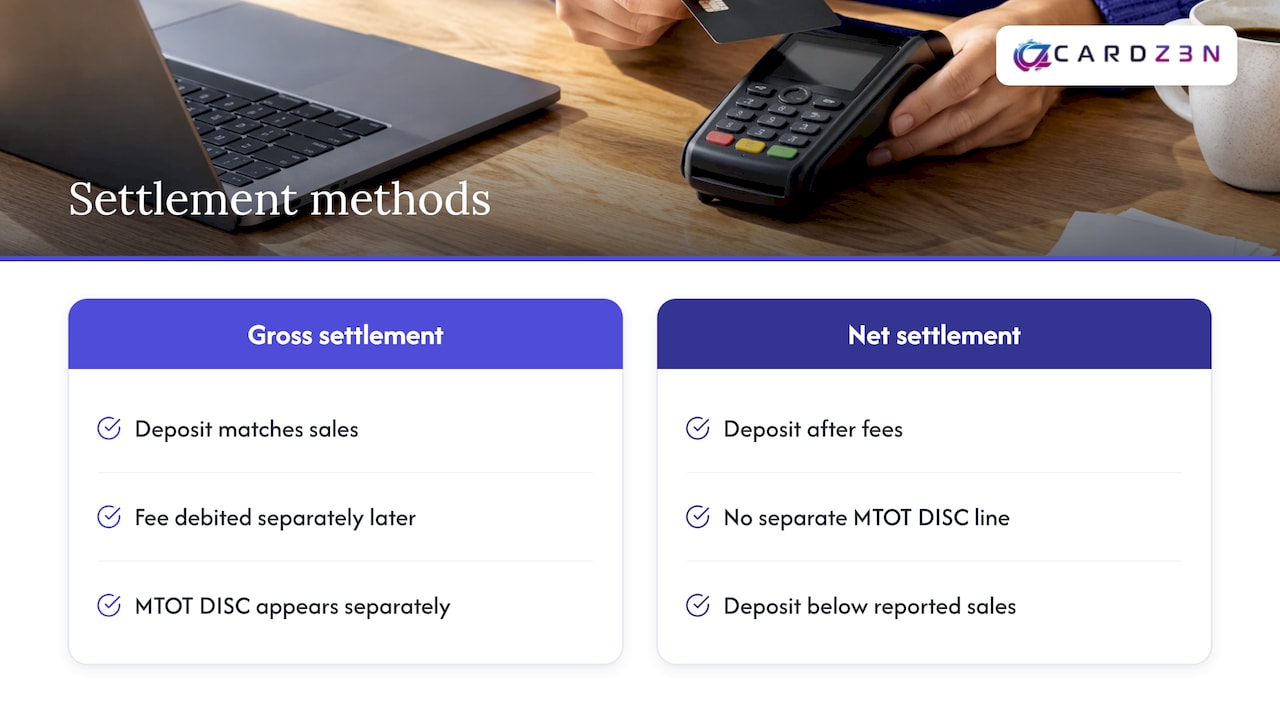
This matters for reconciliation. With net settlement, your deposits will be smaller than your reported sales, and the difference is your fees. With gross settlement, deposits match sales and the fee leaves later. Neither is inherently better for the merchant, but each requires a different bookkeeping entry. If you use accounting software, record the debit as a processing fee expense rather than leaving it as an unmatched withdrawal.
A debit you cannot explain is a debit you should reconcile. The process takes about fifteen minutes once you know where to look.
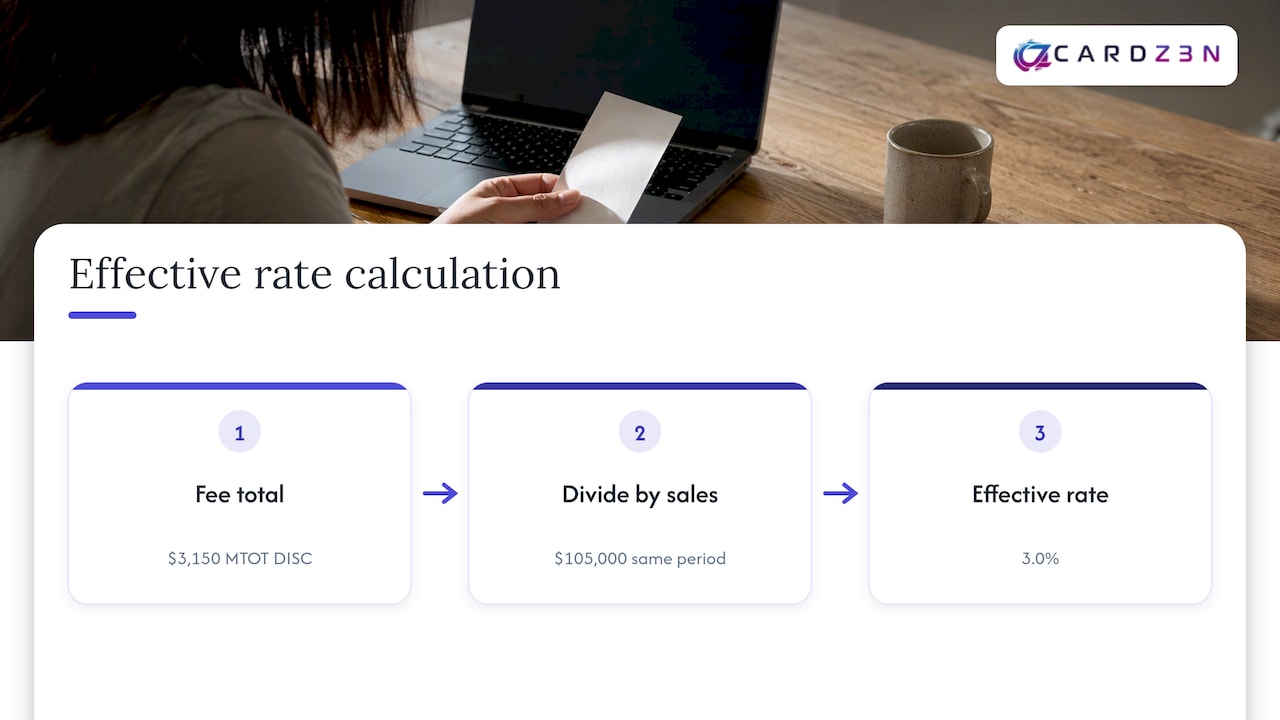
Once you have the fee total, divide it by your total card volume for the same period. That gives you the effective rate: the all-in percentage you pay to accept cards, including interchange, assessments, markup and other fees.
A quick example: if the MTOT DISC debit is $3,150 and you processed $105,000 in card sales, your effective rate is 3.0%. Tracking that number month to month is more informative than watching the dollar amount, because the dollar amount rises and falls with volume.
Be careful with processor-supplied summaries. The same guide cautions that some statements include a section that looks like the effective rate but is not calculated from the correct totals. Some processors also show prior-month fees on the current statement, so confirm that the period on the fee total matches the period you are reconciling.
The debit rarely matches the previous month, and most variation has ordinary causes. Check these first:
If none of these explains the difference, request the itemized statement and compare line by line against your contract’s fee schedule. A pricing line that does not appear in your agreement is the one to question.
A debit is worth escalating when it does not match any statement, when the amount exceeds the total on the statement, when it repeats within the same period, or when it appears and you have no active merchant account. For a business that has not accepted cards in months, an unexplained BANKCARD debit warrants a call to the bank and the former processor about whether the account was actually closed and whether a recurring ACH authorization is still active. Your bank can advise on stopping an authorization you no longer want in place.
The descriptor itself says nothing about your risk level. Any merchant account can produce it. What changes for higher-risk businesses is the content of the total: higher markups, additional monthly fees, chargeback fees, and sometimes reserve-related movements that appear as separate lines rather than inside the debit.
Merchants in industries such as subscriptions, CBD, nutraceuticals, and adult commerce often face more complicated statements because of those add-ons. If your total looks heavy, break out the chargeback-related items first. Disputes cost you the sale, the fee, and, once your ratio climbs, potentially your account standing. Reducing them through better descriptors, clear billing disclosures, and a chargeback management and prevention program lowers the DISC total and protects the account itself.
Merchants call us about MTOT DISC for the same reason each time: the number on the bank statement arrived before the explanation did. A lump-sum debit you cannot trace to a document is a structural problem, not a bookkeeping annoyance.
We build our programs around the opposite principle. We are transparent about reserve structures and quote-based pricing, so what leaves your account is something you expected, with terms you saw before you signed. We are a specialist in high-risk and B2B processing, which means we underwrite for industries mainstream processors turn away and we walk through the fee schedule with you during onboarding, not after the first statement.
Our advice is to treat the monthly debit as the last step in a process you control. Know your effective rate, keep your statements next to your bank records, and ask any processor, us included, to explain every line against the agreement. Backed by top-tier sponsor banks and a team that works high-risk volume daily, we aim to make the debit the least surprising event of your month.
Joshua Benedetti
A clean monthly routine keeps the debit from becoming a recurring mystery:
If you also collect payments by ACH or eCheck, keep those fees on separate lines. Bank-to-bank payments are priced differently from cards, and our overview of ACH payment processing and eCheck solutions explains why mixing the two obscures your true card cost.
If your statements are hard to read, or your account has been frozen or declined elsewhere, we can help. CARDZ3N places high-risk merchant accounts with hands-on underwriting support, and we also offer online payment processing, gateway integrations and chargeback tools. Pricing is quote-based, so request a quote and review the reserve and fee terms before you commit.
It is a monthly debit from your business bank account for the total card processing fees your processor billed you for the period. BANKCARD marks it as a card-processing transaction, MTOT refers to a merchant total, and DISC refers to discount, an older term for processing fees.
On its own, no. If you accept card payments, a fee debit under this descriptor is normal. It becomes a concern only if it does not match a statement, you have no active merchant account, or it repeats. In those cases, contact your processor and your bank.
MTOT DISC is money leaving your account as fees. MTOT DEP is money arriving as monthly card sales, and BTOT DEP is a single batch of sales, usually one per business day. If your processor uses net settlement, you may see no MTOT DISC line at all.
Yes, but you lower it by changing what feeds the total, not the debit. Review your effective rate, reduce chargebacks, and compare the markup on your statement against your contract. Asking your processor for an itemized fee schedule is the first step.
Every merchant's processing setup is different, so the right answer depends on your industry, sales channels, average ticket size and chargeback history. CARDZ3N's payments specialists review those details with you and match your business with the right sponsor bank, gateway and risk tools, whether you sell online, in store, by invoice or on a recurring subscription.
We work with merchants across the USA, Canada, the UK and the EU, including high-risk, B2B and fast-growing businesses that traditional processors often turn away. If you would like a second opinion on your current rates, contract terms or approval options, contact our team for a free, no-obligation processing review.
Joshua Benedetti is the CEO of CARDZ3N, a Las Vegas-based merchant services provider specializing in high-risk payment processing and B2B payment technology.
Joshua Benedetti on LinkedInCARDZ3N Inc is headquartered in Las Vegas, Nevada, and provides merchant services to businesses that traditional processors turn away. Backed by top-tier sponsor banks and processors, CARDZ3N combines institutional stability with the speed of a specialized team that understands high-risk industries. Services include high-risk account underwriting and placement, gateway solutions across the major gateway platforms, POS integrations, ACH and check processing, chargeback prevention through ChargebackZ3N, and business lending and working capital. Its AerospacePay division serves OEMs, MROs, FBOs, and repair stations with B2B and B2G payment processing. CARDZ3N serves merchants in the USA, Canada, the UK, and the EU.
Start protecting your revenue from chargebacks today — schedule your complimentary consultation with CARDZ3N’s dispute management specialists.