

 CARDZ3N — Home
Contact us today for personalized advice and strategic solutions tailored to your goals.

Call us
+1 (702)-623-3528






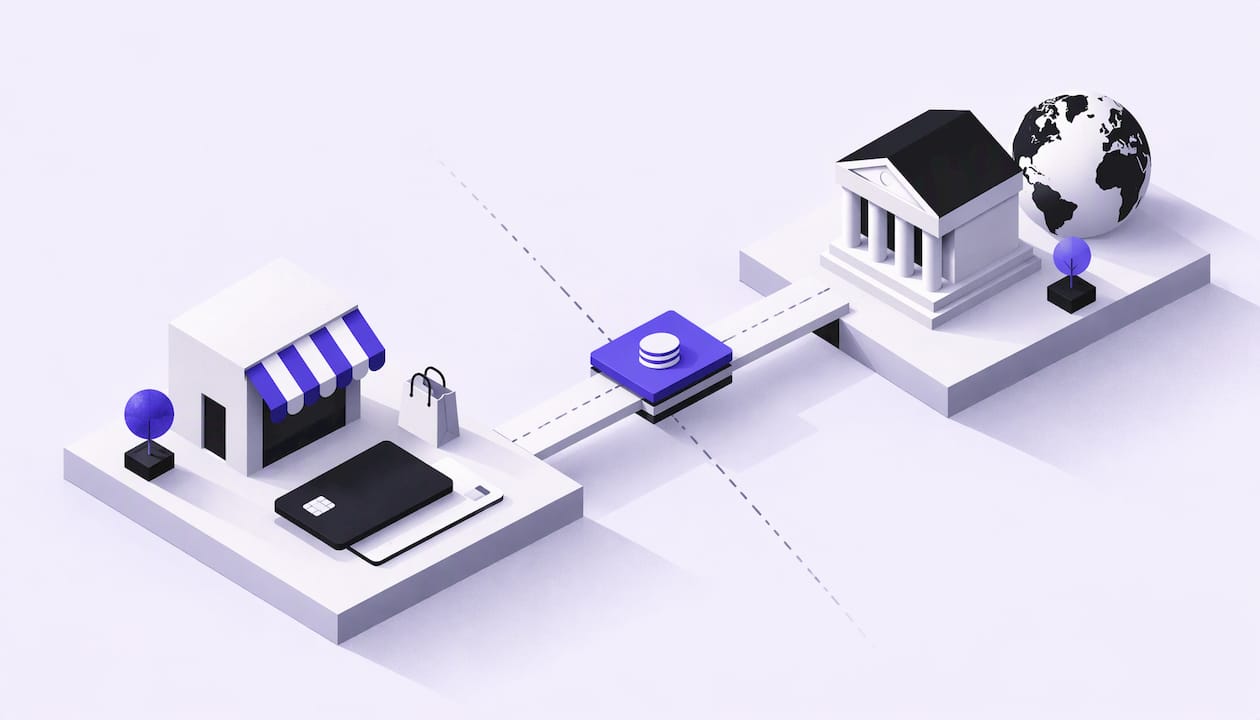





A cross-border assessment fee is a card network charge, set by Visa or Mastercard, on a sale where the card was issued outside the merchant’s country (or settles in a different currency). It is billed by your acquirer and sits on top of interchange. The percentage is small, usually under 1% per fee, but several network fees can stack on one foreign-issued card sale. For a merchant with international customers, high ticket sizes or a high-risk category, that adds up to a real line on the statement. We handle this daily for merchants that mainstream processors rejected, so this guide shows how the fees work, what they cost on a realistic volume, and how to find them in your own data.
Five different charges get called “cross-border fees” in search results, and they are not the same thing. Separating them is the first step to reading a statement correctly.
| Charge | Who pays | Who sets it | When it applies |
|---|---|---|---|
| Cross-border assessment (network fee) | Merchant, via the acquirer | Visa or Mastercard | Card issued outside the merchant’s country, or currency mismatch |
| Interchange | Merchant, paid to the issuing bank | Network schedule, paid to issuer | Every card sale, with a separate international table for foreign-issued cards |
| Processor markup | Merchant | Your processor, by contract | Every sale, on top of network costs |
| Foreign transaction fee | Cardholder | The card issuer | When a US cardholder buys abroad |
| Currency conversion / DCC | Cardholder or merchant, depending on setup | Processor or bank | When the sale is converted between currencies |
The cardholder’s foreign transaction fee is the one consumers know. The CFPB’s database of card agreements shows foreign transaction fees of up to 3% on many US cards, according to a card payments cost overview, but that is billed to the shopper by their own bank and never reaches your statement. Your cost is the network assessment plus interchange plus your processor’s markup.
Mastercard’s own merchant page draws the line that matters here: U.S. interchange applies to a U.S.-issued card at a U.S. merchant, while interregional interchange applies to a non-U.S.-issued card at a U.S. merchant. The same page states that Mastercard has no involvement in acquirer and merchant pricing policies or agreements, which is why two merchants with identical foreign volume can see different effective costs. See Mastercard’s interchange explainer.
For the broader picture of who sets which layer, our guide to how interchange rates work and who sets them goes layer by layer.
The networks look at four facts about each transaction.
Card-present or card-not-present matters indirectly. Ecommerce sales are far more likely to come from foreign-issued cards, and card-not-present interchange categories are usually priced higher than swiped ones, so an online merchant tends to feel both layers.
Visa’s published pass-through schedule, in the Spring 2023 version used by a US state contract, lists two relevant fees.
MCC 5962 covers direct-marketing travel-related arrangement services, 5966 covers outbound telemarketing, and 5967 covers inbound telemarketing with adult-content or similar offers. If you sell through direct marketing, this is the one place in the schedule where your category itself doubles a fee.
Interchange is a separate table. Visa’s US interchange document, effective October 24, 2026, lists international base rates for Visa cards issued outside the US and used at a US merchant: 1.10% for Classic, Gold and Electron, 1.85% for Signature and Premium, 1.98% for Infinite and 2.00% for commercial. Downgraded transactions, those that miss a qualification requirement, run 1.65%, 1.90%, 2.03% and 2.05% in the same order.
The same Spring 2023 schedule lists two Mastercard fees that matter for foreign-issued cards:
These rates are not new. An April 2019 Fiserv pass-through schedule lists the same 0.60% and 1.00% cross-border figures, the same 0.85% support fee, and a base Mastercard assessment of 0.13%. Networks revise schedules periodically and acquirers pass the changes along on their own timetable, so use the dates on these documents as the period they describe, and compare against the schedule your processor currently publishes. Our note on the 2019 Visa and Mastercard rate changes shows how those updates reach merchants.
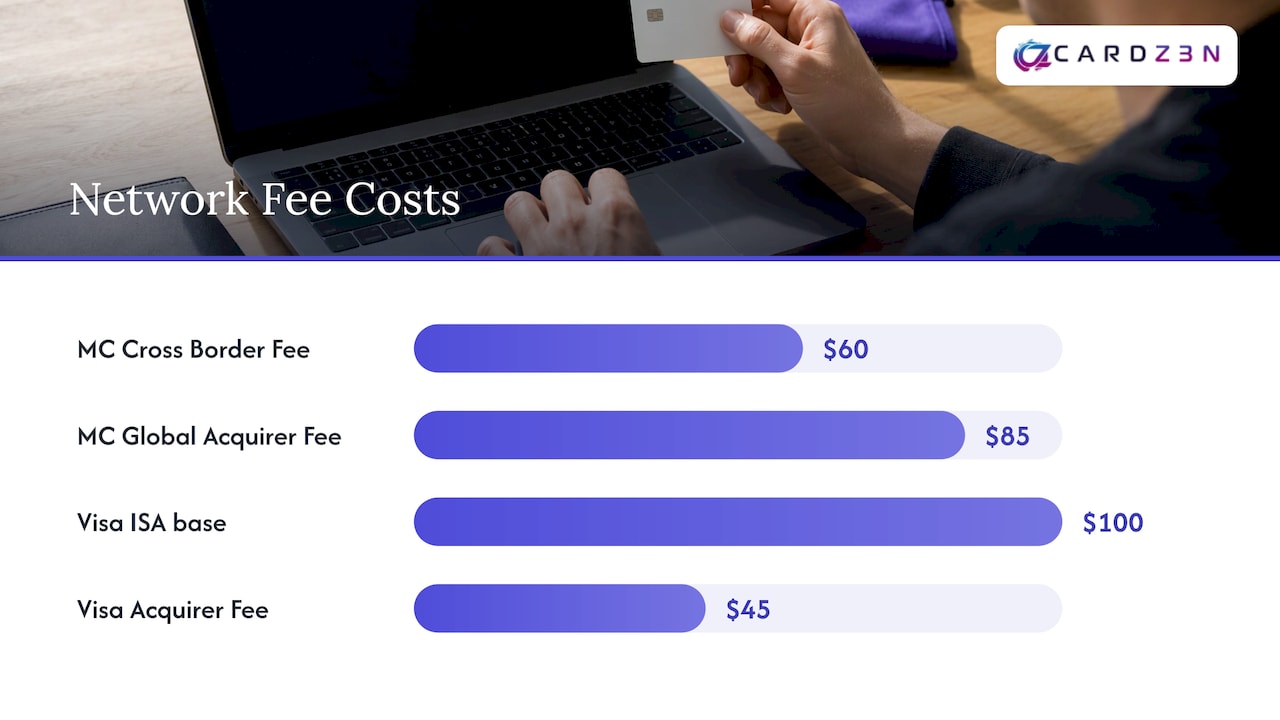
Take an online merchant with $100,000 in monthly card volume, of which 10% ($10,000) comes from foreign-issued cards, all billed and settled in USD. Using the Spring 2023 pass-through rates above (illustrative, before interchange and markup):
| Network | Fee | Rate | Cost on $10,000 |
|---|---|---|---|
| Mastercard | US Cross Border Fee | 0.60% | $60 |
| Mastercard | Global Acquirer Support Fee | 0.85% | $85 |
| Visa | ISA, base | 1.00% | $100 |
| Visa | International Acquirer Fee | 0.45% | $45 |
If the foreign volume were split evenly across the two networks, network assessments alone would come to roughly $145 on Mastercard’s $5,000 half… more precisely, $72.50 on Mastercard ($5,000 at 1.45%) and $72.50 on Visa ($5,000 at 1.45%), or $145 in total, before the higher international interchange. Now change one variable: bill the same customers in their local currency so the sales settle in non-USD. The Mastercard cross-border rate rises from 0.60% to 1.00% and the Visa ISA from 1.00% to 1.40%. The same sales then cost 0.40 percentage points more on the affected fees, or $40 more per $10,000.
If the same merchant is on a high-risk MCC for Visa, the acquirer fee moves from 0.45% to 0.90%, adding another $22.50 per $5,000 of Visa foreign volume. None of this is large on one month. At $2 million of monthly volume with the same mix, every figure is twenty times larger.
Assessments rarely appear under the phrase “cross-border assessment fee.” Statement labels are chosen by the acquirer, and many bundle network charges into one line. Work through your statement in this order.
Chargebacks on foreign-issued cards deserve the same attention, because a cross-border dispute still carries its own fees and ratio impact. Our chargeback management service covers prevention and representment for these cases.
You cannot negotiate the network’s assessment, but you control the facts that trigger or inflate it.
Merchants who come to us after a freeze at a mainstream processor usually ask about the headline discount rate. The better question is how the full stack is built: network assessments, interchange, markup, and the reserve. Cross-border fees are a good test. They are published, formulaic and predictable, so a pricing structure that keeps them visible is easier to forecast than one that blends them away.
We are a specialist in high-risk and B2B processing, backed by top-tier sponsor banks, with hands-on underwriting support and multi-bank, multi-rail approval resilience. We are transparent about reserve structures and quote-based pricing, which matters most to the merchants who sell internationally: subscriptions, CBD and hemp, nutraceuticals, adult, and aerospace and government B2B. These are the businesses where a Visa acquirer fee can double on the category alone, and where a flat guess at foreign costs can hide a margin problem.
Our view is that you should know the cost of a foreign-issued card before you market to that customer, not after the first statement arrives.
Joshua Benedetti
If you take cards from customers outside the US, or you were declined or shut down by a mainstream processor because of your category, our high-risk merchant account is built for that profile, and our online payment processing covers ecommerce with a gateway and fraud tools. Pricing is quote-based, so the quote depends on your category, volume and the share of foreign-issued cards. For B2B and government work, B2B and B2G payment processing includes ACH, eCheck and Level 2 and 3 data.
No. A foreign transaction fee is charged to the cardholder by their issuing bank. A cross-border assessment is a network fee that Visa or Mastercard charges through your acquirer to you, the merchant, when the card was issued outside your country or the currencies differ.
In the Spring 2023 pass-through schedule, Visa’s International Service Assessment base is 1.00% for USD settlement and 1.40% otherwise, plus a 0.45% International Acquirer Fee on non-US-issued cards (0.90% for MCCs 5962, 5966 and 5967). Your processor’s current schedule governs what you are billed.
The same schedule lists a US Cross Border Fee of 0.60% for USD settlement and 1.00% for non-USD, and a Global Acquirer Support Fee of 0.85% on cards issued outside the US region. Mastercard states it does not set acquirer or merchant pricing, so what appears on your statement depends on your agreement.
Not on foreign-issued cards, since the network assesses them per transaction. You can limit the cost by pricing and settling in US dollars, meeting interchange qualification requirements, and choosing a pricing structure that shows network fees as separate lines.
Every merchant's processing setup is different, so the right answer depends on your industry, sales channels, average ticket size and chargeback history. CARDZ3N's payments specialists review those details with you and match your business with the right sponsor bank, gateway and risk tools, whether you sell online, in store, by invoice or on a recurring subscription.
We work with merchants across the USA, Canada, the UK and the EU, including high-risk, B2B and fast-growing businesses that traditional processors often turn away. If you would like a second opinion on your current rates, contract terms or approval options, contact our team for a free, no-obligation processing review.
Joshua Benedetti is the CEO of CARDZ3N, a Las Vegas-based merchant services provider specializing in high-risk payment processing and B2B payment technology.
Joshua Benedetti on LinkedInCARDZ3N Inc is headquartered in Las Vegas, Nevada, and provides merchant services to businesses that traditional processors turn away. Backed by top-tier sponsor banks and processors, CARDZ3N combines institutional stability with the speed of a specialized team that understands high-risk industries. Services include high-risk account underwriting and placement, gateway solutions across the major gateway platforms, POS integrations, ACH and check processing, chargeback prevention through ChargebackZ3N, and business lending and working capital. Its AerospacePay division serves OEMs, MROs, FBOs, and repair stations with B2B and B2G payment processing. CARDZ3N serves merchants in the USA, Canada, the UK, and the EU.
Start protecting your revenue from chargebacks today — schedule your complimentary consultation with CARDZ3N’s dispute management specialists.