
 CARDZ3N — Home
Contact us today for personalized advice and strategic solutions tailored to your goals.

Call us
+1 (702)-623-3528










Interchange optimization means sending richer, structured transaction data with each payment. Eligible payments can then qualify for lower-cost Level II or Level III interchange rates instead of standard pricing.
The main benefit is a lower cost per transaction and stronger authorization results. The core mechanisms are Level II and Level III data submission, Visa’s enhanced-data infrastructure, and disciplined settlement reconciliation.
Card networks set interchange rate tiers based on how much information a transaction carries. A basic consumer swipe qualifies for standard rates. A business or government transaction can qualify for Level II or Level III treatment if it arrives with structured line-item detail. That treatment typically carries a lower rate. The extra detail gives issuers and networks more context to assess risk and category.
Level II data generally includes the tax amount, customer code, and merchant tax ID. Level III builds on that with:
Supplying these fields lets the network move the transaction into a lower-cost tier. Without them, it stays at the default rate. Networks and issuers can read transaction context more precisely when enriched and structured data comes with the payment. That supports lower-cost processing when the fields are accepted.
Savings vary by card mix and current qualification rates. Take any specific basis-point figure from your own processor statement, not from an industry average.
Enhanced data has to reach the network at the right moment in the transaction lifecycle. Some fields, like tax amount, can be added at capture. Line-item detail for Level III, however, generally needs to travel with the authorization or the capture request. It must also use the format the processor’s API expects. A mismatch between what was authorized and what settles is a common cause of downgrades.
Practical integration points include:
Visa’s enhanced-data infrastructure is Visa Intelligent Data Exchange. It lets third-party providers send enriched card-not-present transaction data to issuers ahead of authorization. That extra context can improve issuer approval decisions. A merchant does not have to rebuild its core authorization message. This makes it a practical layer for platforms that cannot easily change existing payloads.
Before rolling anything into production, do three things. Test field mapping in a sandbox environment. Confirm that tokenized and stored-credential transactions carry the same line-item data as one-time charges. Then decide whether data should post in real time or in batches, based on transaction volume and settlement cutoffs.
Pro Tip: Run a side-by-side sandbox test. Submit one transaction with full Level III fields, and the same transaction without the optional fields. Then compare the interchange rate each one receives on a test settlement report.
Submitting enhanced data is only half the job. You also need a reconciliation process that confirms the savings actually showed up. That means matching three sources: your point-of-sale or sales system, the processor’s settlement report, and the bank deposit.
Match them by settlement date, not transaction date, because settlement typically runs on a T+2 cycle. Reconciling against the wrong date will surface discrepancies that are not really discrepancies at all.
Most mismatches trace back to a handful of causes.
| Discrepancy signal | Likely cause | First check |
|---|---|---|
| Settlement total lower than expected | Interchange downgrade on some transactions | Field mapping on line-item data |
| Deposit date does not match sales date | T+2 settlement timing, not an error | Reconcile by settlement date instead |
| Fee line larger than usual | Missing or malformed Level III fields | Processor settlement report detail codes |
| Chargeback deduction unexplained | Dispute posted against a prior batch | Chargeback and dispute log |
Manual reconciliation works for low transaction volume. Errors compound once volume climbs. That is when semi-automated or fully automated reconciliation becomes worth the setup cost.
Daily reconciliation is reasonable for high-volume B2B operations. Weekly is often enough for lower-volume merchants, provided fee records are mapped clearly by type. Accounting systems like NetSuite’s settlement fee configuration allow for interchange, network, and payfac charges.
Rolling out interchange optimization works best as a staged process rather than a single switch.
Track a small set of KPIs rather than everything available. Good ones are interchange mix (share of transactions qualifying for Level II/III), average basis points paid, downgrade rate, authorization approval rate, and reconciliation variance between the settlement report and the bank deposit.
Enriched and structured data, such as line items, LEI, purpose codes, and remittance references, reduces reconciliation ambiguity. It can also enable automated matching between ERP systems and bank feeds. That cuts the manual effort needed to verify savings.
Automation generally pays off once monthly transaction volume grows beyond low levels where manual review becomes error-prone. Test cases should include a standard consumer card, a B2B card with full Level III data, and a tokenized recurring charge, checked monthly at minimum.
Downgrades happen when a transaction that should qualify for a lower rate settles at the standard rate instead. The most common causes are traceable and fixable.
Field mapping errors are the most frequently cited cause of ineligibility. That is the first place to look when a settlement report shows more downgrades than expected. Settlement reports usually flag downgraded transactions with a specific code or fee category. This is the fastest way to tell a downgrade from a normal rate variance.
Start fixing the problem by re-checking field formats against the processor’s current API documentation. Networks update field requirements periodically. If the data is correct and downgrades persist, escalate to the processor first and the network second. Most field-level issues are resolved at the processor layer before they need network involvement.
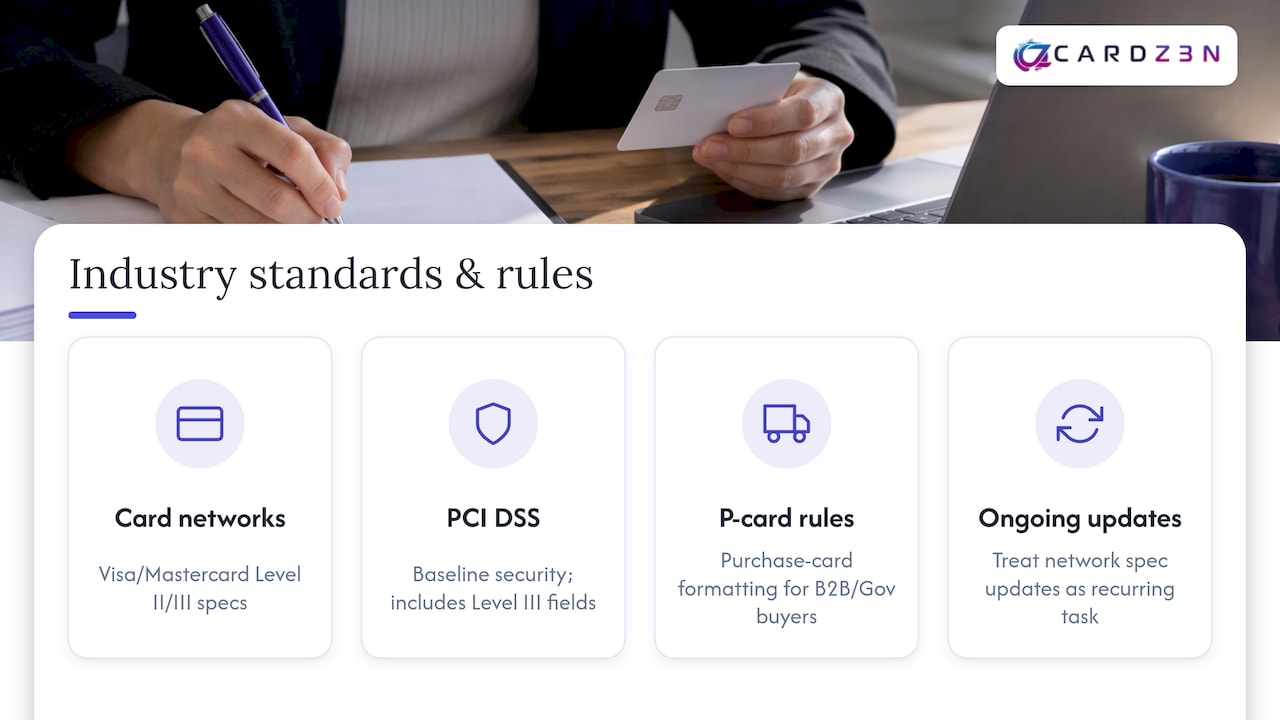
Interchange optimization operates inside rules set primarily by the card networks themselves, not by a single regulatory body. This means field requirements and rate tiers can differ between Visa, Mastercard, and other networks.
Each network publishes its own technical specifications for Level II and Level III data. Processors are responsible for checking that merchant submissions match those specifications before batching for settlement.
PCI DSS compliance is a baseline requirement for any merchant handling card data. That includes the additional line-item fields required for Level III processing, since more data fields in transit mean more surface area to secure. Merchants working with sensitive line-item detail, purchase order numbers, or tax identifiers should confirm that both their gateway and processor maintain current PCI DSS certification.
For B2B and government-facing transactions, additional formatting rules often apply around purchase card (P-card) programs. Many government and large enterprise buyers require these programs as a condition of doing business. They have their own data requirements layered on top of standard Level III fields.
Structured data standards like LEI (Legal Entity Identifier) and purpose codes are becoming more relevant for cross-border B2B payments. Some enriched-data implementations now include them. Regulators and banks want clearer visibility into transaction purpose.
Merchants processing B2B or B2G volume should treat network specification updates as a recurring compliance task, not a one-time setup step. Field requirements are revised periodically. An outdated integration will start generating downgrades without any obvious error on the merchant’s end.
Concrete public case studies with verified savings figures for interchange optimization are not widely published by name. Most merchants treat their processing rates and cost structures as confidential.
What is publicly documented is the mechanism. Businesses that shifted B2B invoice and procurement transactions from standard-rate processing to Level III submission generally saw a portion of that qualifying volume move to lower-cost tiers. This is based on the field requirements networks publish.
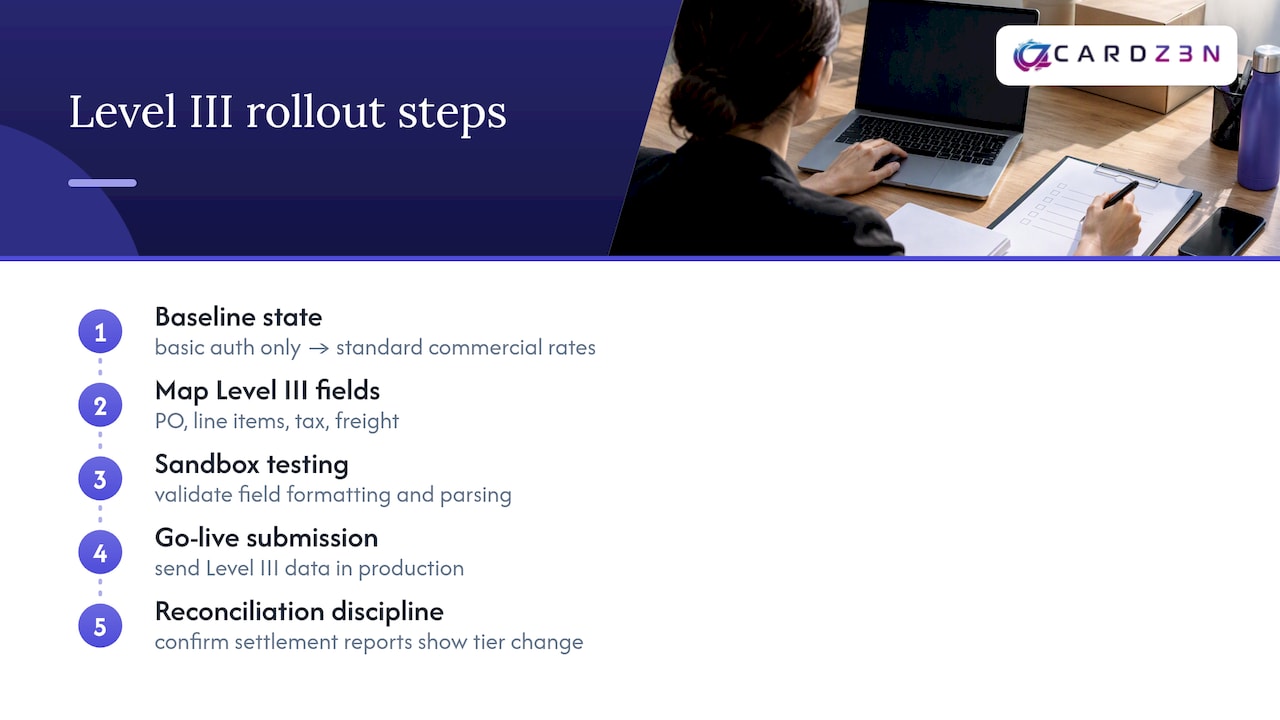
A representative pattern looks like this. A B2B distributor processes purchase-order-based invoices through a standard card-not-present gateway. It submits only basic authorization data, so every transaction settles at standard commercial card rates regardless of size.
The distributor then maps purchase order number, line-item product codes, tax amount, and freight charges into the gateway’s Level III fields. After testing the submission in a sandbox environment, a meaningful share of that same invoice volume becomes eligible for Level III rates instead.
The operational lesson from this kind of rollout is consistent. The technical integration is usually the easy part. The harder part is reconciliation discipline. You must confirm through settlement reports that the rate tier actually changed. It must not silently downgrade because of a field formatting issue introduced during testing.
Merchants that skip the reconciliation step after go-live tend to discover downgrades months later. By then, the settlement variance has already built up across a large transaction volume.
Visa and Mastercard both support enhanced data submission for Level II and Level III qualification. The technical path and field specifications differ between them. A merchant integrating with both networks needs separate field mapping for each.
Visa’s Intelligent Data Exchange is built specifically around card-not-present authorization enrichment. It lets third-party providers pass enhanced data to issuers ahead of the authorization decision. This is distinct from, and complementary to, standard Level III line-item submission. IDX operates earlier in the transaction flow. It focuses on improving the approval decision, not only the interchange rate.
Mastercard’s approach is described in its own guidance on enriched and structured data. It combines line-item detail with structured identifiers like LEI and purpose codes. It positions the enrichment as a reconciliation and risk-context benefit as much as a pure rate-qualification tool.
In practice, a merchant accepting both networks cannot assume one integration covers both. Field names, required formats, and qualification logic need to be validated separately against each network’s current specification.
Testing should also confirm that a transaction routed through Visa and the same transaction type routed through Mastercard both reach their enhanced tiers. One network should not default to standard rates while the other succeeds.
For merchants that mainstream processors decline, interchange optimization only matters once you have stable processing in place. That is where multi-bank sponsor support and transparent reserve terms come first. Once approved, prioritize high-ticket invoices and recurring B2B flows for Level III mapping, since those transactions carry the most potential savings. Pair API-level data submission with daily reconciliation rather than weekly, especially at higher volume.
— Joshua Benedetti
Your business may handle B2B invoicing, government contracts, or high-ticket recurring billing, and mainstream processors may have made approval difficult. If so, CARDZ3N’s high-risk merchant account services are built around that exact profile.
CARDZ3N supports Level 2 and Level 3 data processing alongside B2B and B2G payment integrations, ACH and eCheck processing, and virtual terminal access for invoice-heavy operations.
If downgrades or reconciliation variance are eating into your processing savings, chargeback and dispute management support can help. It can address the settlement-side issues that compound alongside interchange problems.
Reach out when your transaction volume, high-risk classification, or need for multi-rail approval resilience means a generalist processor is not the right fit. Start at Cardz3n to talk through your current setup and where Level III qualification could apply.
Interchange fees are set by the card networks. The merchant’s bank pays them to the cardholder’s issuing bank on each transaction. So issuing banks receive this revenue, not the merchant’s processor.
The amount depends on the transaction’s rate tier. That is exactly what interchange optimization through Level II/III data is designed to lower.
A common example is a business paying a supplier invoice by commercial card. If the transaction includes only basic card data, it settles at a standard commercial rate. If it includes structured Level III fields like line-item detail, tax amount, and purchase order number, it can qualify for a lower Level III rate instead. The card networks publish the required fields for that reclassification.
Interchange rates reflect the risk and cost the issuing bank takes on for that transaction category. Transactions with less data attached default to the network’s standard risk-based tier. They do not get a lower, more informed tier. Submitting enriched data through mechanisms like Visa’s enhanced-data infrastructure gives issuers more context. That can support qualification for a lower rate.
Interchange rates vary by card type, network, and transaction category. There is no single fixed answer. Rewards and commercial cards generally carry higher standard rates than basic consumer cards. The card network sets the specific rate for any transaction. Confirm it on your processor’s current rate sheet rather than assuming it from a general rule.
Every merchant's processing setup is different, so the right answer depends on your industry, sales channels, average ticket size and chargeback history. CARDZ3N's payments specialists review those details with you and match your business with the right sponsor bank, gateway and risk tools, whether you sell online, in store, by invoice or on a recurring subscription.
We work with merchants across the USA, Canada, the UK and the EU, including high-risk, B2B and fast-growing businesses that traditional processors often turn away. If you would like a second opinion on your current rates, contract terms or approval options, contact our team for a free, no-obligation processing review.
Joshua Benedetti is the CEO of CARDZ3N, a Las Vegas-based merchant services provider specializing in high-risk payment processing and B2B payment technology.
Joshua Benedetti on LinkedInCARDZ3N Inc is headquartered in Las Vegas, Nevada, and provides merchant services to businesses that traditional processors turn away. Backed by top-tier sponsor banks and processors, CARDZ3N combines institutional stability with the speed of a specialized team that understands high-risk industries. Services include high-risk account underwriting and placement, gateway solutions across the major gateway platforms, POS integrations, ACH and check processing, chargeback prevention through ChargebackZ3N, and business lending and working capital. Its AerospacePay division serves OEMs, MROs, FBOs, and repair stations with B2B and B2G payment processing. CARDZ3N serves merchants in the USA, Canada, the UK, and the EU.
Start protecting your revenue from chargebacks today — schedule your complimentary consultation with CARDZ3N’s dispute management specialists.