

 CARDZ3N — Home
Contact us today for personalized advice and strategic solutions tailored to your goals.

Call us
+1 (702)-623-3528












A managed PayFac program lets a software platform or marketplace offer embedded payments to its customers without becoming a registered payment facilitator itself. The provider supplies the sponsor-bank relationship, card-network registration, underwriting, risk monitoring and compliance infrastructure. Your platform keeps the customer relationship, the checkout experience and the share of payment revenue. For ISVs, SaaS platforms and B2B marketplaces, it is the most direct path to payments revenue, and it is the model our ISV Embedded Payments and Payfac Solutions are built around.
This guide explains how a managed program works end to end, what it costs compared with building your own, which responsibilities move to the provider, which stay with you, and how Visa’s recent rule changes affect the decision.
A payment facilitator (PayFac) is a company that holds one master merchant account with an acquiring bank and onboards many smaller businesses beneath it as sub-merchants. Those sub-merchants do not each apply for their own merchant account. The PayFac is the party the card networks see, and it is responsible for the sub-merchants it signs.
Being a registered PayFac is a heavy undertaking. Bain & Company’s 2022 brief on integrated payments lists the requirements: an agreement with a sponsoring merchant acquirer, card-network registration, PCI DSS compliance, and in some cases a money-transmitter or equivalent license, plus annual costs for network registration and validation.
A managed PayFac program, also sold as PayFac-as-a-Service or managed payment facilitation, hands most of that machinery to a specialist. To your customers you look like the payments provider. Behind the scenes, the provider carries the registration, the bank relationship and the regulatory infrastructure.
The terms get mixed up, so here is a working distinction:
| Model | Who is the registered PayFac | Who carries underwriting and compliance | Typical fit |
|---|---|---|---|
| Managed PayFac / PayFac-as-a-Service | The provider | The provider, with your platform’s branding and workflow on top | Platforms that want payments revenue and control of the experience without a compliance build |
| Registered PayFac | Your platform | Your platform | Very large volume, with a risk and compliance team to run it |
| ISO / referral model | Neither; merchants hold their own accounts | Each merchant’s acquirer | Platforms that only want a referral commission |
Our own breakdown of the ISV and PayFac embedded payments models goes deeper on where each one fits.
The sequence is the same in most managed programs. What differs is how much of it is automated and who answers when something breaks.
A new customer of your platform completes a payments application inside your product. The data collected typically covers the legal entity, ownership, business type, expected volume, average ticket and a bank account for deposits. Because the customer boards under the program’s master account, the process is built to be faster than a standalone merchant application. This is the main reason platforms choose the model: activation happens inside your product, not on a separate bank form.
Before a sub-merchant can transact, it is screened: identity and beneficial ownership checks, sanctions and watchlist screening, business verification, and a review of the merchant category and what it sells. The PayFac is financially liable for each sponsored merchant’s transactions and disputes under Visa’s acquirer risk standards, so this step decides how much risk your portfolio carries.
In a managed program the provider runs the policy and decisioning. Your platform’s job is to supply accurate data and route edge cases.
Each payment carries identifiers for both the PayFac and the sponsored merchant. Visa’s standards require unique PayFac and sponsored-merchant identifiers on every transaction, and registration confirmed by Visa before transactions flow. Your platform’s gateway connection or API sends the authorization, and the provider’s processing stack handles routing through the card networks.
Funds settle to the master account and are then paid out to each sub-merchant. Because the program touches the money flow, it can support payout timing, split payments, held-back funds and reserve rules. Bain notes that a PayFac or PayFac-alternative route is the right one when your product’s value depends on better underwriting or on controlling money flows, for example to hold back settlement, split payments or offer adjacent financial services such as merchant cash advances (Bain, 2022).
Sub-merchant chargebacks flow up to the PayFac. A managed program monitors dispute ratios, flags outliers and manages representment so that one bad merchant does not threaten the whole portfolio. We cover this in detail below, because Visa changed the thresholds recently.
The most common mistake in evaluating a managed PayFac program is assuming everything transfers. Compliance infrastructure does. Your product, support and customer experience do not.
| Area | Provider takes on | Your platform keeps |
|---|---|---|
| Sponsor bank and network registration | Relationship, registration, ongoing network obligations | Choosing a provider whose bank relationships are stable |
| Underwriting policy | KYC, sanctions screening, risk decisions | Supplying clean applicant data, deciding which customer segments you serve |
| PCI DSS scope | Secure processing environment | Keeping card data out of your own systems by using hosted fields or tokenization |
| Chargebacks and disputes | Monitoring, representment support | Clear billing descriptors, cancellation flows, customer communication |
| Settlement and payouts | Funds flow, reconciliation tooling | Payout experience, pricing to your customers |
| Customer relationship | Back-end support | Branding, onboarding UX, first-line support |
That last column is the strategic point. You are not outsourcing your customer; you are outsourcing the regulated back end beneath it.
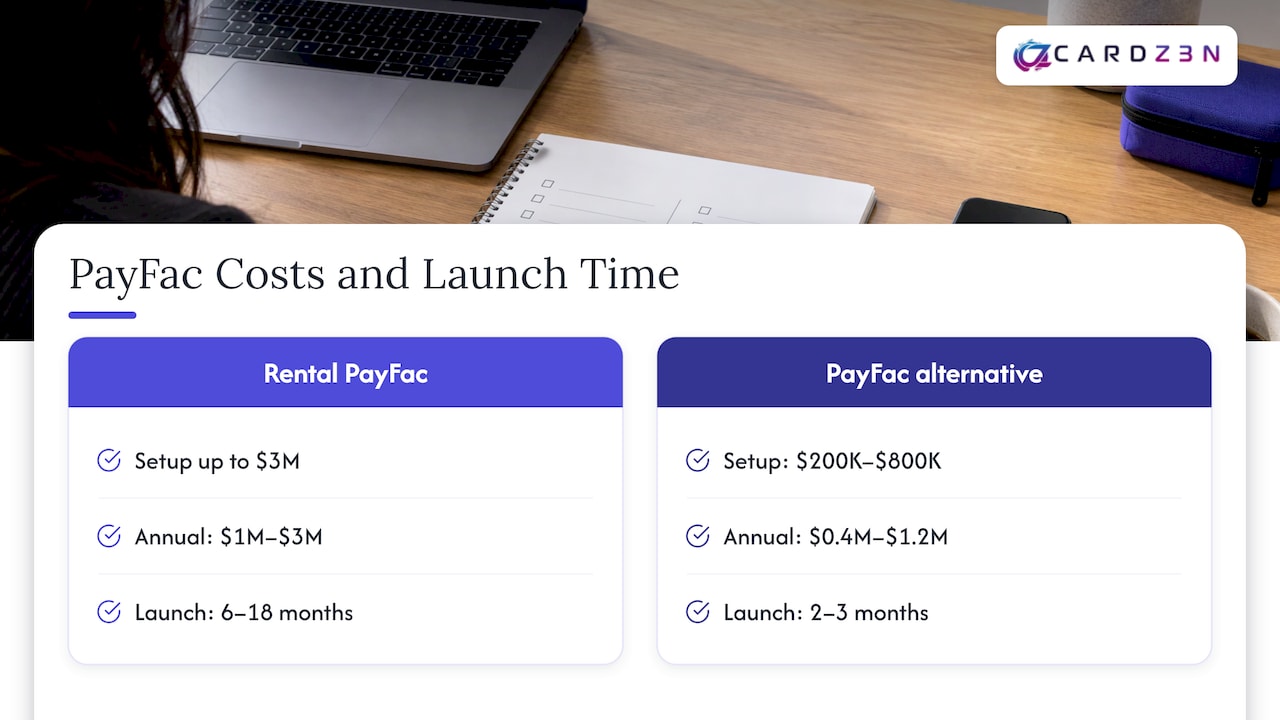
Bain’s August 2022 analysis compares the models by total cost of ownership. A “rental” PayFac, where a platform runs its own program on borrowed infrastructure, can require up to $3 million in setup plus $1 million to $3 million a year, and can take 6 to 18 months to become operational. A payfac-alternative model with limited responsibilities is cheaper: $200,000 to $800,000 up front and $0.4 million to $1.2 million annually, with launches taking two to three months.
Staffing follows the same curve. Per Bain, platforms starting in a payfac-alternative model need a team of 3 to 8 people across product, engineering, operations, support and risk, growing to more than 10 full-time employees to cover all PayFac responsibilities once a program is running.
A managed program is designed to cut that burden, because the provider’s team and systems are already in place. Specific fees are quote-based and depend on your volume, merchant mix and integration; we publish no price list, and our quotes spell out reserve structures and pricing terms rather than leaving them vague.
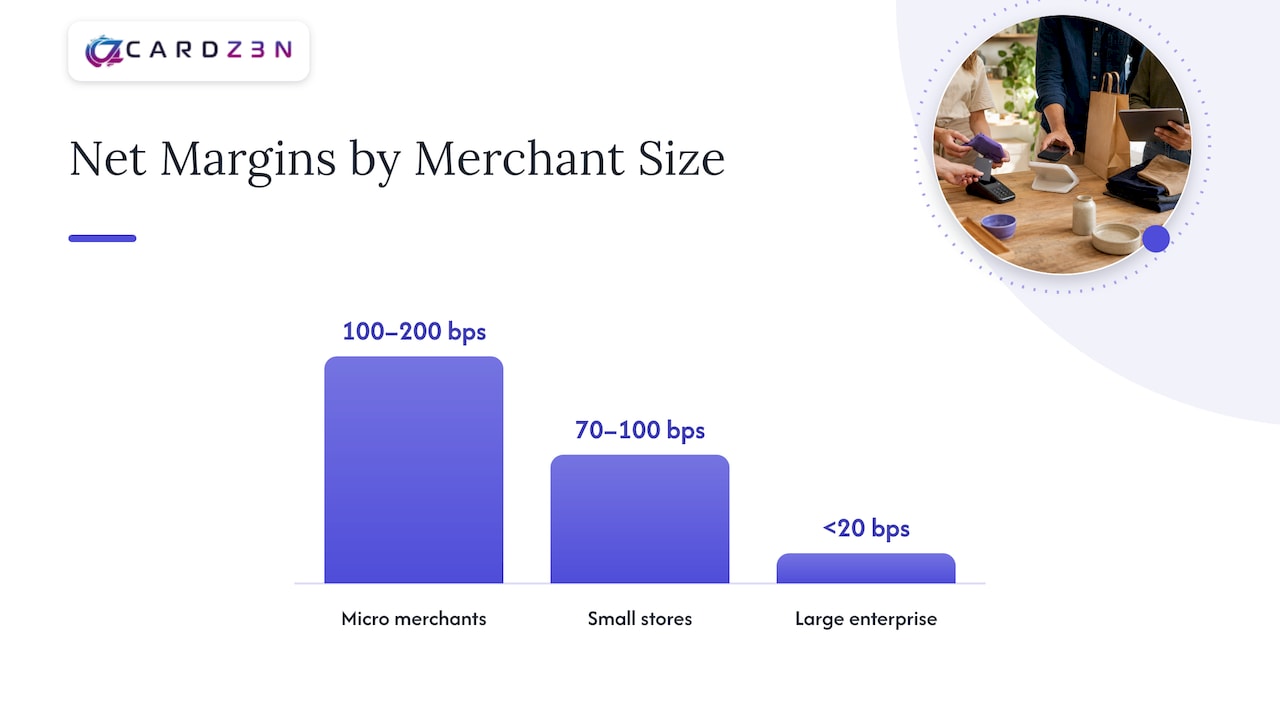
Before any provider conversation, test whether payments revenue pays for the work. Bain’s figures on net margin show it shrinks as merchants get larger: micro merchants may yield 100 to 200 basis points of spread, small stores or restaurants 70 to 100 bps, and large enterprise clients under 20 bps. The same brief gives a worked case: a $100 onboarding cost on a merchant generating 100 bps on $3,000 of annual card volume with a three-year life does not break even.
The lesson is concrete. Automated, low-touch onboarding is what makes small-ticket merchants profitable, and a managed program with a streamlined application is built to keep that per-merchant cost down. Do the math with your own average annual card volume per customer and the onboarding minutes your team spends today.
You do not need to memorize network rules, but you should know the ones that determine how a provider will treat your portfolio.
The change with the biggest day-to-day effect is the Visa Acquirer Monitoring Program (VAMP). Per Visa’s standards, from April 2025 PayFacs are monitored at the acquirer level, with a 0.50% excessive dispute-ratio threshold carrying monthly fines of $25,000 to $100,000 or more. An above-standard tier of 0.30% to 0.50% applies from January 1, 2026. Merchant-level excessive thresholds moved to 1.5% on June 1, 2025 and to 0.9% in North America on April 1, 2026.
For a platform, the implication is that one sub-merchant with a runaway dispute rate can raise the whole program’s ratio. That is why monitoring, early alerts and representment belong in the program from day one. Our guide to how VAMP replaced VFMP and VDMP explains the ratio mechanics, and ChargebackZ3N-backed chargeback management covers prevention and dispute representment for the merchants you board.
Use criteria that tie to the responsibilities above. A good provider should be able to answer each one in writing.
Managed programs suit platforms where payments are a feature of a larger product rather than the product itself: vertical SaaS, field-service and billing software, marketplaces, membership and subscription platforms, and B2B procurement tools. They are particularly useful when your customer base includes merchants that mainstream processors tend to refuse. That is a core part of our work, from high-risk merchant accounts to B2B and B2G payment processing with ACH and Level 2 and 3 data.
If you are weighing referral commissions against owning more of the payments stack, our analysis of the ISO versus PayFac decision point for SaaS walks through the volume threshold where the economics change.
We built our approach on a simple observation: platforms rarely fail at payments because the idea was wrong. They fail because the regulated back end, meaning underwriting, reserves, dispute ratios and bank relationships, consumed the roadmap.
A managed PayFac program should take that burden off you without taking control of your customer. That is why we offer ISV embedded payments and PayFac solutions backed by top-tier sponsor banks, with hands-on underwriting support and multi-bank, multi-rail approval resilience.
We are also a specialist in the merchants others turn away. If your customers include CBD, subscription, nutraceutical or other high-risk businesses, you need a provider that understands those industries inside and out and tells you plainly how reserves and pricing work. Our terms are quote-based and transparent, so you can model your margin before you launch.
With VAMP now monitoring PayFacs at the acquirer level, dispute prevention is no longer a back-office extra. It is part of protecting every merchant on your platform, and we treat it that way.
Joshua Benedetti
If you run a SaaS platform, marketplace or ISV and want to scope an embedded payments program, start with our merchant services and payment processing overview. We will review your merchant mix, volumes and payment methods, and quote the structure, including reserves, in plain terms.
In practice they describe the same arrangement. A provider supplies the registered payment facilitator infrastructure, network registration, underwriting and compliance, while your platform delivers the branded payments experience. Some vendors use “managed” for a more hands-on service and “as-a-Service” for a more self-serve, API-led one, so confirm what is actually included.
Yes, but the scope can be much smaller. PCI DSS is a requirement of a full PayFac, per Bain’s 2022 brief. In a managed program the provider carries the heavy compliance load, and your platform reduces its scope by keeping card data out of your own systems through hosted fields or tokenization.
Bain’s 2022 figures put a rental PayFac at 6 to 18 months to become operational and payfac-alternative launches at two to three months. A managed program is generally closer to the shorter end, though the timeline depends on integration depth and your merchant mix.
When payments are large enough to justify a dedicated risk and compliance team. Bain describes teams growing to more than 10 full-time employees for full PayFac responsibilities, so the case rests on volume and margin. We cover that threshold in our ISO versus PayFac guide.
It can when the provider underwrites those verticals. Ask which industries are accepted, how reserves are structured and how dispute ratios are monitored. We specialize in merchants that mainstream processors reject or freeze, so high-risk segments are part of how we design programs.
Every merchant's processing setup is different, so the right answer depends on your industry, sales channels, average ticket size and chargeback history. CARDZ3N's payments specialists review those details with you and match your business with the right sponsor bank, gateway and risk tools, whether you sell online, in store, by invoice or on a recurring subscription.
We work with merchants across the USA, Canada, the UK and the EU, including high-risk, B2B and fast-growing businesses that traditional processors often turn away. If you would like a second opinion on your current rates, contract terms or approval options, contact our team for a free, no-obligation processing review.
Joshua Benedetti is the CEO of CARDZ3N, a Las Vegas-based merchant services provider specializing in high-risk payment processing and B2B payment technology.
Joshua Benedetti on LinkedInCARDZ3N Inc is headquartered in Las Vegas, Nevada, and provides merchant services to businesses that traditional processors turn away. Backed by top-tier sponsor banks and processors, CARDZ3N combines institutional stability with the speed of a specialized team that understands high-risk industries. Services include high-risk account underwriting and placement, gateway solutions across the major gateway platforms, POS integrations, ACH and check processing, chargeback prevention through ChargebackZ3N, and business lending and working capital. Its AerospacePay division serves OEMs, MROs, FBOs, and repair stations with B2B and B2G payment processing. CARDZ3N serves merchants in the USA, Canada, the UK, and the EU.
Start protecting your revenue from chargebacks today — schedule your complimentary consultation with CARDZ3N’s dispute management specialists.