

 CARDZ3N — Home
Contact us today for personalized advice and strategic solutions tailored to your goals.

Call us
+1 (702)-623-3528










A payment facilitator (PayFac) onboards merchants under one master account it controls, while an independent sales organization (ISO) sets up a dedicated merchant account for each business through a sponsoring bank. PayFacs win for platforms and SaaS products that need instant, embedded onboarding; ISOs win for higher-volume merchants who want negotiated rates and a hands-on account manager. The right call depends on your onboarding speed needs, your appetite for compliance overhead, and how much control you want over the payment experience.
A PayFac holds a single master merchant account with a sponsor bank and card networks, then onboards individual businesses as submerchants underneath it. When a submerchant signs up, it doesn’t get its own standalone merchant ID. It gets a slot inside the PayFac’s account, which is why activation can happen in minutes instead of days. Stripe’s own comparison of the two models confirms this master account structure is the defining trait that separates PayFacs from ISOs.
Running that master account comes with real operational weight. The PayFac, not the sponsor bank, owns the day-to-day compliance work for every submerchant it boards. That includes:
This model fits embedded marketplaces, gig platforms, and SaaS tools selling to small merchants who need to start taking payments the same day they sign up. Pricing tends to run flat or blended, since the PayFac needs a simple rate structure it can apply uniformly across thousands of small accounts. Becoming a registered PayFac also means clearing scheme-level approvals with Visa and Mastercard, a signal that carries real weight with sponsor banks and processors evaluating whether a platform is ready for that responsibility.
An ISO acts as a registered agent of a sponsor bank, setting up a dedicated merchant account for each business it signs. Unlike a PayFac’s shared master account, every ISO-boarded merchant gets its own merchant ID, its own underwriting file, and its own standing with the card networks. Stripe’s breakdown of payment processors versus ISOs lays out this agent relationship clearly: the ISO sells and services the account, but the sponsor bank remains the actual party of record with the card networks.
ISOs typically bundle in services that go beyond payment processing itself:
The merchant profile that benefits most here is the business with real transaction volume. A regional retail chain, a multi-location restaurant group, or a high-ticket B2B seller has enough leverage to negotiate rates that beat flat blended pricing. Underwriting and reserve requirements under the ISO model sit with the sponsor bank, not the ISO itself, though the ISO manages the relationship and often influences the underwriting conversation on the merchant’s behalf.
The theory behind PayFac and ISO models matters less than what happens on a Tuesday morning when a new merchant needs to start processing. Here’s where the practical differences show up:
Four factors decide whether the PayFac or ISO model wins for a given business, and they rarely point the same direction at once.
Pricing is the most visible difference. PayFacs generally run flat or blended pricing because it has to scale across thousands of dissimilar submerchants without manual rate-setting for each one. Wise’s comparison of the two models notes that ISOs typically offer more negotiable structures like interchange-plus, and that advantage only pays off once volume is high enough to justify the negotiation. A merchant processing $50,000 a month rarely has leverage to beat a PayFac’s blended rate. A merchant processing $2 million a month almost always does.
Risk allocation follows the account structure. Under a PayFac, the PayFac itself holds underwriting responsibility and absorbs losses from submerchant fraud or business failure, which is exactly why PayFacs lean on reserves and tighter monitoring. Under an ISO, the sponsor bank holds that underwriting risk directly, with the ISO managing the relationship but rarely carrying the loss itself. Chargeback exposure lands wherever the underwriting sits.
Control and data access cut in favor of PayFacs for any business building a product around payments. Owning the master account means owning the checkout experience, the reporting layer, and the ability to layer in embedded finance features like instant payouts, lending, or working capital advances tied directly to processing data. ISO merchants get a functional payment experience but almost no ability to reshape it around their own product.
Scalability depends on what you’re scaling. PayFacs handle high submerchant count well, onboarding thousands of small accounts without linear increases in manual work. ISOs handle high transaction volume per merchant well, since the pricing and account structure reward concentration rather than breadth. International expansion complicates both: PayFacs often need separate registrations and banking relationships per region, while ISO merchants inherit whatever cross-border capability their sponsor bank already has.
Pro Tip: Run the math on blended PayFac pricing against your actual interchange costs before assuming a dedicated merchant account saves money. Below roughly $500,000 in annual volume, the negotiation leverage an ISO offers usually isn’t enough to beat a well-priced PayFac’s flat rate.
Work through this checklist before committing engineering time or signing a contract:
A few red flags mean you’re better off partnering with an ISO or using PayFac-as-a-Service rather than building a PayFac from scratch:
PayFac-as-a-Service exists precisely for platforms that want the product benefits of embedded payments, faster onboarding, payout control, branded checkout, without carrying the scheme registration and compliance burden themselves. It’s worth running a short gap analysis: compare your current compliance capacity, your data and reporting needs, and your revenue targets against what a full PayFac buildout would actually cost in headcount and time.
This analysis draws on payments industry underwriting standards, sponsor bank practices, and Experience placing high-risk merchant accounts and building gateway integrations across major platforms like NMI, Fluidpay, Authorize.Net, USAePay, and Valor PayTech.
Some business types make the DIY PayFac math especially hard: high-risk verticals with elevated chargeback exposure, B2B and B2G sellers with long sales cycles and complex invoicing, and aerospace suppliers navigating MRO and FBO compliance requirements. For these, a partner with existing sponsor bank relationships beats building underwriting infrastructure from zero.
Before choosing a partner, evaluate:
If you’re weighing a suitability review against your own volume, risk profile, and integration needs, that’s a conversation worth having before you commit engineering resources either way.
The conventional advice treats ISO vs PayFac like a binary product decision. It isn’t. Most SaaS platforms I’d point toward this analysis don’t actually need to become a registered PayFac to get the product benefits they’re chasing, embedded checkout, branded payout experiences, payment data feeding into their own analytics. They need a partner who gives them that experience without the eighteen-month compliance buildout.
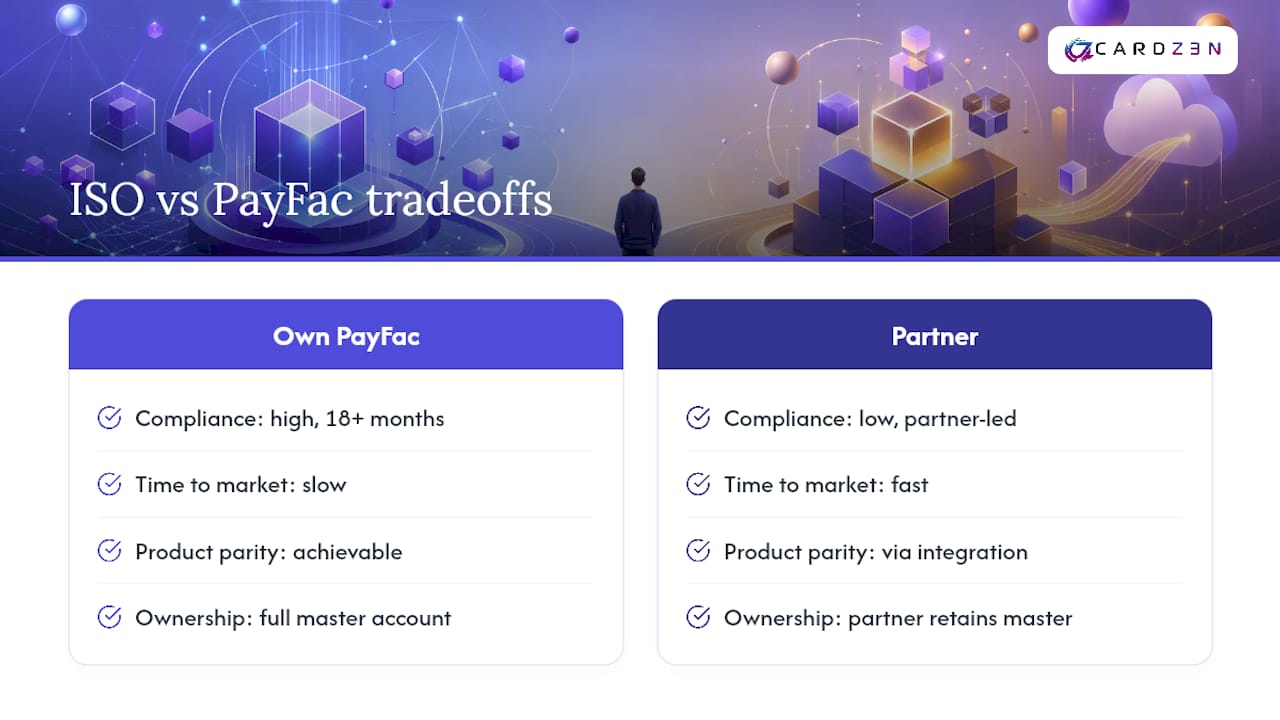
What’s overrated in this space is the idea that owning the master account is inherently more “strategic.” Ownership only pays off once your submerchant volume justifies the compliance headcount, and most platforms underestimate that threshold badly. What’s underrated is how much leverage a well-structured ISO relationship or PayFac-as-a-Service arrangement gives a growing platform, especially one still validating product-market fit.
Prioritize this: map your actual submerchant economics before you map your org chart. The structure should follow the volume, not the ambition.
— Joshua Benedetti
Whether you need a high-risk merchant account placed, a gateway integration built into your platform, or embedded payments support for your ISV product, some providers handle the underwriting relationships and technical integration work so you don’t have to build a PayFac compliance team from scratch. That’s the practical alternative to the multi-month self-registration path: sponsor bank access and gateway integration experience without carrying the scheme approval burden yourself. If you’re an ISV weighing embedded payments against a traditional merchant account setup, CARDZ3N’s ISV payment processing team can walk through your integration options directly. For businesses that need a high-risk merchant account placed with underwriting that actually understands your industry, reach out for a suitability review before you commit to either path.
For deeper technical detail, Stripe’s PayFac versus ISO comparison and PaymentsJournal’s analysis of the PayFac growth model for ISVs cover the structural and strategic angles well. DevProJournal’s rundown of PayFac advantages is worth reading before any registration decision, and Mavericks Office Solutions’ PCI compliance guide covers the security groundwork either model requires.
A payment service provider (PSP) is a broad term for any company that processes payments on a merchant’s behalf, while a PayFac is a specific PSP structure built around a master merchant account with submerchants underneath it.
Stripe operates as a PayFac, aggregating merchants under its own master account and handling their underwriting, risk monitoring, and payout orchestration directly.
Businesses typically compare processors and platforms across pricing structure, onboarding speed, underwriting flexibility, and integration depth rather than a fixed “top five” list, since the right fit depends heavily on merchant volume and risk category.
ISO 20022 is a global messaging standard for financial transactions, unrelated to independent sales organizations. It gives banks a common format for payment messages, which improves cross-border processing accuracy but has no direct bearing on the ISO vs PayFac merchant account decision.
Most growing SaaS platforms benefit more from partnering with an established provider or using PayFac-as-a-Service, since the compliance staffing and scheme registration burden of building a PayFac from scratch rarely pays off until submerchant volume is substantial.
Every merchant's processing setup is different, so the right answer depends on your industry, sales channels, average ticket size and chargeback history. CARDZ3N's payments specialists review those details with you and match your business with the right sponsor bank, gateway and risk tools, whether you sell online, in store, by invoice or on a recurring subscription.
We work with merchants across the USA, Canada, the UK and the EU, including high-risk, B2B and fast-growing businesses that traditional processors often turn away. If you would like a second opinion on your current rates, contract terms or approval options, contact our team for a free, no-obligation processing review.
Joshua Benedetti is the CEO of CARDZ3N, a Las Vegas-based merchant services provider specializing in high-risk payment processing and B2B payment technology.
Joshua Benedetti on LinkedInCARDZ3N Inc is headquartered in Las Vegas, Nevada, and provides merchant services to businesses that traditional processors turn away. Backed by top-tier sponsor banks and processors, CARDZ3N combines institutional stability with the speed of a specialized team that understands high-risk industries. Services include high-risk account underwriting and placement, gateway solutions across the major gateway platforms, POS integrations, ACH and check processing, chargeback prevention through ChargebackZ3N, and business lending and working capital. Its AerospacePay division serves OEMs, MROs, FBOs, and repair stations with B2B and B2G payment processing. CARDZ3N serves merchants in the USA, Canada, the UK, and the EU.
Start protecting your revenue from chargebacks today — schedule your complimentary consultation with CARDZ3N’s dispute management specialists.