


 CARDZ3N — Home
Contact us today for personalized advice and strategic solutions tailored to your goals.

Call us
+1 (702)-623-3528







A PayFac and an ISV are not two competing products. An ISV is a software company that builds the application. A payment facilitator (PayFac) is a registered payments entity that onboards sellers as sub-merchants and receives their settlement. The real question is whether your software company should stay an ISV that refers payments to a partner, or take on PayFac responsibilities to own the payment flow and its economics. The answer turns on payment volume, risk appetite and how much payments operations you are willing to staff.
This guide covers the definitions, who carries underwriting, compliance and chargeback risk, how revenue share works, and a practical way to choose.
Visa defines a payment facilitator as a third-party agent that signs a merchant acceptance agreement on behalf of an acquirer, or receives settlement proceeds on behalf of a seller. It must partner with an acquirer that meets Visa’s minimum equity requirements. In practice, the PayFac holds one master merchant relationship with the acquirer and sponsor bank, and its customers are sub-merchants under that umbrella.
An independent software vendor (ISV) sells software, often vertical SaaS for restaurants, clinics, field services, property managers or membership businesses. Payments are a feature. How the ISV handles that feature falls on a spectrum:
So “PayFac vs. ISV” really compares a position on that spectrum, not two business types. Many PayFacs started life as ISVs.
| Responsibility | Referral or integrated ISV | Managed PayFac | Full PayFac |
|---|---|---|---|
| Merchant agreement holder | Processor or acquirer | Partner PayFac (sub-merchant model) | Your company |
| Sub-merchant underwriting | Partner | Partner, with your input on criteria | You, within sponsor bank limits |
| KYC/KYB and AML program | Partner | Mostly partner | You |
| Chargeback and fraud exposure | Limited, mostly partner | Shared, often passed to you by contract | You |
| Control of onboarding experience | Low | High | Highest |
| Share of payment economics | Smallest | Mid to high | Highest, after costs |
| Time to launch | Fastest | Weeks to months | Longest |
The contractual details vary by partner, so treat the table as the typical shape of each model and read the agreement for your own terms.
This is where the models separate most sharply.
A PayFac must be registered with the card networks and follow their operating rules. It also needs a sponsor bank that holds its funds and carries key compliance risks. The bank underwrites the PayFac itself and holds it liable for sub-merchant losses, while the PayFac underwrites and monitors the sub-merchants beneath it.
That means your team owns:
On the compliance side, PayFacs carry PCI scope as Level 1 service providers and must maintain an AML/BSA program, whereas ISVs that are not PayFacs are generally not responsible for AML/BSA and their PCI scope depends on how they integrate. Treat these as the questions to take to your counsel and sponsor bank before committing.
The ISV bears no financial risk for the payment service under a referral arrangement, but also has no control over customer onboarding or the payment experience. That lack of control can create friction with customers and pushes them to look for software that has payments built in. Flagship’s analysis adds that software providers with embedded payments gain a competitive advantage over those without.
The same Flagship paper describes how an ISV can use a managed PayFac: onboarding runs through payment forms and payouts through APIs or pre-built tools. The payment service provider acts as merchant of record and absorbs losses from fraudulent merchants, while the software provider can still bear chargeback risk and costs from its own customers. A hybrid PayFac registers with the networks, uses an enabler for back-office tooling, and staffs its own underwriting and support.
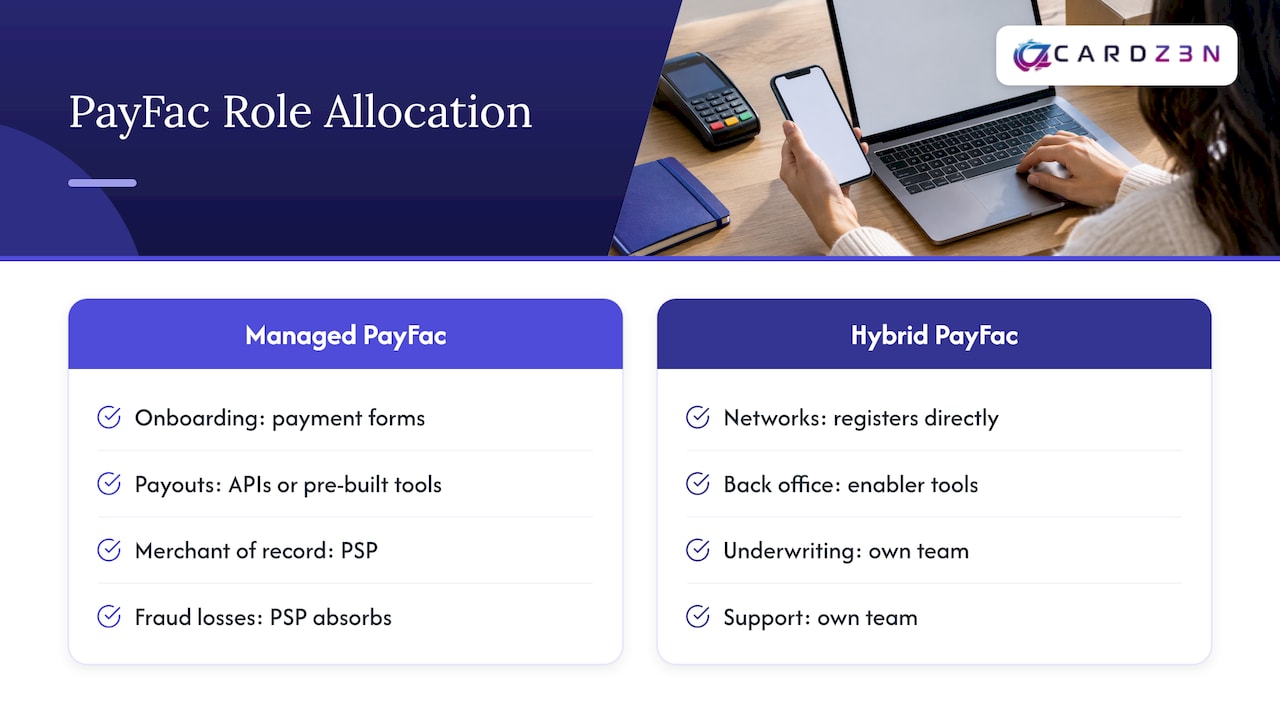
The lesson: read the chargeback and loss-allocation clauses line by line. “Managed” does not always mean “risk-free.”
Visa rules in the U.S. also cap what a PayFac can carry on its own paper. If a sponsored merchant’s annual Visa sales exceed $1 million, the acquirer must be added to the merchant acceptance agreement, and the PayFac may continue servicing the merchant. Edgar Dunn’s overview describes the same threshold, noting the PayFac can keep processing transactions and receiving settlement. For platforms serving larger merchants, this shapes onboarding design from day one.
Revenue share is the main reason ISVs look at payments at all. The structure is simple even if the numbers are not.
Every card transaction carries a stack of costs: interchange paid to the issuer, network assessments, processor and gateway fees, and the sponsor bank’s margin. What the merchant pays above that stack is the spread. Who keeps how much of the spread depends on the model:
What erodes platform earnings:
For the accounting side of recurring revenue and payment-driven income, a guide on bookkeeping for subscription-based business models helps you model how residuals, fees and refunds hit your books. Our own analysis in ISO vs PayFac for SaaS goes deeper on the economics and the decision point by revenue.
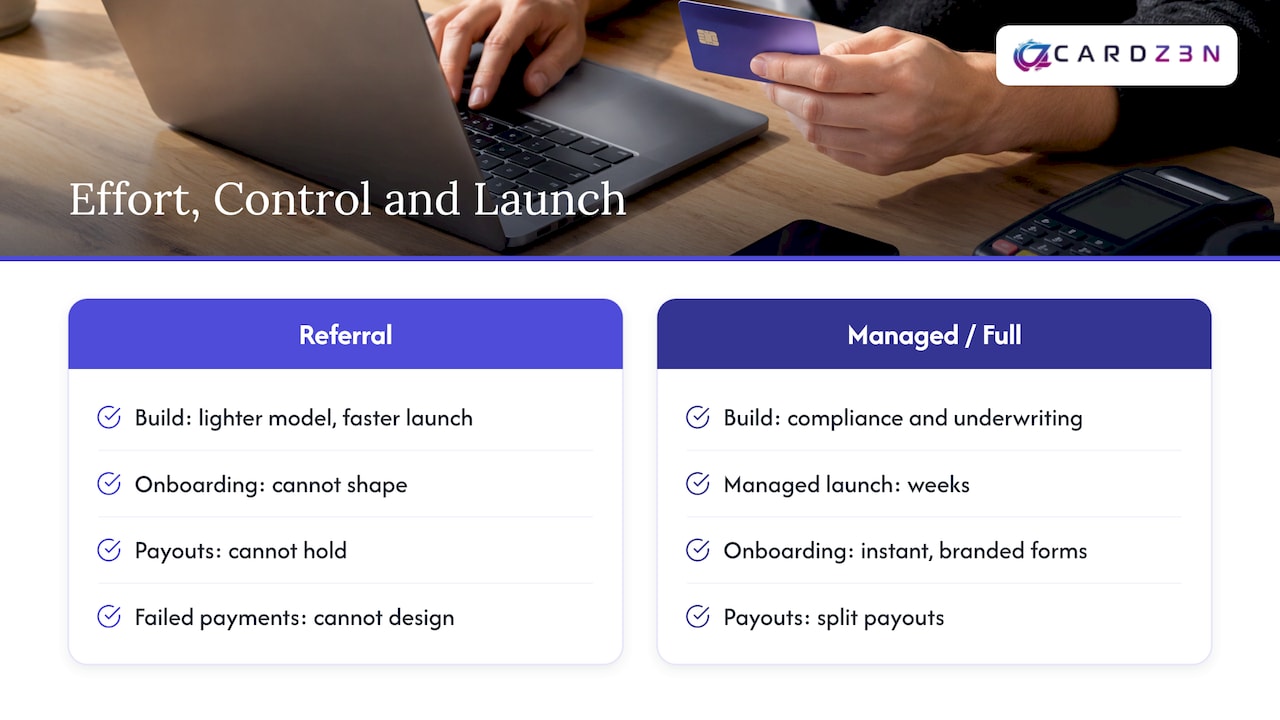
The trade-off is consistent across the industry: lighter models launch faster, while PayFac and managed PayFac routes take on compliance and underwriting but keep more of the economics. Margin Labs makes the same point when comparing ISO and PayFac. Build effort scales with ambition. Managed programs can go live in weeks, while registering directly means network registration, a sponsor bank, a Level 1 PCI assessment, an AML program and a staffed risk team. Expect a long timeline and a substantial budget, and get written quotes from partners and counsel instead of relying on rules of thumb.
Control is the other axis. With a referral, you cannot shape onboarding, hold payouts, or design the failed-payment experience. With a managed or full PayFac you can: instant onboarding, branded payment forms, split payouts, and faster support. For subscription software, that also means you can tackle declines directly. A failed payment recovery playbook is a good place to map retry logic and dunning before you design checkout.
Work through these five questions in order.
Most software vendors that reach the PayFac stage start with a managed model and revisit full registration only when volume and operations justify it. That staged path keeps optionality open.
Whichever path you choose, scoping PCI correctly matters. See our guide on how to avoid PCI scope creep in ISV payment integration.
Most platforms ask us whether they should become a PayFac. The better first question is what happens to your merchants who do not fit the standard underwriting box. Subscription billing, regulated products and high-volume B2B accounts are exactly where referral models and generic PayFacs tend to decline or freeze accounts, and that is where a platform’s customers feel the pain.
We build for that reality. CARDZ3N is a specialist in high-risk and B2B payments, with underwriting support, multiple banking relationships and transparent reserve and quote-based pricing terms. For ISVs, our design goal is embedded payments and PayFac solutions that give you control of the merchant experience without forcing you to build a payments company on day one.
Our advice: choose the model your operations can sustain today, insist on written clarity about reserves, chargeback liability and revenue share, and keep a path open to deepen your ownership as volume grows.
Joshua Benedetti
We offer ISV embedded payments and PayFac solutions, API-based integrations, Level 2 and Level 3 data processing for B2B and government buyers, ACH and eCheck, recurring billing and chargeback management through ChargebackZ3N. If your platform serves merchants that mainstream processors turn away, our high risk merchant account program gives them a place to land. For B2B software, see our B2B and B2G payment processing page, and for dispute handling, our chargeback management services. Pricing is quote-based, so contact us with your volume, verticals and integration needs.
A payment facilitator is a registered entity that signs one merchant relationship with an acquirer and sponsor bank, then onboards many smaller sellers as sub-merchants and receives their settlement. Visa describes it as a third-party agent acting on behalf of an acquirer or receiving settlement for a seller. It takes on underwriting, monitoring and compliance duties for those sub-merchants.
No. An ISV is a software vendor, while a PayFac is a payments role. An ISV may refer payments to a partner, use a managed PayFac, or register as a PayFac itself. Only in the last case does the software company carry the full PayFac obligations.
No. Referral and enhanced-residual models let an ISV earn a share of processing revenue without registration, though the share is usually smaller and you control less of the merchant experience. A managed PayFac sits between the two.
It depends on the contract. Under a managed model the payment provider usually acts as merchant of record and absorbs losses from fraudulent merchants, but the software provider can still bear chargeback costs from its own customers. Review the loss-allocation and reserve clauses before signing.
Every merchant's processing setup is different, so the right answer depends on your industry, sales channels, average ticket size and chargeback history. CARDZ3N's payments specialists review those details with you and match your business with the right sponsor bank, gateway and risk tools, whether you sell online, in store, by invoice or on a recurring subscription.
We work with merchants across the USA, Canada, the UK and the EU, including high-risk, B2B and fast-growing businesses that traditional processors often turn away. If you would like a second opinion on your current rates, contract terms or approval options, contact our team for a free, no-obligation processing review.
Joshua Benedetti is the CEO of CARDZ3N, a Las Vegas-based merchant services provider specializing in high-risk payment processing and B2B payment technology.
Joshua Benedetti on LinkedInCARDZ3N Inc is headquartered in Las Vegas, Nevada, and provides merchant services to businesses that traditional processors turn away. Backed by top-tier sponsor banks and processors, CARDZ3N combines institutional stability with the speed of a specialized team that understands high-risk industries. Services include high-risk account underwriting and placement, gateway solutions across the major gateway platforms, POS integrations, ACH and check processing, chargeback prevention through ChargebackZ3N, and business lending and working capital. Its AerospacePay division serves OEMs, MROs, FBOs, and repair stations with B2B and B2G payment processing. CARDZ3N serves merchants in the USA, Canada, the UK, and the EU.
Start protecting your revenue from chargebacks today — schedule your complimentary consultation with CARDZ3N’s dispute management specialists.