 CARDZ3N — Home
Contact us today for personalized advice and strategic solutions tailored to your goals.

Call us
+1 (702)-623-3528


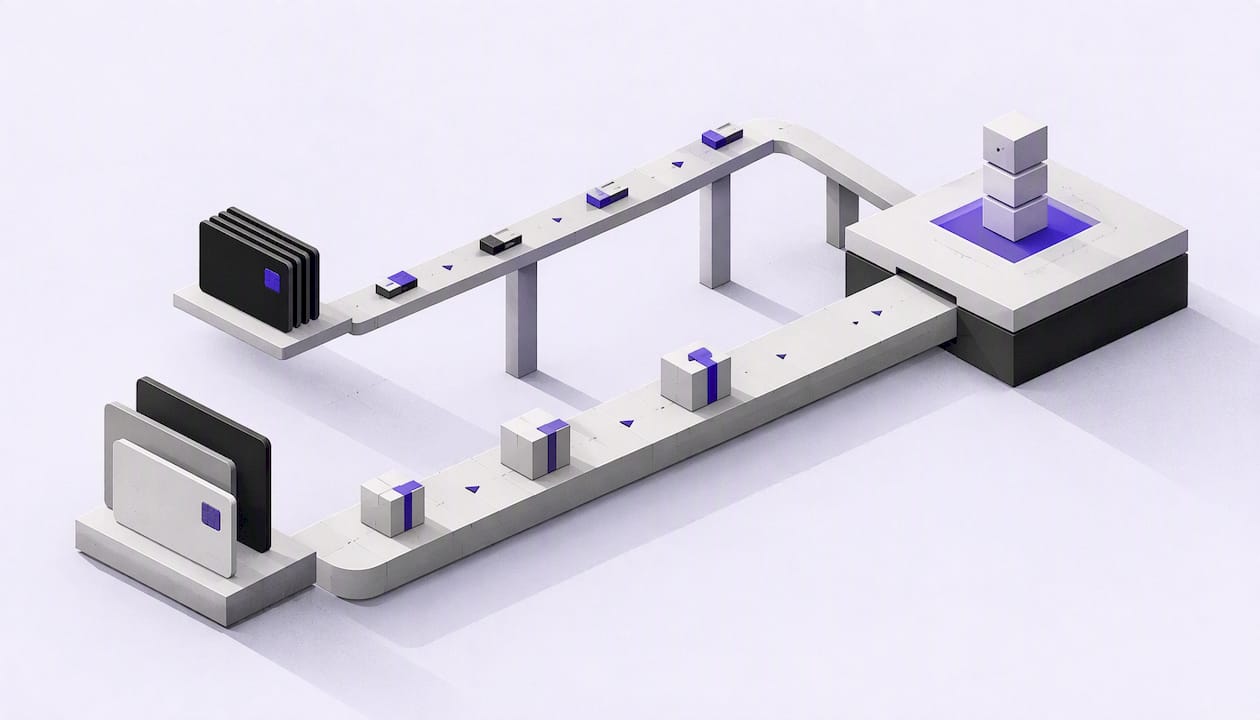




B2B payment processing is the set of systems that move money from one business to another for goods or services: the invoice or order, the authorization of the payment, the clearing and settlement through a card network or bank rail, and the reconciliation in the supplier’s books. The mechanics resemble consumer checkout, but the ticket sizes, payment terms, data requirements and fraud exposure differ enough that a setup built for retail often fails a B2B seller. This guide walks through the rails, the costs, the compliance thresholds and the controls, so you can decide how your business should accept and send payments.
Every B2B payment, whatever the rail, passes through the same stages:
The reconciliation step is why B2B processors compete on data, not just on speed. A payment that clears but cannot be matched to an invoice is a collections problem, not a finished sale.
Businesses use four rails in volume. Each has a different cost, speed, risk and data profile.
| Rail | Typical use | Speed | Main cost driver | Main risk |
|---|---|---|---|---|
| ACH (credit or debit) | Recurring invoices, payroll-adjacent vendor payments, large tickets | Next day, or same day | Low per-item fee | Returns, account takeover, credit-push fraud |
| Credit and purchasing cards | Smaller invoices, buyers who want float or rewards | Authorization in seconds, funding in 1 to 2 days | Interchange plus processor markup | Chargebacks, higher cost on large tickets |
| Check | Legacy buyers, government and some trades | Days to weeks | Handling labor, postage, deposits | Check fraud, loss, slow reconciliation |
| Wire | One-off high-value or urgent payments | Same day | Flat bank fees on both sides | Irreversible once sent |
The Federal Reserve’s payments data puts the total value of U.S. noncash payments at $140.01 trillion in 2024, and ACH accounted for 74% of that value, up from 72% in 2021. Cards, by contrast, made up 79% of noncash payments by count. In plain terms: cards are the rail for frequent, smaller payments, and ACH is the rail for the dollars.
Same Day ACH has become a practical option for urgent invoices. Nacha reports 1.4 billion Same Day ACH payments worth $3.9 trillion in 2025, and it has announced a higher per-payment limit. If you are weighing bank transfers against cards for a small operation, this comparison of ACH and credit card rails covers the basic trade-offs. For the processing side, see our own explanation of 1 to 3 day ACH processing for B2B.
The 2025 AFP Digital Payments Survey found 26% of B2B payments were still made by check in 2025, down from 33% in 2022. If your customers include municipalities, older distributors or contractors, you will still receive checks. Remote check deposit and eCheck conversion reduce the handling cost, but they do not remove the fraud exposure.
Cards make sense when the buyer values the payment float, when the invoice is modest, or when you want to collect at the moment of order instead of chasing net-30 terms. They get expensive on large tickets unless you qualify the transaction for lower interchange with enhanced data, covered next.
A basic card transaction carries little more than the amount and the card details. B2B and government buyers typically pay with commercial, corporate or purchasing cards, and the card networks reward merchants who pass additional data with the transaction.
The practical effects are lower interchange on qualifying commercial card transactions, and a cleaner audit trail for the buyer’s AP team. The catch is that the data must come from your gateway or invoicing system at the time of the transaction. A terminal or gateway that cannot pass these fields leaves the savings on the table. Eligibility and the rate difference vary by network, card type and ticket size, so ask any processor for the specific qualification criteria and the resulting rate, in writing, before you sign.
Our breakdown of B2B transaction charges and how they work goes deeper on how interchange, assessments and markup stack up.
B2B sellers rarely take payments in only one way. A typical stack includes:
The gateway is the piece most worth getting right, because it determines which processors you can use and how portable your setup is. Our payment gateway services are built around that flexibility.
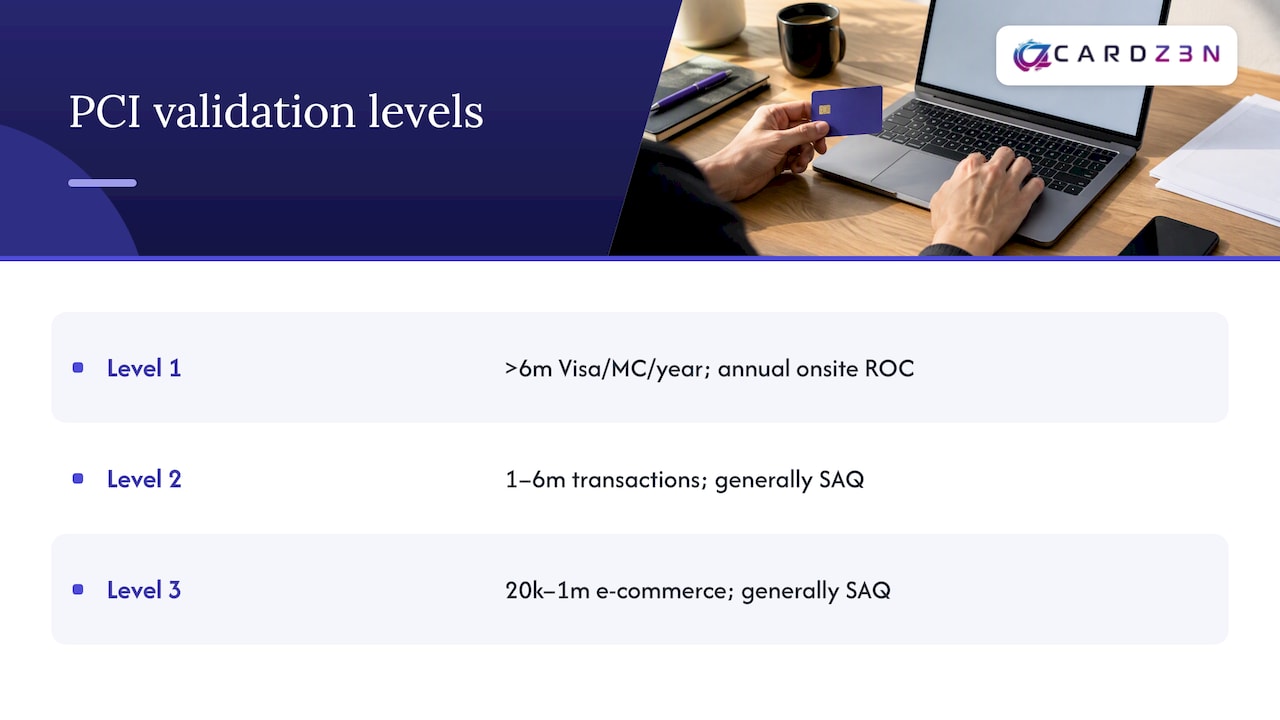
Accepting cards means meeting the PCI Data Security Standard, and the burden scales with volume. Per Mastercard’s site data protection guidance, Level 1 merchants process more than 6 million Visa or Mastercard transactions a year and need an annual onsite Report on Compliance. Level 2 covers 1 to 6 million transactions, and Level 3 covers 20,000 to 1 million e-commerce transactions. Levels 2 through 4 generally use Self-Assessment Questionnaires.
Mastercard’s guidance is to confirm your level with your acquiring bank, because a missed validation can lead to fines or a terminated account. Most B2B sellers have low transaction counts and high dollar values, so they usually sit in a lower level by count while still carrying serious exposure per transaction. Our PCI compliance checklist for B2B merchants lists what to document.
B2B payments are a favorite target because the amounts are large and the processes are manual. The 2025 AFP survey reports that 79% of organizations experienced attempted or actual payment fraud, and 63% reported check fraud attempts in 2024.
The typical attacks:
If you are replacing manual steps with automation, do it in this order: controls first, speed second. A walkthrough of business processes worth automating helps you map which approvals should stay human.
We underwrite and place merchant accounts for a living, and the failures we see are rarely about the rail. They are about mismatch.
A seller with $8,000 average tickets gets approved on a retail-style profile, then has a processor flag every large payment as an anomaly and hold funds. A distributor sends no Level 3 data and pays full commercial-card interchange for years without knowing. A contractor takes ACH debits with no account verification, and returns arrive after the goods have shipped.
Our view is that you should design the stack around three questions before you pick a processor:
B2B is also not automatically low-risk in a processor’s eyes. Aerospace, government contracting, regulated goods and high-ticket sellers can all fall outside what mainstream processors are comfortable with, and that is the segment our B2B and B2G work is built for. Approval is a placement problem: matching your profile to the right sponsor bank and rails, with an underwriting file that tells the truth well.
— Joshua Benedetti
Use these criteria when you compare options:
| Criterion | What to ask |
|---|---|
| Rails | Card, ACH, eCheck and virtual terminal under one account? |
| Enhanced data | Does the gateway pass Level 2 and Level 3 data automatically? |
| Pricing | Is the quote itemized: interchange, assessments, markup, monthly fees, ACH per-item fees? |
| Reserves and holds | Is there a rolling reserve, what percent, for how long, and what triggers a release? |
| Risk tolerance | Does the provider understand your industry and ticket size? |
| Disputes | Is there chargeback prevention and representment support? |
| Integrations | Does it connect to your ERP, invoicing or accounting tools? |
| Portability | Can you move gateway or processor without rebuilding your checkout? |
A few patterns follow from the table. Low-volume, high-ticket sellers should weigh ACH heavily, because the per-item fee barely changes with ticket size. Sellers with many mid-size invoices to commercial cardholders benefit most from Level 2/3 optimization. Sellers in regulated or high-risk categories should put the provider’s underwriting fit ahead of the headline rate.
We run card, ACH and eCheck processing, a virtual terminal and gateway integrations for B2B and government-facing merchants, with Level 2 and Level 3 data processing and chargeback management alongside. If your business has been turned away or frozen by a mainstream processor, or you sell into aerospace or government, see our B2B and B2G payment processing page. For merchants whose category or ticket profile needs specialized underwriting, our high risk merchant account page explains how placement works. Pricing is quote-based, and we explain reserve structures up front.
For a plain-language comparison of how business payments differ from consumer ones, read B2B payments decoded.
The four in volume are ACH, credit or purchasing cards, checks and wires. ACH dominates by dollar value, cards dominate by transaction count, and checks persist in some industries. Most sellers do best accepting at least ACH and cards.
A restaurant supplier invoices a restaurant group $12,000 on net-30 terms, and the group’s accounts payable team pays by ACH. Alternatively, a parts distributor charges a contractor’s corporate card for a $2,400 order over a virtual terminal, passing tax and line-item data. Both are B2B transactions, on different rails.
B2B tickets are larger, payments are often made against invoices on terms, and several people approve them. Buyers need detailed remittance data, and sellers face different fraud patterns such as vendor impersonation. Cards add Level 2 and Level 3 data requirements that consumer checkout never touches.
PCI applies to any card data you store, process or transmit, so if you accept even some cards, yes. The validation level depends on your annual card transaction count, and your acquiring bank confirms it. ACH has its own obligations under Nacha rules, including fraud monitoring for originators.
Some B2B sellers, such as aerospace, regulated goods or very high-ticket businesses, fall outside mainstream processors’ standard underwriting. A specialist provider places them with banks that understand the profile. It is a fit question, not a judgment on the business.
Every merchant's processing setup is different, so the right answer depends on your industry, sales channels, average ticket size and chargeback history. CARDZ3N's payments specialists review those details with you and match your business with the right sponsor bank, gateway and risk tools, whether you sell online, in store, by invoice or on a recurring subscription.
We work with merchants across the USA, Canada, the UK and the EU, including high-risk, B2B and fast-growing businesses that traditional processors often turn away. If you would like a second opinion on your current rates, contract terms or approval options, contact our team for a free, no-obligation processing review.
Joshua Benedetti is the CEO of CARDZ3N, a Las Vegas-based merchant services provider specializing in high-risk payment processing and B2B payment technology.
Joshua Benedetti on LinkedInCARDZ3N Inc is headquartered in Las Vegas, Nevada, and provides merchant services to businesses that traditional processors turn away. Backed by top-tier sponsor banks and processors, CARDZ3N combines institutional stability with the speed of a specialized team that understands high-risk industries. Services include high-risk account underwriting and placement, gateway solutions across the major gateway platforms, POS integrations, ACH and check processing, chargeback prevention through ChargebackZ3N, and business lending and working capital. Its AerospacePay division serves OEMs, MROs, FBOs, and repair stations with B2B and B2G payment processing. CARDZ3N serves merchants in the USA, Canada, the UK, and the EU.
Start protecting your revenue from chargebacks today — schedule your complimentary consultation with CARDZ3N’s dispute management specialists.