

 CARDZ3N — Home
Contact us today for personalized advice and strategic solutions tailored to your goals.

Call us
+1 (702)-623-3528






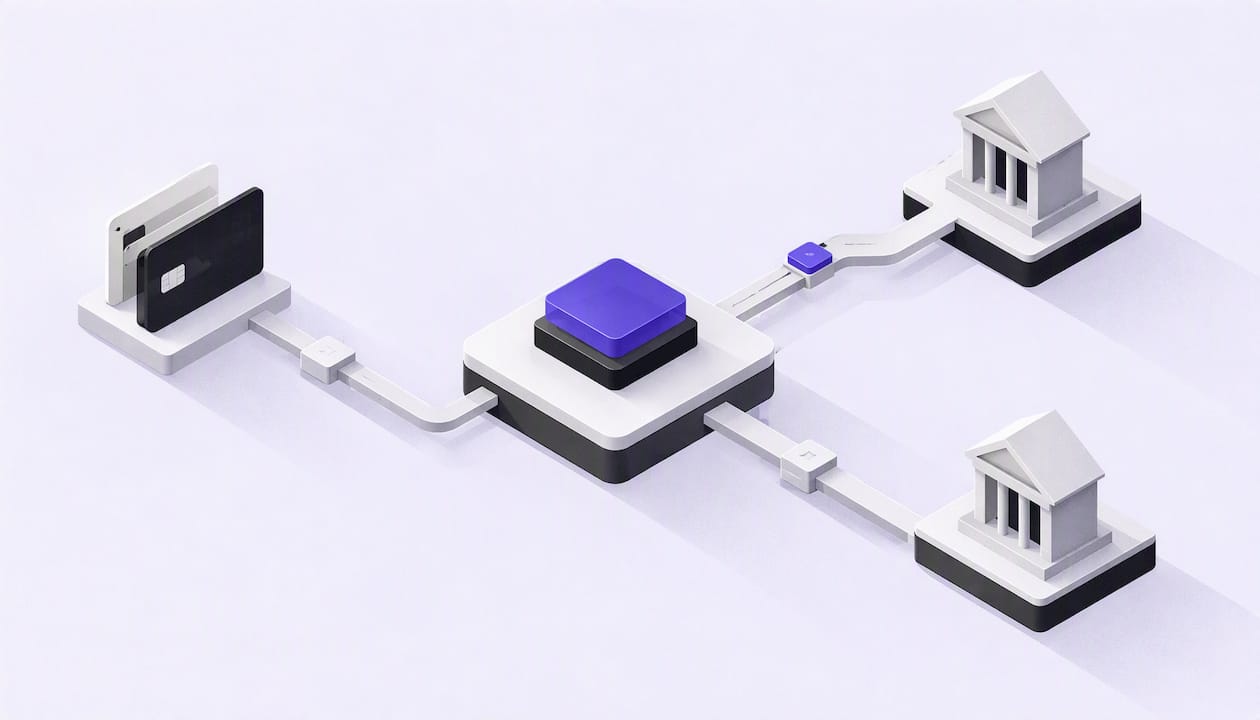
Net terms invoicing gives your buyer a fixed window, typically 30 days, to pay after the invoice date, so you carry the credit risk and wait for your cash. Credit card payments put your money in your account within days, but you pay processing fees and take on chargeback exposure. Neither is better in the abstract. The right choice depends on invoice size, buyer quality, your own working capital and how much margin you can spare for fees.
This guide compares the two on the four things that decide it (timing, cost, cash flow and risk), then shows how to offer both without losing control of receivables.
Net terms are trade credit: you ship the goods or deliver the service, send an invoice, and the buyer pays later. OpenStax describes net terms as the full credit period, and net 30 as payment in full within 30 days of the invoice. Net 60 and net 90 work the same way over longer windows.
The number counts from the invoice date, not the delivery date, unless your contract says otherwise. That detail matters. A buyer who receives goods ten days after you invoice has only 20 days left on a net 30 invoice.
The payment terms line on an invoice states three things: when payment is due, how much is owed, and which payment methods you accept. A typical line reads “Net 30, ACH or card accepted, 1.5% monthly late fee.” If your invoice leaves any of those unstated, you give a slow-paying buyer a reason to dispute the due date.
Sellers who want cash sooner can attach a discount. OpenStax explains 2/10 net 30 as a 2% discount when the buyer pays within 10 days, with the full balance due in 30 days otherwise. You are effectively paying 2% to pull cash forward by 20 days, which can be cheaper than a card fee on a large invoice and cheaper than short-term borrowing.
Terms are negotiated, not fixed. JPMorgan notes that buyers and vendors tailor net terms to their operational and cash-flow needs. Larger buyers often ask for longer windows because their own accounts payable cycles are longer. Smaller sellers often have less leverage than they assume, which is why written terms matter.
With a card, the buyer pays at the time of sale or when the invoice is issued, through a payment link, a virtual terminal, a gateway on your site or a terminal. Your merchant account processor authorizes the transaction and settles funds to your bank, typically within a few business days.
The buyer’s side looks different. Card timing follows the card billing cycle. DSA Factors reports that this commonly leaves roughly 15 to 45 days before the buyer’s card bill is due, which can resemble a short net term for the buyer while you are already paid.
For B2B, two features of cards deserve attention:
| Factor | Net terms invoicing | Credit card payment |
|---|---|---|
| When you get paid | After the term ends (30, 60 or 90 days) or when the buyer chooses to pay | Within days of authorization |
| Seller’s direct cost | Staff time, collections, possible financing cost | Processing fees on every transaction |
| Who carries credit risk | You | The card issuer and the buyer, not you |
| Chargeback exposure | Minimal | Present; must be managed |
| Buyer’s cash flow | Strong: pays after receiving goods | Good: card billing cycle adds time |
| Best for | Established buyers, recurring orders, large contracts | New buyers, smaller orders, fast fulfillment |
| Administrative load | Invoicing, reminders, reconciliation, collections | Lower, mostly automated |
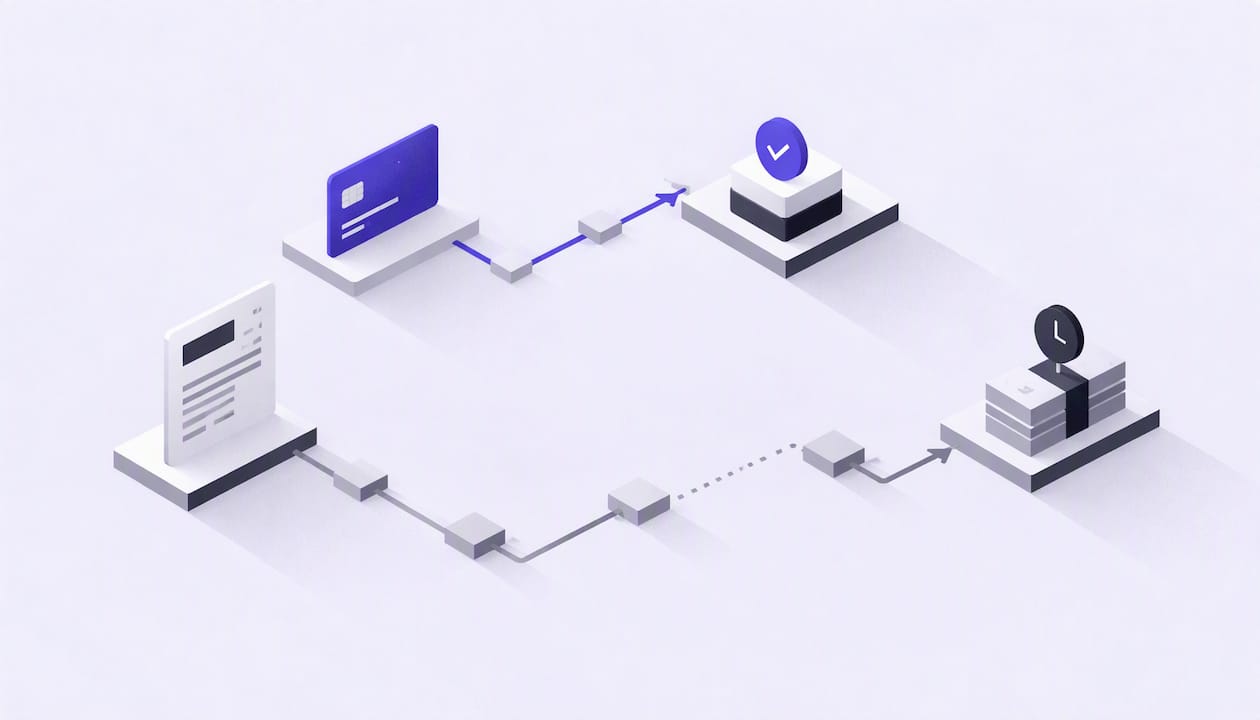
The table reflects the core trade. DSA Factors contrasts the seller economics clearly: on a card sale, the vendor receives proceeds promptly but pays processing fees; on ordinary net terms, the vendor receives the full invoice amount later but bears the customer’s nonpayment risk.
Every day of credit you extend is a day you finance your buyer. JPMorgan states that moving from net 30 to net 60 lets buyers hold cash longer, improving their working capital while extending your receivables and days sales outstanding (DSO).
Here is a simple worked example. Say you invoice $50,000 a month.
The question is whether the fee costs more than funding that receivable balance. If your cost of capital is low and your buyers pay on time, net terms can be cheaper. If you borrow against receivables or stretch to pay your own suppliers, the card fee may be the cheaper way to buy certainty. The U.S. Chamber of Commerce makes the same point from the other side: payment terms directly affect cash flow, so choose deadlines that let you pay your own suppliers, vendors and employees.
The two methods fail in different ways.
Net terms risk is concentrated in nonpayment and slow payment. A buyer can go quiet, dispute the invoice, or simply pay at day 75 on a net 30. The U.S. Chamber’s practical view is that net terms can support sales and customer relationships, but they need disciplined underwriting, deposits, written late-fee provisions and a collections process.
Card risk is concentrated in fees, chargebacks and processor scrutiny. If your dispute ratio climbs, a processor can raise reserves or close your account. That risk is sharper for merchants in sectors mainstream processors treat as high risk, where an account shutdown can stop revenue overnight.

Before you extend credit, build the controls into your process:
Most B2B sellers end up offering both and steering buyers by situation. Use these criteria.
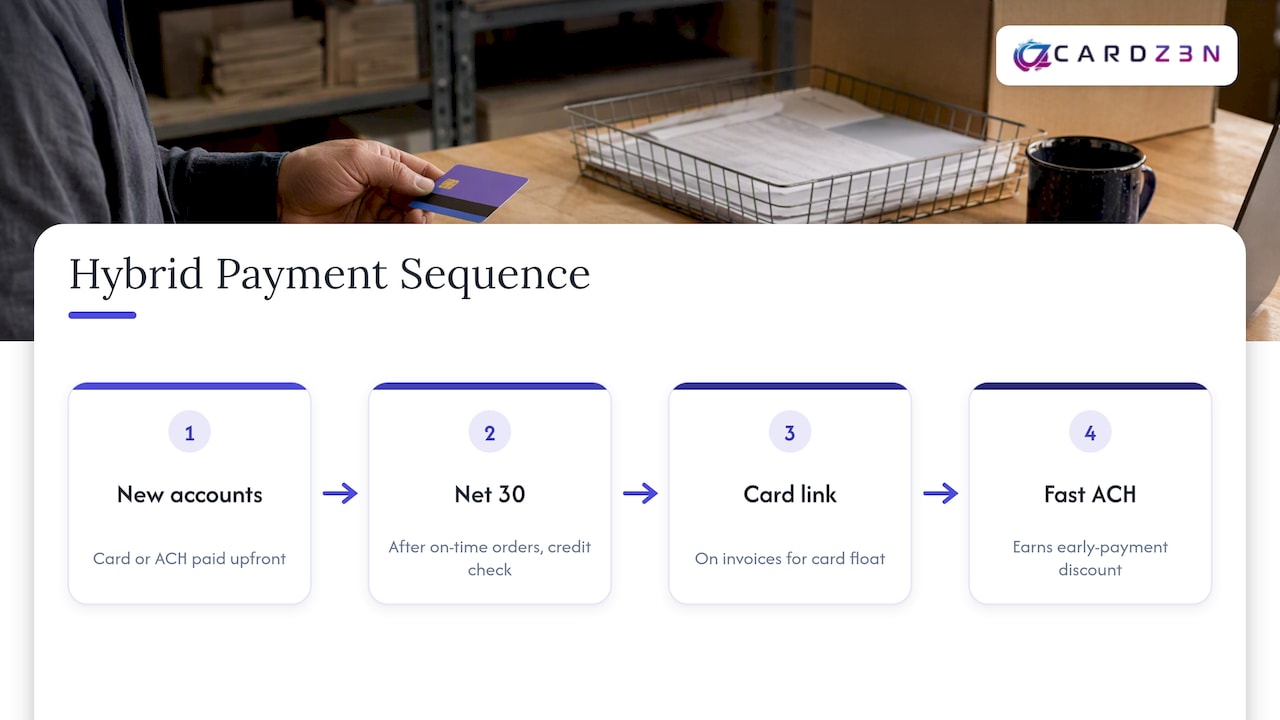
Many sellers combine the two like this: new accounts pay by card or ACH upfront; after several on-time orders and a credit check, they qualify for net 30; invoices carry a pay-by-card link so a buyer who wants the card float can use it; and an early payment discount rewards fast ACH. If you want to reduce what cards cost you, see how cash discounts, surcharges and dual pricing work, and confirm your state’s and card network’s rules before you apply any of them.
The real choice is often not net terms versus cards but net terms versus cards versus bank payments. ACH and e-check payments generally cost less per transaction than cards on large invoices, and they suit recurring B2B relationships. They settle more slowly than cards and carry their own return risk, so they work best with buyers you already know. Our overview of B2B payment rails, costs and controls compares them in more detail, and our explainer on how B2B payments differ from consumer payments covers why invoices, approvals and remittance data shape B2B behavior.
Terms only work if paying is frictionless. Put the due date, accepted methods and late-fee terms on the invoice, then attach a payment link so the buyer can pay by card or bank transfer in one step. A step-by-step setup is in our guide to online invoice payments for SMBs. If you are also trying to see how payment timing affects your overall runway, this walkthrough on cash flow management software shows how receivables tracking fits into the picture.
We work with merchants whose mainstream processor froze their account, held reserves without explanation, or declined them outright. What we see repeatedly is that the net terms versus card question gets answered by habit rather than math. A seller offers net 30 to everyone because a competitor does, or accepts cards on a $40,000 invoice because it is convenient, and neither choice was priced.
Our view is that you should decide per segment, not per company. Price the card fee on your average and largest invoices. Price the cost of carrying receivables for your actual DSO, including slow payers. Then set a rule: which accounts get terms, which pay at order, and what the invoice offers as a card option.
For high-risk and regulated sellers, there is one more factor. If you take cards, your processing relationship is part of your cash flow. That is why we put weight on transparent reserve structures and quote-based pricing that is explained up front, and on a merchant account that has been underwritten for your real business model. A card option that disappears during a dispute spike is not a safety net. Offering ACH and card side by side with net terms gives you resilience: when one rail slows, the others keep cash moving.
— Joshua Benedetti
If you want to offer card, ACH and e-check payments next to your net terms, our B2B and B2G payment processing covers ACH, e-check, virtual terminal and Level 2 and Level 3 data. Merchants that mainstream processors have turned away can start with our high risk merchant account options. Pricing is quote-based, so you will see terms for your volume and ticket size before you commit.
With net terms, you ship first, invoice, and wait a set period (often 30 days) for payment, carrying the credit risk yourself. With a credit card, you receive funds within days but pay processing fees and may face chargebacks. The tradeoff is the cost of waiting and nonpayment risk against the cost of fees.
Not automatically. Net 30 helps the buyer’s cash flow and may win you the sale, but it stretches your receivables and exposes you to late payment. For new or small buyers, a card or ACH payment upfront is usually safer. Move reliable accounts to net terms after a credit check.
Yes, and many B2B sellers do. A common setup is net terms for vetted repeat buyers, with a card or ACH payment link on every invoice for those who prefer to pay sooner or want the card billing cycle. Make sure your invoice states the terms and accepted methods clearly.
The U.S. Chamber says most business owners charge 1.5% to 2% of the invoice amount, and that some states cap late fees. Put the fee in a signed agreement and on every invoice. Check your state’s rules or ask a business attorney before setting it.
Every merchant's processing setup is different, so the right answer depends on your industry, sales channels, average ticket size and chargeback history. CARDZ3N's payments specialists review those details with you and match your business with the right sponsor bank, gateway and risk tools, whether you sell online, in store, by invoice or on a recurring subscription.
We work with merchants across the USA, Canada, the UK and the EU, including high-risk, B2B and fast-growing businesses that traditional processors often turn away. If you would like a second opinion on your current rates, contract terms or approval options, contact our team for a free, no-obligation processing review.
Joshua Benedetti is the CEO of CARDZ3N, a Las Vegas-based merchant services provider specializing in high-risk payment processing and B2B payment technology.
Joshua Benedetti on LinkedInCARDZ3N Inc is headquartered in Las Vegas, Nevada, and provides merchant services to businesses that traditional processors turn away. Backed by top-tier sponsor banks and processors, CARDZ3N combines institutional stability with the speed of a specialized team that understands high-risk industries. Services include high-risk account underwriting and placement, gateway solutions across the major gateway platforms, POS integrations, ACH and check processing, chargeback prevention through ChargebackZ3N, and business lending and working capital. Its AerospacePay division serves OEMs, MROs, FBOs, and repair stations with B2B and B2G payment processing. CARDZ3N serves merchants in the USA, Canada, the UK, and the EU.
Start protecting your revenue from chargebacks today — schedule your complimentary consultation with CARDZ3N’s dispute management specialists.