 CARDZ3N — Home
Contact us today for personalized advice and strategic solutions tailored to your goals.

Call us
+1 (702)-623-3528


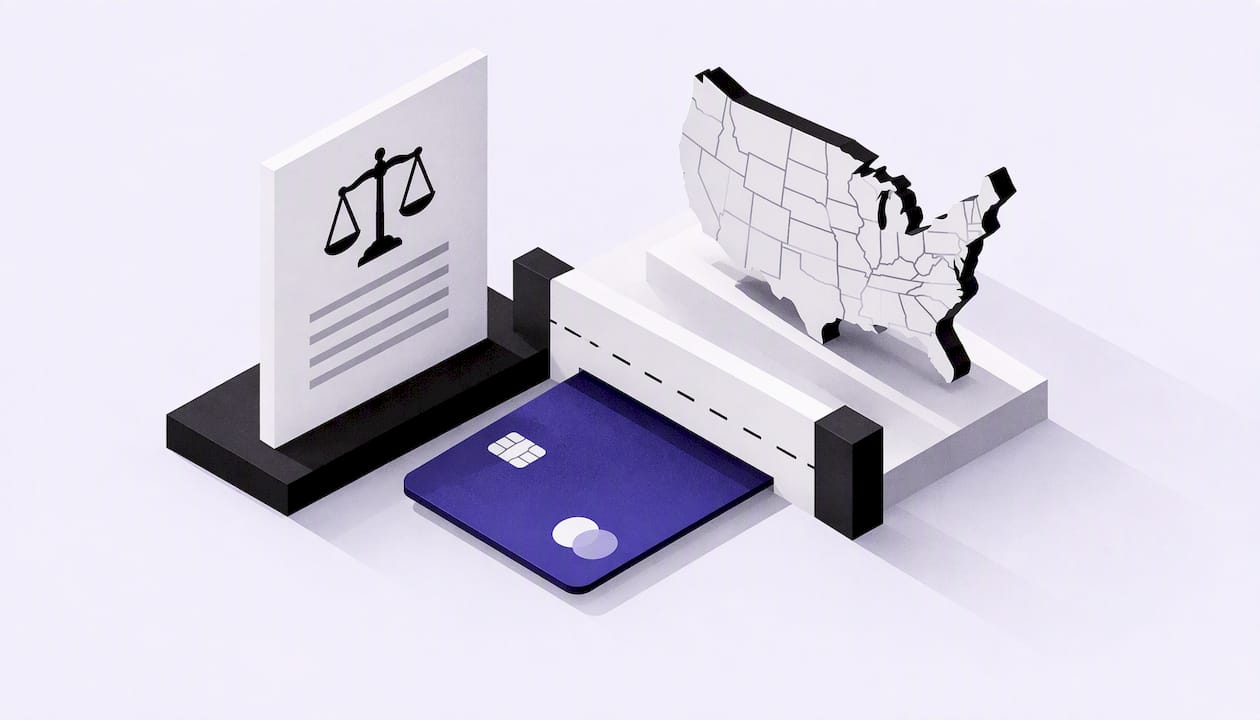




Credit card surcharging is legal in most of the US in 2026, but three layers of rules apply at once: your state’s statute, the card network’s rules, and your acquirer’s contract. Connecticut, Maine and Massachusetts generally prohibit credit card surcharges. Colorado, Oklahoma, New York, New Jersey and a few others allow them under caps or disclosure conditions. Debit and prepaid cards cannot be surcharged anywhere under Visa’s rules. This guide sets out the state picture, the network requirements that apply even where your state says yes, and how dual pricing and cash discounts differ from a surcharge.
One caution first. State surcharge law is changing, and secondary summaries disagree on several states. Treat the state list below as a screening tool. Before you launch in any state, confirm the current statute with counsel and your acquirer’s written approval.
Yes, with conditions. A surcharge is an added fee on a credit card purchase that offsets processing costs. The Arkansas Attorney General distinguishes it from a convenience fee: a surcharge applies specifically to credit card transactions and is calculated as a percentage of the sale.
The practical test is cumulative. You pass only if all three of these hold:
“Legal in my state” is therefore never enough. A merchant in a permissive state can still break network rules and expose its acquirer to penalties.
These are the main points from Visa’s U.S. merchant surcharging Q&A:
Visa also states that improper surcharging can expose an acquirer to a US$1,000 assessment, which is why acquirers screen programs closely. Visa’s considerations and requirements sheet covers the same ground in a shorter format, and the full surcharge section sits in the Visa Core Rules at 5.5.1.
Mastercard and the other networks publish their own rules. Check each one your program touches, and have your acquirer confirm in writing.
The states most consistently identified as prohibiting or restricting credit card surcharges are California, Colorado, Connecticut, Florida, Kansas, Maine, Massachusetts, New York, Oklahoma and Texas, plus Puerto Rico, according to NCSL’s statutory summary and recent state guides. Older national summaries are often stale, and some of these states have changed status or remain in litigation.
| State | General position | What to confirm |
|---|---|---|
| Connecticut | Generally prohibited | Cash discounts are treated differently, so check the statute before choosing a model |
| Maine | Generally prohibited | Confirm current text |
| Massachusetts | Generally prohibited | Confirm current text |
| Colorado | Permitted with conditions and a 2% or actual-cost framework | Notice wording and cap |
| Oklahoma | Ban ended November 1, 2025; now capped at the lesser of 2% or your cost | Secondary summaries differ, so verify |
| New York | Permitted, but the surcharge cannot exceed processing cost | Display the total credit price in dollars and cents |
| New Jersey | Permitted within actual processing cost | Advance disclosure |
| Minnesota | Permitted with required oral notice and a conspicuous sign, plus a statutory cap | Both notices |
| California | SB 478 restricts add-on fees and requires up-front total pricing | NFIB’s guide discusses the effect on surcharges |
| Florida, Texas | Statutes on the books, but sources disagree on enforceability after litigation | Get counsel’s current view |
The rules for California, Florida, Texas and Oklahoma are where summaries diverge most. If you operate in one of them, treat a competitor’s blog post, or ours, as a starting point and not as the answer.
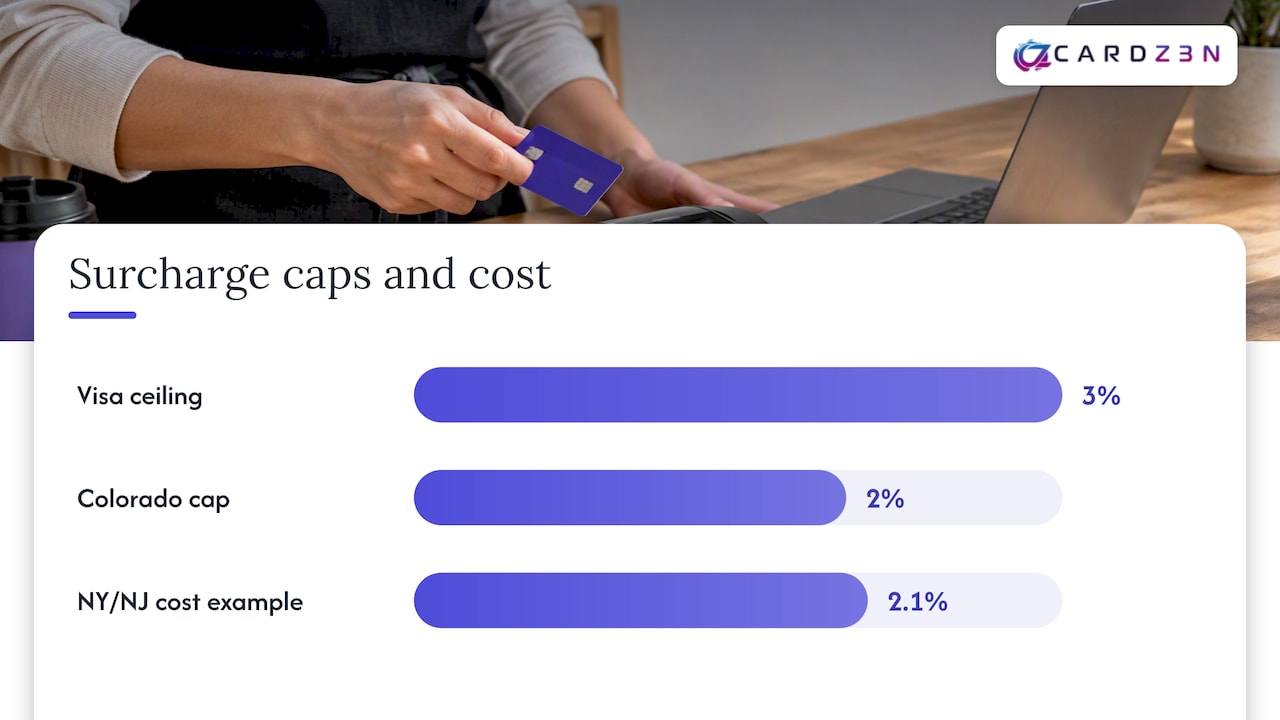
The state cap, where there is one, wins over Visa’s 3% ceiling when it is lower. A Colorado merchant working to a 2% limit does not get to use 3% because the network allows it. Similarly, in New York and New Jersey the limit is your actual cost of acceptance, so a flat 3% on a card that costs you 2.1% is a problem.
New York requires the total credit price to be shown in dollars and cents. Minnesota requires an oral notice as well as a sign. Build your checkout and in-store signage to the strictest state you serve, then loosen only where counsel confirms you can.
It is generally not legal to add a 3% fee to a debit card transaction. NFIB describes federal law as prohibiting debit surcharges nationwide, and Visa’s rules separately forbid surcharging debit and prepaid cards.
States are adding their own layer. Louisiana’s SB 254, now Act 751, takes effect August 1, 2026 and prohibits retail businesses from imposing a debit card surcharge, with consumer damages and enforcement mechanisms.
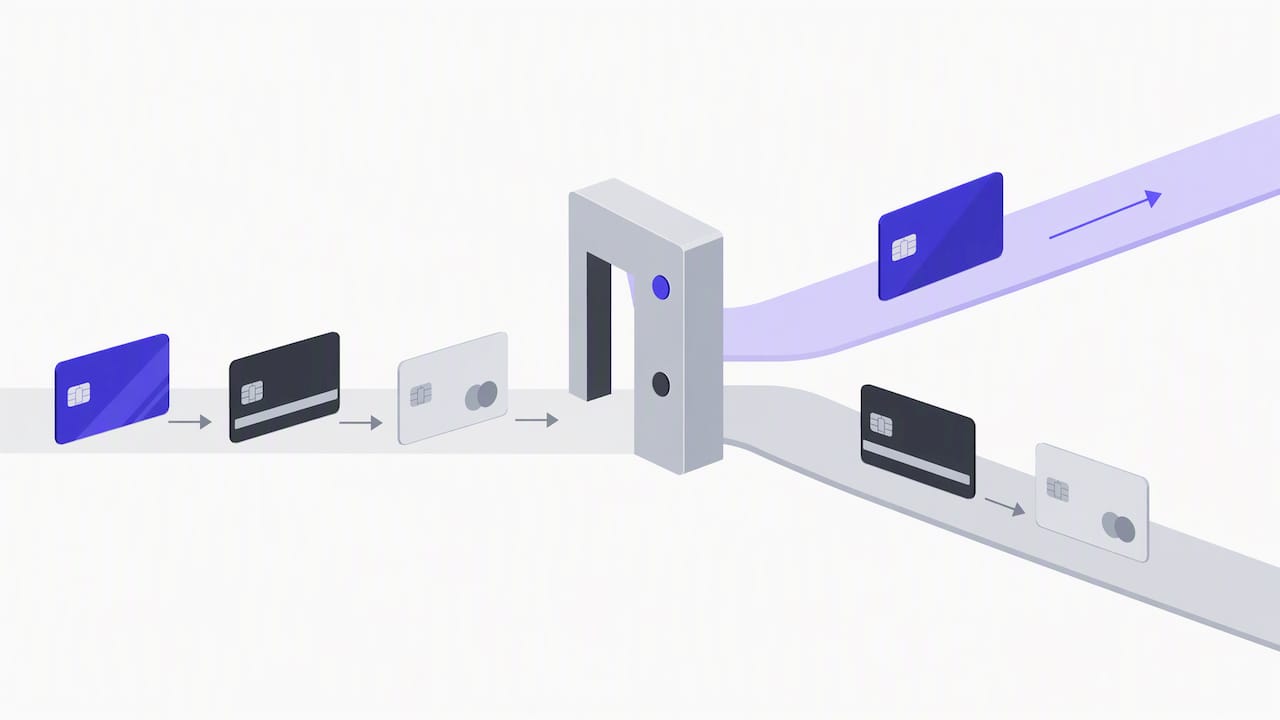
The operational lesson is to avoid a generic “card fee.” Your system has to distinguish credit from debit and prepaid at the BIN level and apply the fee to credit only. A program designed to recover all card costs is overbroad by design. For a deeper explanation of how card products differ, the difference between credit and prohibited debit surcharges is also covered by this overview of card network banking.
These three models are often sold as interchangeable. They are not, and each is judged by different rules.
| Model | How the price works | Main exposure |
|---|---|---|
| Surcharge | The posted price is the cash price. A fee is added when the customer pays by credit card. | State statute, plus all Visa surcharge requirements |
| Cash discount | The posted price is the card price. Cash buyers get a discount off it. | State law, plus network display rules |
| Dual pricing | Each item shows two prices side by side, one for card and one for cash. | Network display rules and state guidance |
Rundoo’s 2026 state guide notes that Visa allows a discount offer, but warns that posting a low price and then adding a card fee at the register may be treated as a surcharge, with all the surcharge rules attached. That distinction trips up merchants who rename a surcharge as a “cash discount” without changing the price display.
The label does not decide the treatment. The way the customer sees the price does. If the card price is the lowest displayed number and cash buyers get something off, you are in discount territory. If cash is the displayed price and a card fee appears later, you are surcharging.
Visa’s rules treat convenience fees and service fees separately from surcharges, with their own conditions in section 5.5.2. Do not relabel a surcharge as a convenience fee to sidestep a state ban. Misclassifying a fee can create network problems and consumer-law problems together.
Merchants face rising acceptance costs, and states are shifting from single-purpose surcharge statutes to broader fee-transparency rules. Venable’s June 2026 analysis reports that legislatures introduced, debated, enacted and sometimes rejected surcharge and fee proposals across the 2025-2026 cycle. NCSL reports that at least 30 states, D.C. and Puerto Rico considered broader consumer-price and fee-transparency bills in 2026.
Not all of those measures regulate card surcharges. Many target restaurant fees, ticket fees, or dynamic pricing. But they interact: a state that requires all-in pricing can undermine a surcharge model even when no surcharge statute exists.
Fee regulation is now a monitoring problem, not a one-time setup task. Expect continuing proposals on caps, mandatory fee-free payment options, debit card limits and up-front price disclosure.
A workable monitoring habit:
If you want a view of how checkout choices affect conversion alongside compliance, this comparison of retail payment plan options shows what consumers can be offered instead of a card fee.
This sequence is an operational synthesis of Visa’s requirements and the state rules above. It is not legal advice.
For teams building this into software, guidance on audit-ready payment integration shows how a compliance trail can be designed into the stack from the start.
Two cases catch merchants late. On a refund, you should return the surcharge in proportion to the amount refunded, and your receipt logic must handle that. On subscriptions, the customer must have been told of the fee before the first charge, and later changes to the rate or to state law need fresh notice. Disputes over undisclosed fees feed directly into chargebacks, so your chargeback prevention practices and your fee disclosures should be built together.
We work with merchants whose accounts mainstream processors refuse or freeze, and we see the same pattern with surcharging. A merchant adds a fee to protect margin, skips the notice step or applies the fee to debit, and then the fee itself becomes a source of disputes. Customers who see an unexpected line item are more likely to call their issuer than to call you.
For high-risk and subscription merchants, that matters more than the percentage saved. A chargeback ratio that creeps up can cost far more than the fee recovers. We therefore advise a few things:
None of this replaces a lawyer’s reading of your state’s statute. It does mean your processor should be a partner in getting the program approved, and not just the system that charges the fee.
— Joshua Benedetti
If your current processor has declined, frozen or restricted your account, a surcharge or dual pricing program is harder to get approved, because acquirers look at your whole risk profile. CARDZ3N places high-risk merchant accounts with underwriting support, and we can discuss fee programs as part of onboarding. Pricing is quote-based, and reserve structures are explained up front. For merchants taking recurring or online payments, see our online payment processing page. For disputes that arise from fee disclosure problems, see chargeback management.
Connecticut, Maine and Massachusetts generally prohibit credit card surcharges, and Visa also lists Puerto Rico. California, Florida, Kansas, Texas and a few others have restrictions or contested statutes, and sources disagree on their current effect. Confirm each one against the current statute before you launch.
In general, yes. Federal law is described as prohibiting debit card surcharges, and Visa’s rules forbid surcharging debit and prepaid cards. Louisiana’s debit surcharge ban took effect August 1, 2026.
Often, on credit cards only, where your state allows it. You must stay within your cost of acceptance, within Visa’s 3% ceiling, and within any lower state cap. You also need to give your acquirer 30 days’ notice, disclose the fee, and show it on the receipt.
Dual pricing shows a card price and a cash price side by side on each item. A cash discount starts from the card price and takes something off for cash. Both can draw surcharge treatment if the display is misleading, so ask your acquirer to approve your price display in writing.
Every merchant's processing setup is different, so the right answer depends on your industry, sales channels, average ticket size and chargeback history. CARDZ3N's payments specialists review those details with you and match your business with the right sponsor bank, gateway and risk tools, whether you sell online, in store, by invoice or on a recurring subscription.
We work with merchants across the USA, Canada, the UK and the EU, including high-risk, B2B and fast-growing businesses that traditional processors often turn away. If you would like a second opinion on your current rates, contract terms or approval options, contact our team for a free, no-obligation processing review.
Joshua Benedetti is the CEO of CARDZ3N, a Las Vegas-based merchant services provider specializing in high-risk payment processing and B2B payment technology.
Joshua Benedetti on LinkedInCARDZ3N Inc is headquartered in Las Vegas, Nevada, and provides merchant services to businesses that traditional processors turn away. Backed by top-tier sponsor banks and processors, CARDZ3N combines institutional stability with the speed of a specialized team that understands high-risk industries. Services include high-risk account underwriting and placement, gateway solutions across the major gateway platforms, POS integrations, ACH and check processing, chargeback prevention through ChargebackZ3N, and business lending and working capital. Its AerospacePay division serves OEMs, MROs, FBOs, and repair stations with B2B and B2G payment processing. CARDZ3N serves merchants in the USA, Canada, the UK, and the EU.
Start protecting your revenue from chargebacks today — schedule your complimentary consultation with CARDZ3N’s dispute management specialists.