


 CARDZ3N — Home
Contact us today for personalized advice and strategic solutions tailored to your goals.

Call us
+1 (702)-623-3528










A payment gateway captures and secures card data at the point of sale; a payment processor authorizes the transaction and moves the funds between banks. Most small business owners never deal with them separately. Bundled providers combine both roles into one contract, but understanding the split still matters, because it determines who is responsible when a transaction stalls, a chargeback lands, or an underwriter flags your account for review.
A gateway is the front-end technology layer that captures a card number, encrypts it, and forwards it toward the processor for authorization. It never touches settlement or bank rails. Three deployment models dominate the market, and the one you pick affects both your integration timeline and your PCI scope.
Security features like encryption, tokenization, 3D Secure (3DS), and hosted fields exist specifically to shrink the cardholder data environment (CDE) merchants are responsible for defending. If you sell through multiple channels, need a custom checkout flow, or want PCI scope reduction without rebuilding your storefront, gateway capability should drive your provider evaluation. CARDZ3N’s gateway integrations support this kind of setup for merchants who need flexibility without inheriting more compliance burden than necessary.
A processor is the back-end engine that routes an authorized transaction to the card networks and issuing banks, then handles clearing and settlement once the sale is approved. It does not capture card data from the customer. That’s the gateway’s job. The processor’s job starts the moment the gateway hands off an authorization request.
Processors typically operate under an acquiring bank’s sponsorship rather than as standalone entities, because card network rules require a bank to underwrite and vouch for every merchant account. That relationship is why your merchant agreement often names a sponsor bank you’ve never heard of, even though your day-to-day contact is the processor’s support team.
The cleanest way to separate these two roles is to ask what each one owns. A gateway owns data capture and transmission security. A processor owns fund movement and settlement. Everything else, integration complexity, reporting, dispute handling, follows from that split.
Fee shapes differ too. Gateways commonly charge a setup fee plus a flat monthly platform fee, sometimes with a small per-transaction add-on for advanced features. Processors charge per-transaction fees, a percentage of volume, and pass through interchange set by the card networks, plus assessments. A bundled provider folds both into one blended rate, which is simpler to read but harder to audit line by line.
Pro Tip: Ask any bundled provider for a separated fee breakdown before you sign. If they can’t isolate the gateway fee from the processing fee, you have no way to benchmark either one against the market.
A bundled payment service provider (PSP) makes sense for low-volume merchants who want one login and one support line. Separate gateway and processor stacks make sense once you need multi-processor redundancy, specialized high-risk underwriting, or a checkout experience your bundled PSP simply can’t build.
Every card transaction, regardless of which provider you use, moves through the same sequence of handoffs. Knowing where each step happens tells you exactly who to call when something breaks.
Tokenization and 3DS checks happen at the gateway layer, before the authorization request ever reaches the network. Fraud scoring can occur at either layer depending on the provider’s architecture. Operational holds, acquirer risk reviews, reserve placements, or manual underwriting checks, happen after settlement is initiated, not before authorization, which is why a transaction can show “approved” and still take days to actually reach your bank account.
Merchants keep PCI DSS obligations no matter how much of the transaction flow a gateway or processor handles. Hosted checkout pages and tokenized fields can meaningfully shrink your cardholder data environment, but they don’t erase your responsibility to validate that the implementation actually works as advertised. PCI guidance treats tokens and tokenization systems as part of the CDE unless the merchant can prove proper segmentation.
The FFIEC identifies acquiring banks as the risk-controlling entity in the merchant relationship, which means your bank expects documented proof that your gateway and processor are handling their end correctly, not just a verbal assurance from a sales rep. Whether your checkout uses an iFrame, a hosted page, or a direct-post API changes how much PCI scope actually transfers away from you, and assuming “hosted equals compliant” is one of the most common audit failures small merchants run into.
Your sales volume, average ticket size, and industry risk profile should drive this decision more than brand recognition. A boutique doing $8,000 a month in card-present sales has almost nothing in common with a subscription business processing recurring card-not-present charges at scale, and they shouldn’t shop the same way.
Pro Tip: If a provider hesitates when you ask who their sponsor bank is, treat that as a warning sign. A transparent processor names its sponsor without prompting.
Bundled PSPs are the right call for low-volume, low-risk merchants who want simplicity. Businesses with higher chargeback exposure or complex integration needs usually do better with direct merchant account placement built around specialized underwriting.
The gateway vs. processor distinction matters most when a business gets rejected by a mainstream provider and needs to understand why. CARDZ3N works with merchants in categories that generic processors routinely decline, including sectors such as CBD and hemp, nutraceuticals, vape, subscription billing, firearms, and B2B and B2G payments for aerospace and government contractors.
That work covers underwriting and merchant account placement with sponsor banks willing to take on higher-risk categories, gateway integrations built for the security and tokenization requirements those industries face, and chargeback prevention through ChargebackZ3N for merchants whose dispute ratios would otherwise put their account at risk. For a business that’s been shut down by a mainstream processor once already, the difference between a generic PSP and a provider that understands sector-specific underwriting isn’t cosmetic. It’s the difference between staying open and starting the application process over again.
Most of the content written about gateways and processors treats this as a technical vocabulary problem, define the two terms, draw a diagram, move on. That framing undersells what actually determines whether a small business keeps processing payments six months from now: who is underwriting the account and how well that underwriter understands the merchant’s industry.
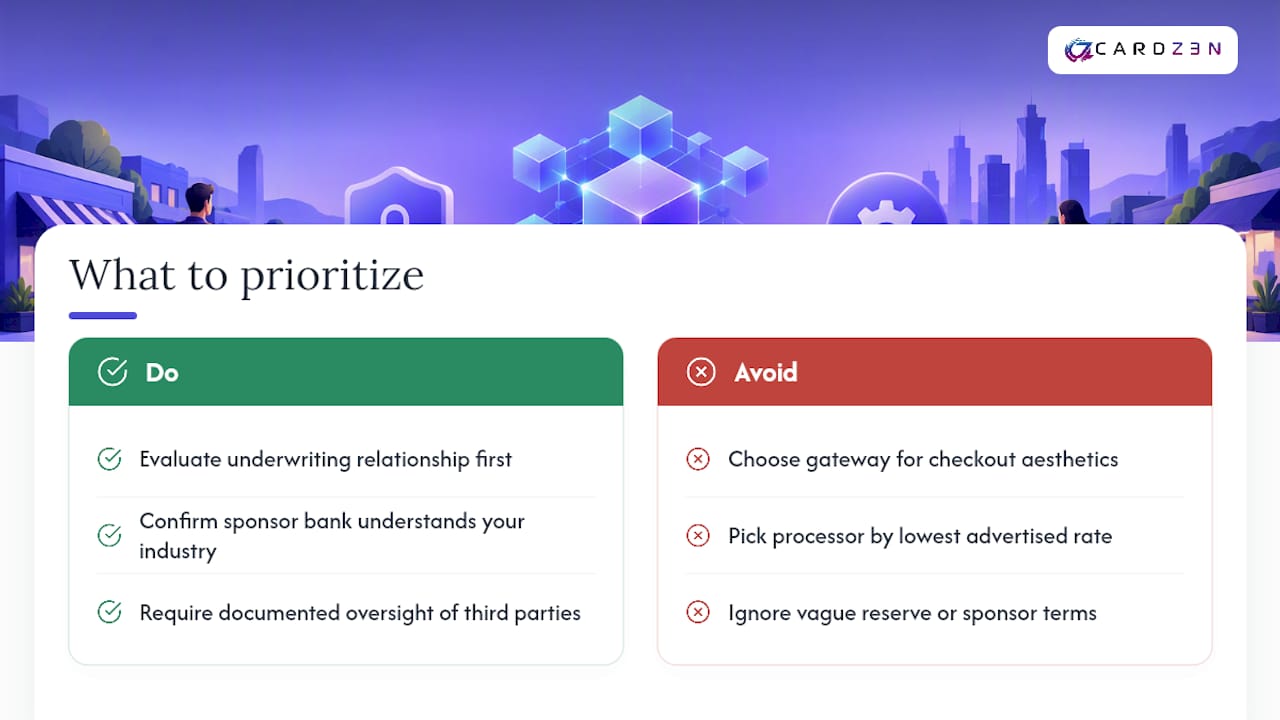
The FFIEC’s own guidance makes this explicit. Acquiring banks are the risk-controlling entity, and they expect documented oversight of every third-party provider in the chain. A merchant who picks a gateway based on checkout aesthetics, or a processor based on the lowest advertised rate, is optimizing for the wrong variable. The businesses that get shut down without warning are almost never the ones with bad checkout design. They’re the ones whose underwriter never understood the risk profile in the first place, or whose reserve terms were vague enough to hide a problem until it became a frozen account.
If you take one thing from this guide, let it be this: evaluate the underwriting relationship before you evaluate the checkout button. The technology stack is replaceable. A bad sponsor bank relationship in a high-risk category is not.
— Joshua Benedetti
CARDZ3N exists for the merchants mainstream processors won’t touch. If Stripe, PayPal, or Square has frozen or rejected your account, that’s usually an underwriting mismatch, not a reflection of your business model. CARDZ3N places accounts with sponsor banks built for higher-risk categories, integrates gateways that handle the tokenization and compliance load those industries face, and backs it with chargeback prevention through ChargebackZ3N so dispute ratios don’t put your account back at risk.
Services span high-risk merchant accounts, online payment processing, POS integrations, and B2B and B2G payment processing for aerospace and government contractors. Pricing is quote-based rather than a generic rate card, because risk profiles vary too much for a flat number to mean anything. Start by requesting a quote through CARDZ3N’s merchant services page to see what a specialized underwriter can actually offer your account.
For deeper technical detail, review the FFIEC’s merchant acquiring guidance, the PCI Security Standards Council’s tokenization supplement, and, for storefront-level security controls, this rundown of ecommerce security plugins.
Neither. Visa is a card network that routes authorization requests between the processor and the issuing bank. Gateways and processors both connect into networks like Visa, but Visa itself doesn’t capture card data or hold a merchant’s settlement funds.
Clover is a point-of-sale platform that bundles hardware, software, and payment acceptance, and it typically works with an underlying processor rather than functioning as a standalone processor itself. Most merchants experience it as an all-in-one system rather than a distinct gateway or processor layer.
Fiserv operates primarily as a payment processor and financial technology company, handling authorization routing, settlement, and banking infrastructure for merchants and financial institutions. Some Fiserv product lines include gateway functionality, which is common among large payment companies that bundle both roles.
The gateway captures and secures the data; the processor moves the money. If you remember that one split, you can correctly place almost any payment gateway comparison or provider pitch you encounter.
Yes. CARDZ3N provides gateway integrations alongside high-risk merchant account placement, so merchants get both the front-end checkout technology and the underwriting relationship from one provider. Pricing is quote-based, and details are available through CARDZ3N’s payment gateway page.
Every merchant's processing setup is different, so the right answer depends on your industry, sales channels, average ticket size and chargeback history. CARDZ3N's payments specialists review those details with you and match your business with the right sponsor bank, gateway and risk tools, whether you sell online, in store, by invoice or on a recurring subscription.
We work with merchants across the USA, Canada, the UK and the EU, including high-risk, B2B and fast-growing businesses that traditional processors often turn away. If you would like a second opinion on your current rates, contract terms or approval options, contact our team for a free, no-obligation processing review.
Joshua Benedetti is the CEO of CARDZ3N, a Las Vegas-based merchant services provider specializing in high-risk payment processing and B2B payment technology.
Joshua Benedetti on LinkedInCARDZ3N Inc is headquartered in Las Vegas, Nevada, and provides merchant services to businesses that traditional processors turn away. Backed by top-tier sponsor banks and processors, CARDZ3N combines institutional stability with the speed of a specialized team that understands high-risk industries. Services include high-risk account underwriting and placement, gateway solutions across the major gateway platforms, POS integrations, ACH and check processing, chargeback prevention through ChargebackZ3N, and business lending and working capital. Its AerospacePay division serves OEMs, MROs, FBOs, and repair stations with B2B and B2G payment processing. CARDZ3N serves merchants in the USA, Canada, the UK, and the EU.
Start protecting your revenue from chargebacks today — schedule your complimentary consultation with CARDZ3N’s dispute management specialists.