


 CARDZ3N — Home
Contact us today for personalized advice and strategic solutions tailored to your goals.

Call us
+1 (702)-623-3528










A hosted payment page is a checkout screen hosted by your payment provider rather than your own servers, so your customer enters card details on the provider’s secure domain instead of yours. The main advantage: cardholder data never touches your infrastructure, which shrinks your PCI DSS obligations down to the lightest self-assessment tier. It suits merchants wanting a fast, secure checkout without building or maintaining card-handling code.
A hosted payment page (HPP) works through a session, redirect, and confirmation cycle rather than a single API call. Your server talks to the provider, the provider takes over the sensitive part of the transaction, and your server gets notified once money moves. That handoff is the entire point: your infrastructure never sees a card number.
The lifecycle typically breaks down into five steps:
Checkout.com’s documentation describes exactly this pattern: a merchant requests a session and redirects the customer to a secure hosted page, with the provider handling the payment and firing a webhook back. Stripe’s Checkout product follows the same session-based model: create a session, redirect, confirm via webhook.
Two variants matter here. A full redirect sends the shopper to a separate page entirely. An embedded or pop-up checkout keeps them on your site visually while the sensitive fields still load from the provider’s domain, often inside an iframe. Providers frequently restrict or disable that iframe embedding for the classic hosted page format, and sessions expire after a fixed window, so test your redirect and retry logic before launch.
The single biggest benefit is scope reduction. When card data never reaches your servers, you typically qualify for SAQ-A, the shortest PCI DSS self-assessment questionnaire, instead of the far more demanding SAQ-D that applies when you handle cardholder data directly. The PCI Security Standards Council’s SAQ documentation lays out exactly which questionnaire applies to which integration model, and the hosted-page pattern is one of the clearest paths to the lightest one.
Pro Tip: Ask your provider in writing which SAQ type their integration qualifies you for. “PCI compliant” is a marketing phrase; the SAQ letter is the fact.
Beyond compliance, hosted pages deliver:
That combination is why hosted checkout has become the default starting point for merchants without a dedicated payments engineering team.
Implementation follows a predictable sequence, and skipping steps here is where most integration bugs originate. Elavon’s developer documentation and similar hosted payment page overviews walk through workflow diagrams that map almost exactly to this checklist.
Pro Tip: Never treat the redirect back to your success page as proof of payment. Only a verified webhook confirms the transaction actually settled. Customers close browser tabs, lose connections, and hit back buttons constantly.
Most providers let you adjust the visual layer without touching the security model underneath. That balance is what makes hosted pages workable for merchants who still care about brand consistency at checkout.
Color choices at checkout aren’t purely cosmetic. Research on color psychology in branding shows that consistent color cues reduce hesitation at decision points, and checkout is the highest-stakes decision point on your entire site.
A hosted page reduces your PCI scope, but it doesn’t eliminate it. You still sign a formal attestation, and you still carry responsibility for anything happening on your side of the redirect.
Qualifying for SAQ-A typically requires that your return pages, session-creation code, and any embedded elements meet the PCI SSC’s specific eligibility criteria for that questionnaire tier. Miss one of those criteria, like allowing a card field to render inside your own iframe, and you can be bumped to a stricter SAQ without realizing it.
Before you commit to a provider, verify:
None of that is exotic. It’s due diligence any competent developer or finance lead should run before signing a contract, not after a breach makes it mandatory.
Selecting a provider comes down to documentation quality and fee transparency as much as feature lists. Run through this checklist during vendor calls:
Providers that hesitate on any of these four points are telling you something about how they’ll behave after you sign.
Hosted pages aren’t the right fit for every checkout flow, and pretending otherwise sets up avoidable friction later.
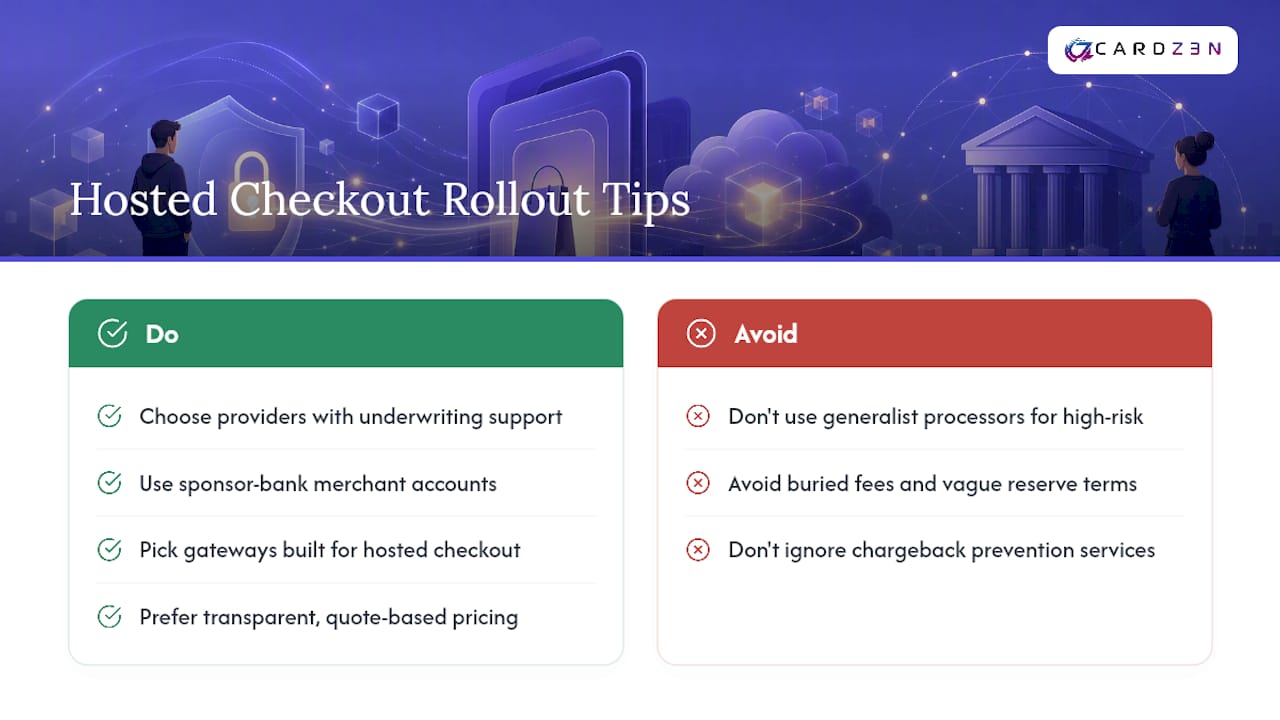
Choosing a hosted checkout is only half the equation if you’re in an industry mainstream processors avoid. CARDZ3N works with businesses that Stripe, PayPal, and Square have rejected, frozen, or shut down outright, including CBD and hemp, nutraceuticals, and other regulated categories.
That work goes beyond UX polish on a checkout page. It means underwriting support, merchant account placement with sponsor banks that actually approve high-risk volume, gateway integrations, ACH and check processing, POS integrations, and chargeback prevention that keeps your account in good standing once you’re live.
Merchants without dedicated payments engineering, or those in regulated categories facing constant account risk, get the most from an HPP. If that’s your situation, compare provider documentation closely, run a staging test end to end, and talk to a specialist about onboarding before you build anything permanent.
— Joshua Benedetti
Picking a hosted payment page is the easy part. Getting approved to actually process transactions, especially in CBD, nutraceuticals, vape, subscription billing, or aerospace and government contracting, is where most merchants stall out with mainstream processors. Certain specialized providers offer underwriting and merchant account placement with support from sponsor banks, along with gateway integrations for hosted checkout flows and chargeback prevention services to help maintain account stability as volume grows.
Some providers offer transparent, quote-based pricing from the start rather than vague reserve terms and buried fees. If your business has been rejected, frozen, or shut down by a generalist processor, start with a look at high-risk merchant account options or explore payment gateway integrations built for exactly this kind of checkout implementation.
Yes. Hosted payment pages are a standard, widely used method for accepting card payments securely, used by major providers including Stripe and Checkout.com. The model exists specifically to reduce fraud risk and PCI scope for merchants, not to obscure anything from them.
A hosted payment page loads on the provider’s own domain, separate from your website. An iframe embeds that provider content visually inside your page, but many hosted checkout products restrict or disable iframe embedding for security reasons, so check your provider’s specific rules before assuming that option is available.
You create a checkout session server-side with order details, receive a checkout URL from your provider, and redirect the customer to that URL to complete payment. After that, you confirm the result through a verified webhook rather than relying on the redirect alone.
A self-hosted gateway means your own servers collect and transmit card data directly, instead of redirecting to a provider’s page. It gives you full control over the checkout experience but puts you in a much stricter PCI DSS scope, since cardholder data flows through your systems. For most merchants, and especially for those in higher-risk categories, a managed gateway integration paired with hosted checkout balances control with a manageable compliance footprint.
Every merchant's processing setup is different, so the right answer depends on your industry, sales channels, average ticket size and chargeback history. CARDZ3N's payments specialists review those details with you and match your business with the right sponsor bank, gateway and risk tools, whether you sell online, in store, by invoice or on a recurring subscription.
We work with merchants across the USA, Canada, the UK and the EU, including high-risk, B2B and fast-growing businesses that traditional processors often turn away. If you would like a second opinion on your current rates, contract terms or approval options, contact our team for a free, no-obligation processing review.
Joshua Benedetti is the CEO of CARDZ3N, a Las Vegas-based merchant services provider specializing in high-risk payment processing and B2B payment technology.
Joshua Benedetti on LinkedInCARDZ3N Inc is headquartered in Las Vegas, Nevada, and provides merchant services to businesses that traditional processors turn away. Backed by top-tier sponsor banks and processors, CARDZ3N combines institutional stability with the speed of a specialized team that understands high-risk industries. Services include high-risk account underwriting and placement, gateway solutions across the major gateway platforms, POS integrations, ACH and check processing, chargeback prevention through ChargebackZ3N, and business lending and working capital. Its AerospacePay division serves OEMs, MROs, FBOs, and repair stations with B2B and B2G payment processing. CARDZ3N serves merchants in the USA, Canada, the UK, and the EU.
Start protecting your revenue from chargebacks today — schedule your complimentary consultation with CARDZ3N’s dispute management specialists.