
 CARDZ3N — Home
Contact us today for personalized advice and strategic solutions tailored to your goals.

Call us
+1 (702)-623-3528







Buy now, pay later (BNPL) lets your customer split a purchase into installments while you are paid up front, minus a merchant fee. The provider takes on the collection from the shopper. In return you pay a fee that is usually higher than a card rate, and you inherit a more complicated refund and customer-service flow. Whether it earns its place depends on your margins, your average order value, your return rate and the terms of the provider agreement, which is what this guide walks through.
A BNPL provider sits between your checkout and the shopper’s repayment. According to the Congressional Research Service, U.S. providers most commonly originate Pay-in-4 and monthly installment loans through merchant-specific point-of-sale agreements, or sometimes centralized applications, and the merchant is paid upfront less merchant fees.
The customer-facing sequence, as Venable describes it, runs like this:
For you, the practical consequences are three. First, the credit decision and the fraud screen are made by the provider, not by your own risk rules. Second, the funds you receive come from the provider’s settlement, not from the card networks, so your standard card reconciliation does not cover them. Third, the customer relationship is split: the shopper owes the provider, but they will still contact you when an order is late, wrong or returned.
Consumer BNPL typically takes two forms: short Pay-in-4 plans and longer monthly installment loans for larger tickets. The longer plans tend to suit higher-priced goods, where an installment schedule changes whether a customer can afford to buy at all. If you sell to businesses, the same idea appears as net terms or invoice financing, where you are paid early and the financing partner collects from the buyer. The mechanics differ, but the questions to ask are the same: who carries the credit risk, what is the fee, and who handles disputes.
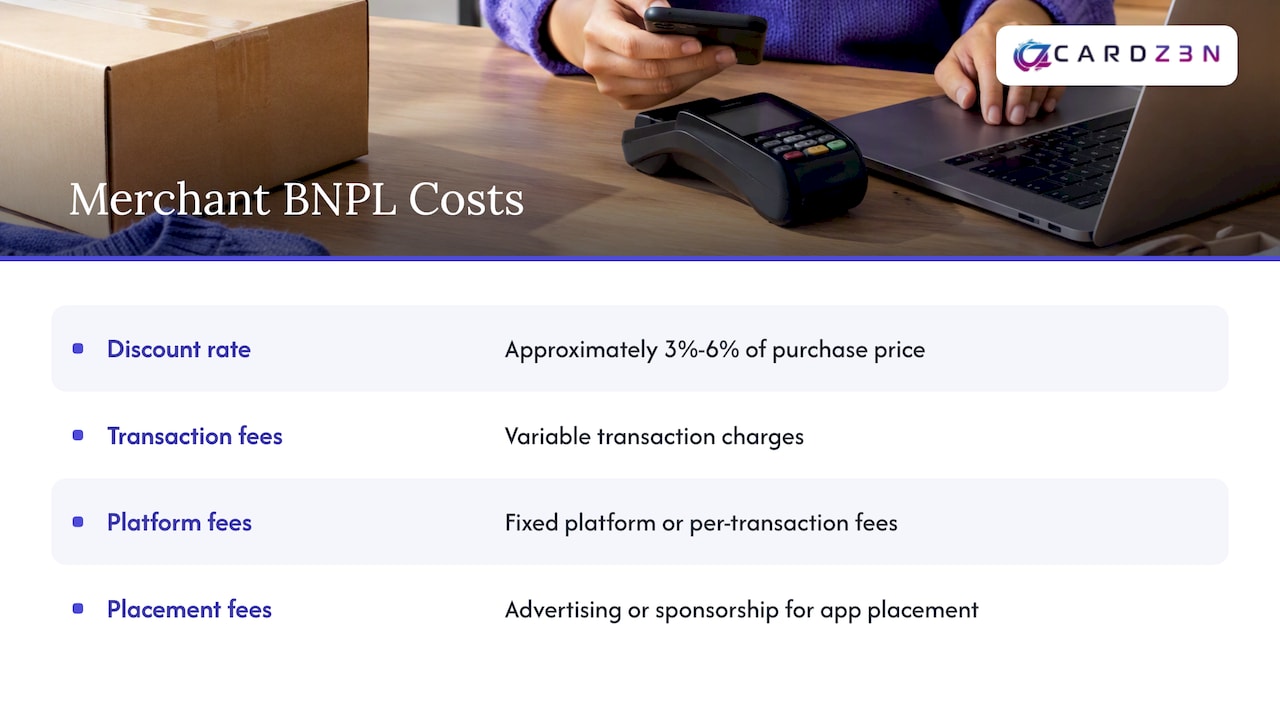
The headline number most merchants quote is the discount rate. Venable reports that, according to the CFPB, merchants pay approximately 3% to 6% of the purchase price, and that the exact rate depends on the provider, the product, the merchant and the contract. The Federal Reserve Bank of Richmond adds that providers’ revenue comes primarily from merchant fees, and that those fees are often higher than credit-card fees.
The percentage is rarely the whole bill. The Bank for International Settlements notes that merchant costs commonly include both variable transaction charges and fixed platform or per-transaction fees. The Congressional Research Service also points to advertising or sponsorship fees that some BNPL firms charge merchants for placement in their apps and marketplaces, while the providers separately earn consumer interest, late fees, subscriptions or card interchange, as described in its report.
Take an order of $400 with a 35% gross margin, so $140 of gross profit before payment costs. At an illustrative 5% BNPL fee, the fee is $20, leaving $120. An illustrative 2.9% card fee would cost $11.60 and leave $128.40. The difference, $8.40, is about 2.1% of the order. BNPL has to lift conversion or order size enough to cover that gap on the share of orders that use it. These rates are examples for arithmetic, not quotes. Your own processing costs are broken down in our guide to credit card processing fees, which is the baseline you should compare any BNPL quote against.

When you model the cost, think in total dollars paid per $1,000 of sales, not in headline percentages. The same discipline applies to any financing product that quotes a multiplier instead of a rate: a merchant cash advance factor rate only makes sense once you convert it to total payback. Treat BNPL fees the same way, with fixed per-transaction fees folded in.
The reason merchants accept higher fees is the sales lift. The Richmond Fed explains that merchants accept BNPL despite comparatively high fees because it can raise conversion rates, average ticket sizes and consumer spending. The same brief cautions that excessive use can shift customers away from cheaper payment methods and raise merchants’ costs, so you are not simply adding sales: some of your existing card volume will migrate to the more expensive rail.
Academic work shows the lift is uneven. A November 2024 NBER working paper found that in its study setting BNPL profitability followed an inverse U-shape, highest for customers in the middle of the creditworthiness spectrum. The same paper describes BNPL as a way to price-discriminate, offering subsidized credit that can attract lower-creditworthiness customers and increase sales. In practical terms: BNPL tends to help most where the price is a real barrier and the product is something customers want to keep.
Merchants who do see a lift usually pair it with other order-value tactics. If you add BNPL, consider how post-purchase upsell offers interact with the installment flow, since an add-on after the BNPL approval has to be handled as an amendment to the plan or as a separate payment.
The risks sit mostly in the post-sale period. The CFPB reported that more than 13% of BNPL transactions involved a return or dispute, and that in 2021 shoppers disputed or returned $1.8 billion in transactions at the five firms surveyed. That is a figure about the surveyed lenders’ loans, not your store, but it explains why returns policy is the first thing to design.
The U.S. Chamber of Commerce cautions that BNPL can bring more returns or exchanges and customer-service complexity, because the merchant ends up handling the customer-service issues. The Bank for International Settlements notes the counterpoint: BNPL can transfer credit and fraud risk from merchants to the platform. Both can be true at once. Credit and fraud risk typically move to the provider, while operational risk stays with you.
| Risk | Where it shows up | What to do |
|---|---|---|
| Returns and partial refunds | Refund must be passed to the provider and reflected in the installment plan | Confirm refund API or dashboard steps and timing before launch |
| Order disputes | Shopper disputes with the provider, and the provider asks you for proof | Keep delivery confirmation, order records and support logs per order |
| Cannibalized card volume | Customers who would have used a cheaper rail choose BNPL | Track the share of orders by payment method, and margin by method |
| Support load | Questions about installments land in your inbox | Publish a plain explanation of who to contact for repayment issues |
| Reconciliation | Settlement arrives outside your card batches | Map provider payouts to orders in your accounting system |
BNPL does not replace dispute readiness on your card traffic. Card chargebacks continue to apply to the rest of your volume, and a disciplined evidence process helps on both. Our guide on how to prevent chargebacks covers the documentation habits that carry over.
In May 2024 the CFPB issued an interpretive rule that treated BNPL lenders as credit card providers under the Truth in Lending Act (TILA). According to the agency, lenders must investigate disputes, pause payment requirements during investigations, credit refunds for returned products or cancelled services, and provide billing statements.
The obligations in that rule fall on the lender, not on you. But they shape what you will be asked to do: provide refund confirmations quickly, document returns and cancellations, and respond to dispute inquiries. Federal and state treatment of BNPL has been moving, so confirm the current position with your provider and a payments attorney before you write your refund terms around any one rule. If you sell in regulated categories, ask that attorney specifically how your category’s rules combine with installment lending.
Providers underwrite merchants as well as shoppers. Expect to supply the following, though each provider’s list differs:
Integration follows one of three routes. A hosted option adds a BNPL button or payment method to a checkout you already run on an ecommerce platform. A gateway-level option exposes BNPL as one more payment method through the same integration you use for cards. An API route lets a software platform or custom checkout call the provider directly. The gateway route is often the least disruptive, since reporting and refunds stay near your other payment data. See how payment gateway integrations fit into an ecommerce stack, and how online payment processing is organized around one account.
Before going live, run a short test plan:
Two providers with the same headline percentage can produce very different economics. Compare these terms line by line, in writing:
| Term | Why it matters |
|---|---|
| Discount rate and fixed fee per order | Sets the true cost per order, especially on low tickets |
| Other charges (setup, monthly, advertising or placement) | Can add costs the percentage hides |
| Settlement timing | You are paid upfront, but how quickly, and in what batches |
| Credit and fraud liability | Who bears losses when a shopper does not repay or an order is fraudulent |
| Refund mechanics | How returns are reflected, and how fast you get the fee treatment clarified |
| Eligibility and limits | Minimum and maximum order values, and the customer approval pattern |
| Dispute handling and evidence requests | What proof you must supply, and in what window |
| Support and escalation | A named contact for your account, not a general queue |
| Termination and reserves | Whether funds can be held, and how you exit |
Two questions deserve extra attention. Ask whether the fee is refunded on returned orders, since that changes your effective cost for categories with high returns. And ask whether the provider can hold funds or require a reserve, which affects your cash flow in a way the rate does not show.
We see BNPL as one payment method inside a broader acceptance strategy, not a substitute for a stable merchant account. Installment options can help a customer afford a larger purchase, but your business still depends on a processing foundation that approves your category, pays out predictably and handles disputes cleanly.
The merchants we work with are often in categories that mainstream processors reject, freeze or shut down. For them, the order of operations matters. First secure a reliable card, ACH and eCheck setup with transparent reserve and pricing terms. Then layer alternative checkout options such as BNPL, crypto or recurring billing on top, so that one provider’s policy change cannot stop your revenue.
Our approach is to treat every payment method as a cost and a risk line. Know the fee per order, know who carries the loss, and know what happens to your funds when something goes wrong. Keep your chargeback ratio, refund rate and decline rate visible by payment method, because the blended number hides the problem.
Joshua Benedetti
We are a high-risk merchant account and B2B payment technology provider based in Las Vegas, built for businesses that Stripe, PayPal and Square decline or drop. Our services include crypto and buy now, pay later checkout payments, payment gateway integrations, recurring and subscription billing, payment decline recovery and chargeback management through ChargebackZ3N. Pricing is quote-based and we are upfront about reserve structures, so you can compare our terms against any BNPL quote line by line. If you want to add installment checkout alongside a card account built for your category, start with our high risk merchant account page, or see how we handle chargeback management and dispute representment.
If you are still working out the basics of how a payment moves from checkout to your bank, how credit card processing works is a good starting point, and our guide to choosing a payment processing provider covers the questions to ask before you sign.
BNPL tends to suit you when:
It tends to suit you less when margins are thin on low-priced goods, when returns run high, or when your core card processing is still unstable. In those cases, fix the foundation first. Then pilot BNPL on a limited set of products or a limited order-value band, measure conversion, order value, refund rate and net margin against a control, and expand only if the numbers hold.
The CFPB figure reported by Venable is roughly 3% to 6% of the purchase price, and the exact rate depends on the provider, product, merchant and contract. Fixed per-transaction fees and advertising or placement fees can add to that. Get the full fee schedule in writing and model it per $1,000 of sales.
In the typical structure the provider pays you upfront and takes on the collection, so credit and fraud risk move from you to the platform, as the Bank for International Settlements explains. Liability terms still vary by contract, so confirm how the provider treats fraud, returns and disputes before you sign.
It can. The Richmond Fed reports that merchants accept BNPL because it can raise conversion rates, average ticket sizes and spending. Results differ by product and customer mix, and some card volume may shift to the more expensive method, so test on a limited range of products and compare net margin.
Provider appetite varies by category, and many providers restrict regulated or high-risk sectors. Having a stable merchant account in your category gives you a base to build on. Talk to our team about your category and the checkout options that fit it.
Every merchant's processing setup is different, so the right answer depends on your industry, sales channels, average ticket size and chargeback history. CARDZ3N's payments specialists review those details with you and match your business with the right sponsor bank, gateway and risk tools, whether you sell online, in store, by invoice or on a recurring subscription.
We work with merchants across the USA, Canada, the UK and the EU, including high-risk, B2B and fast-growing businesses that traditional processors often turn away. If you would like a second opinion on your current rates, contract terms or approval options, contact our team for a free, no-obligation processing review.
Joshua Benedetti is the CEO of CARDZ3N, a Las Vegas-based merchant services provider specializing in high-risk payment processing and B2B payment technology.
Joshua Benedetti on LinkedInCARDZ3N Inc is headquartered in Las Vegas, Nevada, and provides merchant services to businesses that traditional processors turn away. Backed by top-tier sponsor banks and processors, CARDZ3N combines institutional stability with the speed of a specialized team that understands high-risk industries. Services include high-risk account underwriting and placement, gateway solutions across the major gateway platforms, POS integrations, ACH and check processing, chargeback prevention through ChargebackZ3N, and business lending and working capital. Its AerospacePay division serves OEMs, MROs, FBOs, and repair stations with B2B and B2G payment processing. CARDZ3N serves merchants in the USA, Canada, the UK, and the EU.
Start protecting your revenue from chargebacks today — schedule your complimentary consultation with CARDZ3N’s dispute management specialists.