
 CARDZ3N — Home
Contact us today for personalized advice and strategic solutions tailored to your goals.

Call us
+1 (702)-623-3528







A U.S. online store can accept cryptocurrency in three ways: a checkout plugin from a crypto payment processor, a hosted payment link or invoice, or a gateway that is built into your merchant account and settles to your bank in dollars. The plugin route is the fastest to launch. The processor-settled route is the one that keeps your accounting, tax reporting and fraud controls in a single place. Which one fits depends on how much crypto volume you expect, whether you want to hold digital assets at all, and how your existing card processing is set up.
This guide walks through the integration options, the coins worth supporting, the cost and settlement questions you should ask before you sign, and the U.S. tax and money-transmission rules that apply to merchants. It also covers the part most guides skip: what happens when a customer wants a refund, or when a crypto payment turns out to be fraud-driven.
Every crypto checkout reduces to one question: who receives the coins, and who converts them to dollars? The answer sorts the options.
| Approach | How it works | Who holds the crypto | Best for |
|---|---|---|---|
| Plugin or extension from a crypto processor | You install a module for your cart platform, connect a processor account, and a crypto option appears at checkout | The processor receives it and either converts it or forwards it to your wallet | Small and mid-size stores that want to launch in days |
| Hosted invoice or payment link | You generate a link or QR code per order and send it by email or chat | Depends on the provider | Low-volume stores, custom orders, B2B invoices |
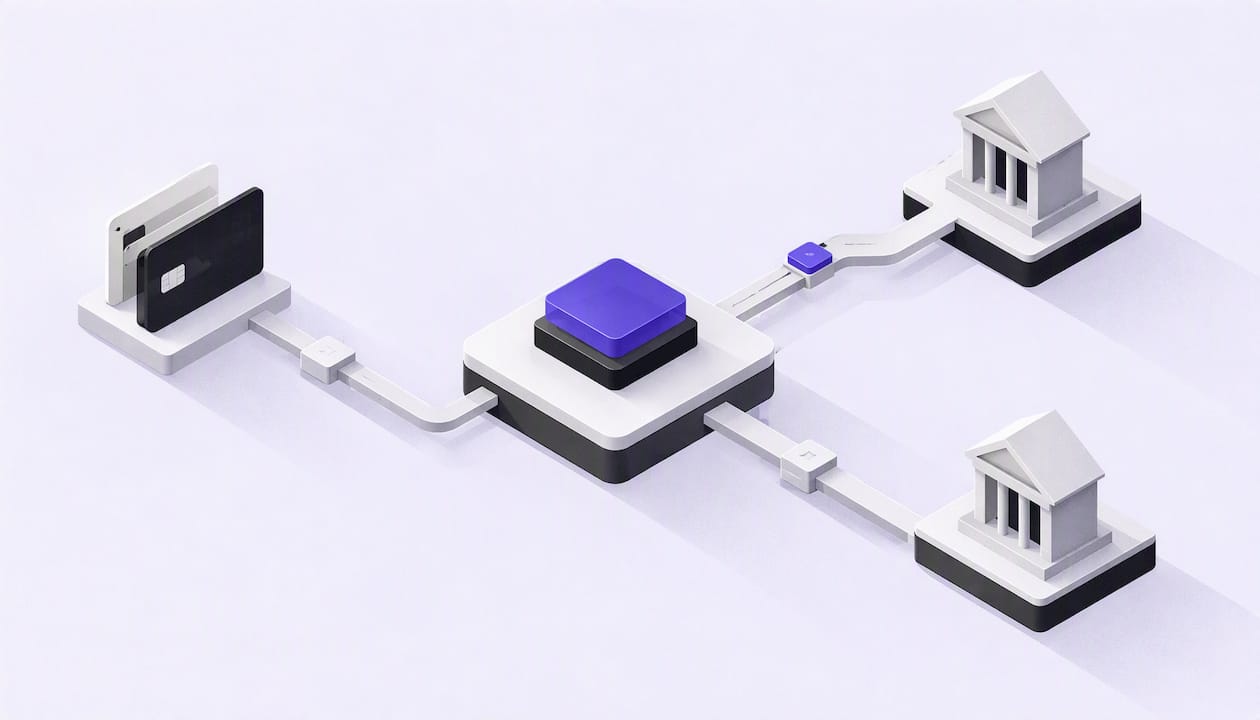
| Gateway tied to a merchant account | Crypto is one more tender type next to cards and ACH, with dollar settlement and one set of reports | The provider converts; you receive USD | Higher-volume stores and regulated or high-risk categories |
| Direct wallet payments | You show a wallet address and match transactions to orders manually | You | Very low volume, or testing demand |
The direct wallet method costs nothing in processing fees, but it has no order matching, no refund workflow and no price locking. Every payment has to be reconciled by hand against an order, and you carry the full exchange-rate exposure. Treat it as a test, not a checkout.
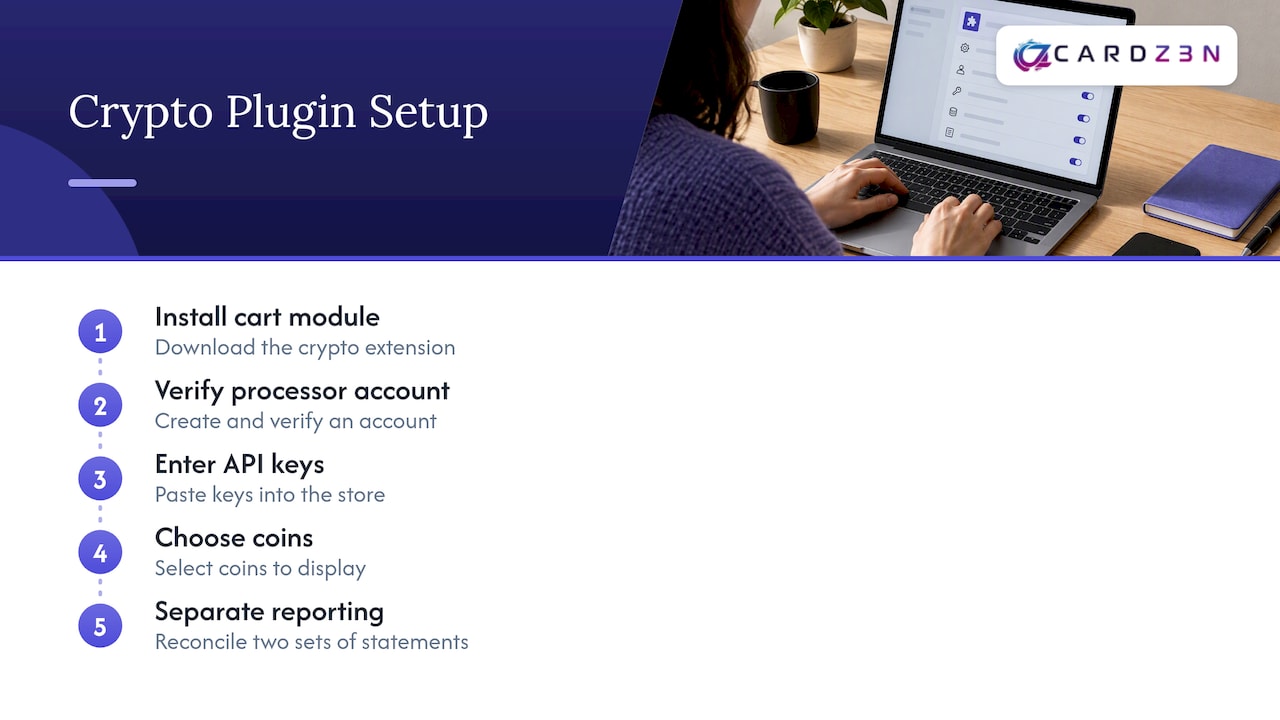
Most major cart platforms have crypto extensions: you download the module, create and verify an account with the processor, paste in API keys, and choose which coins to display. A store can usually go live in an afternoon. The trade-off is that your crypto flow now sits outside your card reporting, so your finance team reconciles two sets of statements, and your fraud monitoring does not see the whole customer.
If you already run a merchant account, the cleaner design is a gateway that treats crypto as another payment method and returns a normal order status to your cart. You keep one dashboard, one settlement schedule and one set of customer records. Our payment gateway integrations for eCommerce cover the carts and platforms most online stores run, and our payment gateway page explains how methods are layered behind a single checkout.
More coins at checkout does not mean more sales. Customers who pay in crypto overwhelmingly hold a short list of assets, and each extra coin adds a confirmation rule, a conversion path and a support question.
A practical starting set looks like this:
Start with two or three assets, watch what customers choose for 60 to 90 days, and add only what the data supports.
A crypto payment is not final the moment the customer hits send. The transaction has to be broadcast to the network and collect a number of confirmations before the processor marks it paid. Bitcoin confirmations take longer than most card authorizations, so processors typically show the customer a payment window with a locked exchange rate and a timer, then release the order once the transaction reaches the confirmation threshold the processor has set. Ask each provider three things in writing:
Underpayments and late payments are the most common source of support tickets in crypto checkout. A good provider handles them with a defined rule, not a manual email thread.
Crypto processing is commonly marketed on low headline percentages, and the headline is rarely the whole cost. When you compare providers, build a simple model that includes:
Prices for crypto and card processing are quote-based and vary by risk profile, volume and average ticket, so we do not publish a single number here. What you can do is ask every provider for the all-in cost on a sample month: for example, 200 orders averaging $85, 30 percent paid in crypto, settled to USD. Compare the net deposit, not the rate card.
If you accept volatile coins and hold them, you are now speculating on the price of Bitcoin as well as selling products. Most merchants do not want that. There are two clean policies:
Whichever you choose, price your catalog in dollars and let the checkout convert at payment time. Do not maintain a separate crypto price list.
Some large consumer wallets and payment apps now let buyers pay with crypto balances, and some let merchants receive crypto-funded payments settled in dollars. The details change often: which merchants are eligible, which coins count, what fee applies, and whether the feature is available to your business category. Those programs are built for mainstream, low-risk merchants and can be withdrawn, limited or reserve-heavy when your category or chargeback profile draws attention. If your store sells CBD, supplements, vape, adult content, subscriptions or anything else on the restricted lists of general-purpose providers, check the current merchant terms of any wallet before you build checkout around it. A feature that can be turned off with your account is not a payment strategy.
This is the part where a mistake costs real money. The points below come from federal agency guidance. Your own situation depends on your structure and state, so involve a CPA, and for money-transmission questions a lawyer who handles financial regulation.
Accepting crypto for goods is still taking in revenue. The IRS says you must report all income received in digital assets on your return, whether or not you receive a Form 1099-K or any other reporting document. In practice:
On the broker side, the IRS has finalized rules under which certain brokers that take possession of digital assets report gross proceeds on Form 1099-DA for transactions on or after January 1, 2025. The IRS describes the purpose as helping taxpayers file accurate returns. If you convert crypto through an exchange or broker, expect to see that form, and match it against your own records.
FinCEN has treated an exchanger, meaning a person engaged as a business in exchanging virtual currency for real currency or other virtual currency, as a money transmitter unless a limitation or exemption applies. FinCEN has also said that businesses that limit their activity to investing in virtual currency for their own account are not money transmitters, while transfers to third parties at the behest of others deserve close scrutiny.
For a store, the lesson is simple. Selling your own products and receiving payment for them is a different activity from taking in crypto on behalf of other people and passing it along. If your business model includes marketplace payouts, wallet top-ups, remittance or exchange features, you may be on the regulated side of that line, and our MSB and remittance merchant accounts page is written for that situation. If you are an exchange or digital asset business yourself, see our crypto exchange merchant account page.

Crypto transfers are irreversible once confirmed. That is the feature buyers of crypto like, and it changes your operations in three ways.
Refunds are a new payment, not a reversal. You send funds back, usually to an address the customer supplies. Decide your policy in advance: refund in the original coin, refund in dollars at the sale-time value, or refund as store credit. State it at checkout, because the exchange rate will have moved. Verify the refund address with the customer through a channel you trust, since a wrong address is unrecoverable.
No chargeback does not mean no dispute. A customer who paid in crypto and is unhappy can still go to their bank if they funded the purchase with a card, file a complaint with a regulator, or leave the story on review sites. The card-network protections you get with documented fulfillment and clear descriptors have no crypto equivalent, so your own paper trail carries more weight: order confirmation, delivery proof, and your policy acceptance. Our guide to five ways to prevent chargebacks applies to the card side of your store, and our chargeback management service covers the card disputes that will still make up most of your volume.
Crypto is the currency of scams. The FTC has reported that impersonation scams increasingly demand payment in cryptocurrency, directing victims to “transfer” money to fake safety lockers. For a merchant, that has two consequences. First, a buyer paying with funds that came from a scam can lead to complaints that reach your store. Second, processors watch crypto merchants closely. In a 2020 settlement, the FTC alleged a payment processor knew or should have known it processed fraudulent schemes and that it was required to apply enhanced screening to certain clients, including crypto merchants. Expect any serious provider to ask about your products, your marketing and your refund practices before approving you. For a broader look at the scam patterns behind this, see this overview of online scams and digital attacks.
Practical controls:
Adding crypto does not take your card checkout out of PCI scope. If the same store takes cards, how you embed the payment form decides which self-assessment questionnaire applies, and this breakdown of SAQ paths for PCI compliance shows how much responsibility stays with your developers and security team even when a hosted processor handles card data.
We see crypto checkout the way we see any new tender type: it is useful when it is added to a sound payment stack and risky when it is added to cover for a weak one. The merchants who approach us after being turned away by mainstream processors are often tempted to treat crypto as the escape hatch. It rarely works as one. You still need a stable settlement path in dollars, transparent reserve terms, clear descriptors and a plan for disputes, because most of your customers will keep paying by card and ACH.
Our advice is to build in this order. First, secure a merchant account that fits your category, with reserve and pricing terms you can read and understand. Second, add crypto as a gateway-level payment method that settles to USD, so volatility never touches your margin. Third, document your refund policy, your recordkeeping and your fraud thresholds before the first coin arrives. We are a specialist in high-risk and B2B processing backed by sponsor banks, and that is the lens we apply: approval resilience first, new payment rails second.
— Joshua Benedetti
If your store is in a category general-purpose processors decline, or you have been frozen or shut down before, crypto is best added on top of a merchant account built for your risk profile. Our high risk merchant account placement handles underwriting with sponsor banks, and our online payment processing page covers card, ACH and alternative checkout methods for ecommerce. If you want to talk through your category and volume, start at CARDZ3N. We quote pricing based on your profile and are upfront about reserve structures.
Not always. A crypto processor can give you a plugin and settle to your bank without any change to your card setup. Still, your card processing should be stable first, and a gateway that handles both keeps reporting and fraud monitoring in one place.
A confirmed crypto transfer cannot be reversed through the network the way a card payment can be disputed. That puts the burden on your refund policy and your records. Customers who funded the purchase some other way may still complain to their bank or a regulator.
Yes, the value is income. The IRS says merchants must report all income received in digital assets, with or without a Form 1099-K. Record the dollar value at the time of each sale and talk to a CPA about how to handle any coins you hold afterward.
Offer both if demand exists, but settle to dollars right away. Stablecoins pegged to the dollar keep the order value steady while the payment confirms, which is why many stores start with one stablecoin and Bitcoin as the second option.
Every merchant's processing setup is different, so the right answer depends on your industry, sales channels, average ticket size and chargeback history. CARDZ3N's payments specialists review those details with you and match your business with the right sponsor bank, gateway and risk tools, whether you sell online, in store, by invoice or on a recurring subscription.
We work with merchants across the USA, Canada, the UK and the EU, including high-risk, B2B and fast-growing businesses that traditional processors often turn away. If you would like a second opinion on your current rates, contract terms or approval options, contact our team for a free, no-obligation processing review.
Joshua Benedetti is the CEO of CARDZ3N, a Las Vegas-based merchant services provider specializing in high-risk payment processing and B2B payment technology.
Joshua Benedetti on LinkedInCARDZ3N Inc is headquartered in Las Vegas, Nevada, and provides merchant services to businesses that traditional processors turn away. Backed by top-tier sponsor banks and processors, CARDZ3N combines institutional stability with the speed of a specialized team that understands high-risk industries. Services include high-risk account underwriting and placement, gateway solutions across the major gateway platforms, POS integrations, ACH and check processing, chargeback prevention through ChargebackZ3N, and business lending and working capital. Its AerospacePay division serves OEMs, MROs, FBOs, and repair stations with B2B and B2G payment processing. CARDZ3N serves merchants in the USA, Canada, the UK, and the EU.
Start protecting your revenue from chargebacks today — schedule your complimentary consultation with CARDZ3N’s dispute management specialists.