

 CARDZ3N — Home
Contact us today for personalized advice and strategic solutions tailored to your goals.

Call us
+1 (702)-623-3528










Merchant statement analysis is a forensic audit that separates non-negotiable card network costs from negotiable processor markup. The single number to track is your effective rate: total fees divided by total sales. If yours runs materially above your card mix’s typical interchange cost, run a three-month audit now or request a human-verified review before renewing your contract.
TL;DR:
- A three-month review helps identify patterns and anomalies, especially for seasonal businesses, and should include detailed classification of all fee lines.
- Most of the processing cost (around 85%) is non-negotiable interchange and assessments set by card networks, which should be verified against actual card mix.
- Fees like PCI non-compliance, minimum volume shortfalls, and regulatory charges are common targets for quick savings and can often be eliminated with administrative fixes.
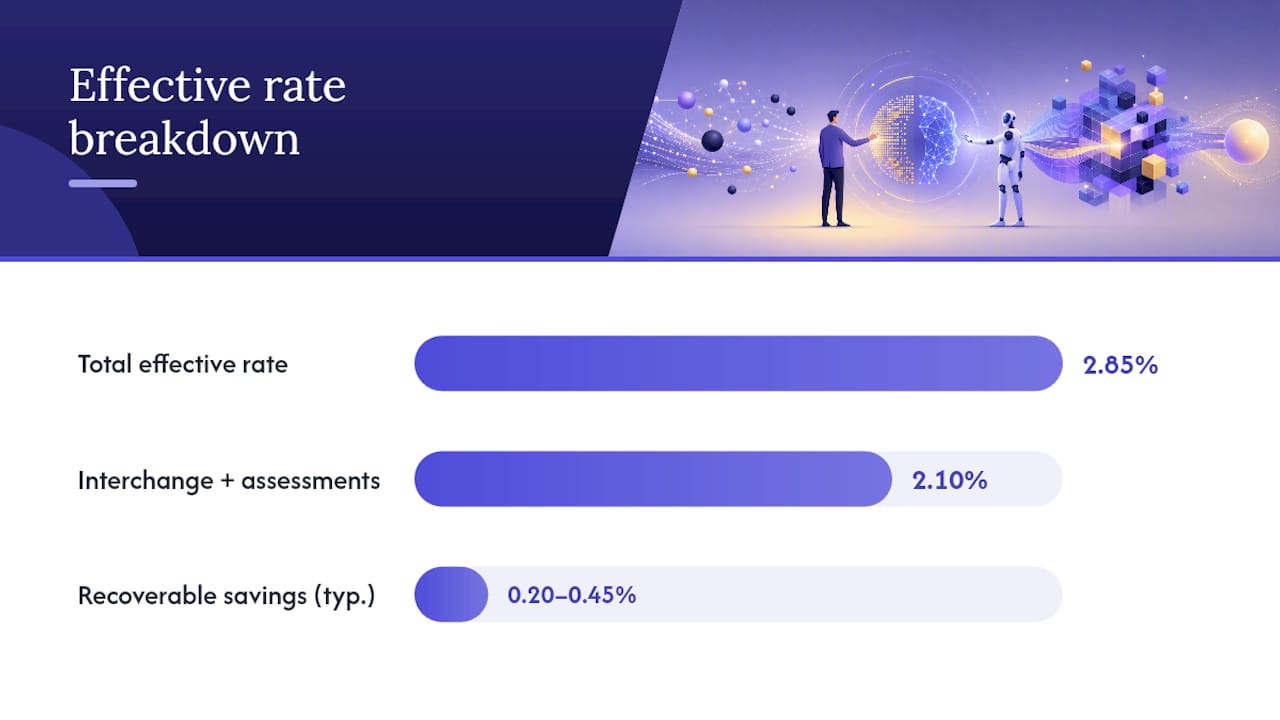
- Effective rate calculation is key for comparison; cost savings typically range from 0.20% to 0.45%, plus hundreds of dollars monthly in hidden fees for mid-size merchants.
- A hybrid review approach, combining automated scans with human analysis for ambiguous findings, ensures the most accurate auditing and negotiating leverage.
Every merchant statement breaks into the same structural sections regardless of processor: a summary, a card-brand breakout, itemized fee lines, and an adjustments section. Learning to read a merchant statement line by line means knowing which of those sections you can actually push back on.
Interchange and assessments sit in the card-brand breakout, and they’re set by Visa, Mastercard, and the other networks. Roughly 85% of your total processing cost comes from interchange and network assessments, and that portion is non-negotiable no matter which processor you choose.
That markup shows up differently depending on your pricing model. Interchange-plus pricing itemizes the network cost and shows the processor’s margin as a separate line, which makes it the easiest model to audit. Tiered pricing bundles everything together, which is exactly why so many merchants overpay without noticing. The effective rate is what reconciles all of it into one comparable figure.
A credible audit starts with the right raw material and a consistent classification system, not a quick glance at last month’s total.
Pro Tip: *Keep a running log of your effective rate every quarter, even between full audits.
Some fee lines almost always deserve a phone call before they deserve a rate negotiation. Certain categories consistently produce the fastest, cheapest wins in a merchant fee audit:
Most of these require an administrative fix, like filing an SAQ or requesting a fee waiver, rather than a full rate renegotiation.
Effective rate is total fees divided by total sales, expressed as a percentage. It’s the closest thing to a net deposit ratio your bank statement will show you, and it’s the number that lets you compare processors on equal footing regardless of how confusing their pricing model looks.
Say a business processes $100,000 in card sales in a month and pays $2,850 in total fees across interchange, assessments, markup, and junk fees. If comparable interchange and assessment costs for that card mix run closer to 2.10%, roughly 0.75 points, or $750 that month, is markup and fees rather than network cost.
Per-transaction fees hit low-ticket merchants hardest. A $0.20 per-transaction fee barely registers on a $150 sale but eats over 2% of a $10 sale, on top of the percentage rate.
A typical clean audit for a mid-size merchant surfaces 0.20% to 0.45% in recoverable effective-rate savings, plus $300 to $800 monthly in junk fees. For a business doing $200,000 a month, that’s thousands of dollars a year sitting in plain sight on statements nobody read closely.
Automated parsers earn their place as a fast first pass, not as the final word.
A hybrid approach works best for most mid-volume merchants: run the automated scan first, then send anything flagged as ambiguous, high-dollar, or contract-related to a human reviewer. Businesses under roughly $50,000 in monthly volume often get by with automated review alone; above that, the dollars at stake usually justify the human layer.
Walk into any renegotiation with three numbers: your 90-day effective rate, your markup-only rate (effective rate minus estimated interchange and assessments), and your total recoverable junk fees in dollars.
If your processor won’t budge on markup after two rounds of discussion, stop negotiating and start collecting migration artifacts: current gateway credentials, terminal lease terms, and settlement timing requirements. That’s the point to build a request for proposal instead.
Pro Tip: Never lead a negotiation call with your headline rate complaint. Lead with the specific dollar figure from your audit. Processors respond to line-item numbers far faster than general dissatisfaction.
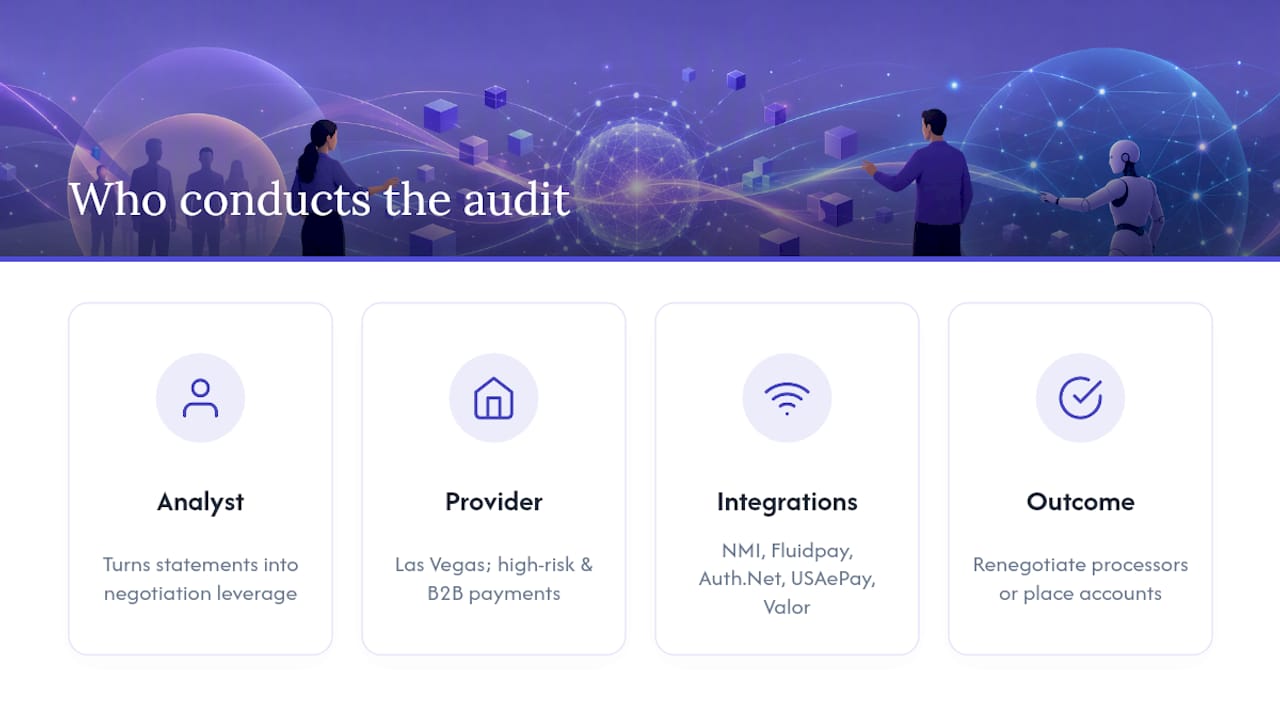
Reliable statement analysis depends on who’s reading the numbers, not just which software parses them. Joshua, who covers merchant services and payment processing for Cardz3n, focuses on translating dense statement language into concrete negotiation leverage for finance teams that don’t process statements for a living.
Cardz3n is a Las Vegas based merchant services provider specializing in high-risk payment processing and B2B payment technology, backed by top-tier sponsor banks and processors. Its underwriting and placement work spans gateway integrations through NMI, Fluidpay, Authorize.Net, USAePay, and Valor PayTech, along with POS integrations, ACH and check processing, and chargeback prevention through its ChargebackZ3N division. That range matters because a statement audit is only useful if someone on the other end can act on the findings, whether that means renegotiating with an existing processor or placing a merchant account with a better fit.
Processing pricing drifts. Those small basis-point leaks compound into real annual dollars once volume scales. Quarterly effective-rate monitoring paired with an annual forensic audit is the right cadence for most mid-market merchants, not because it’s exciting work, but because nobody else is going to flag it for you.
— Joshua
Running your own audit tells you what’s wrong. Fixing it, renegotiating rates, filing PCI paperwork, or moving your account entirely, is a different job, and it’s the one Cardz3n handles end to end. Where a DIY spreadsheet or an automated parser stops at a list of findings, Cardz3n’s underwriting and placement team acts on them directly: renegotiating markup, correcting PCI compliance status, and if your current processor won’t move, placing you with a better-fit account backed by its sponsor bank relationships.
That matters most for high-risk, high-volume, or regulated merchants, where a generic processor often can’t offer the flexibility a forensic audit reveals you need. Cardz3n’s gateway integrations (NMI, Fluidpay, Authorize.Net, USAePay, Valor PayTech), POS integrations, and chargeback prevention through ChargebackZ3N mean remediation and migration happen under one roof instead of across three vendors. If your last statement review turned up numbers you don’t like, request a statement review from Cardz3n and find out what a managed fix actually looks like.
This article is general information, not a substitute for advice from a qualified financial advisor. Consult a qualified financial professional about your own circumstances before acting on anything here.
Every merchant's processing setup is different, so the right answer depends on your industry, sales channels, average ticket size and chargeback history. CARDZ3N's payments specialists review those details with you and match your business with the right sponsor bank, gateway and risk tools, whether you sell online, in store, by invoice or on a recurring subscription.
We work with merchants across the USA, Canada, the UK and the EU, including high-risk, B2B and fast-growing businesses that traditional processors often turn away. If you would like a second opinion on your current rates, contract terms or approval options, contact our team for a free, no-obligation processing review.
Joshua Benedetti is the CEO of CARDZ3N, a Las Vegas-based merchant services provider specializing in high-risk payment processing and B2B payment technology.
Joshua Benedetti on LinkedInCARDZ3N Inc is headquartered in Las Vegas, Nevada, and provides merchant services to businesses that traditional processors turn away. Backed by top-tier sponsor banks and processors, CARDZ3N combines institutional stability with the speed of a specialized team that understands high-risk industries. Services include high-risk account underwriting and placement, gateway solutions across the major gateway platforms, POS integrations, ACH and check processing, chargeback prevention through ChargebackZ3N, and business lending and working capital. Its AerospacePay division serves OEMs, MROs, FBOs, and repair stations with B2B and B2G payment processing. CARDZ3N serves merchants in the USA, Canada, the UK, and the EU.
Start protecting your revenue from chargebacks today — schedule your complimentary consultation with CARDZ3N’s dispute management specialists.