

 CARDZ3N — Home
Contact us today for personalized advice and strategic solutions tailored to your goals.

Call us
+1 (702)-623-3528









Friendly fraud chargebacks happen when a cardholder disputes a legitimate, authorized transaction, usually by claiming it was unrecognized, undelivered, or unauthorized. The immediate move is to preserve every scrap of transaction evidence and check your billing descriptor and post-purchase communications before disputes escalate. Frameworks like Visa’s CE3.0 and partners like CARDZ3N exist specifically to help you win that fight.
You’ll also hear friendly fraud called first-party misuse, chargeback fraud, or the “liar-buyer” problem. All three describe the same core issue: the cardholder made the purchase, but disputes it anyway, either by mistake or on purpose.
That distinction matters for how you fight back. True fraud involves a stolen card and an unauthorized transaction, so tools like 3D Secure (3DS2) that verify the cardholder’s identity at checkout work well. Friendly fraud involves the actual cardholder completing a real purchase, so authentication signals carry almost no weight once the dispute lands. The transaction was authorized. The argument is about what happened after.
Misclassifying a friendly fraud case as garden-variety fraud leads merchants toward the wrong defense:
A friendly fraud chargeback moves through a fairly rigid sequence, and missing a step usually means losing the case by default.
Deadlines here are non-negotiable. Miss the representment window and the chargeback becomes final regardless of how strong your evidence would have been, so understanding how dispute resolution works in remittance apps can help you manage timelines and evidence requirements effectively.
Not every friendly fraud chargeback comes from a bad actor. Some of the most common cases are honest mistakes that still cost you money.
The diagnostic clue that separates accidental from intentional misuse is repetition. A single confused customer is a communications problem. The same person or the same device disputing five times across six months is a pattern, and CE3.0 representment increasingly relies on exactly that kind of behavioral history.
Every friendly fraud chargeback costs you more than the sale price. You lose the goods or service already delivered, eat the chargeback fee your acquirer charges regardless of outcome, and absorb the staff hours spent pulling evidence and filing representment.
Statistic Callout: Global retail ecommerce sales have climbed steadily according to Statista’s tracking of worldwide ecommerce volume, and every additional transaction is another opportunity for a dispute. More volume means more exposure, not just more revenue.
The bigger threat sits at the account level. Card networks track your chargeback ratio, the percentage of transactions disputed against total transaction count, and once you cross their threshold you land in a monitoring program. Visa’s excessive chargeback tracking (part of what’s often referred to under VAMP) can trigger higher fees, reserve requirements, or termination of your processing agreement. A merchant with thin margins and a rising dispute rate isn’t just losing individual sales; the entire account becomes a liability to the acquiring bank.
Most friendly fraud is preventable before it ever becomes a dispute. These are the controls that move the needle fastest.
Pro Tip: Route your gateway data into an issuer collaboration tool before you touch representment templates. Preventing the dispute is always cheaper than winning it.
Mastercard and Visa both frame this the same way: reduce statement confusion first, then fight the disputes that still get filed. Merchants who treat these as sequential steps, not competing priorities, see the biggest drop in overall dispute volume.
Winning a friendly fraud dispute comes down to whether your evidence tells a story the issuer can’t ignore. The strongest submissions combine several kinds of proof, not just one.
Visa’s CE3.0 framework formalizes this. It asks for structured, corroborating data points, one of the most useful being evidence of a prior undisputed transaction from the same device or IP address that’s more than 120 days old. That single data point tells the issuer this customer has a track record of legitimate, unchallenged use.
Networks report that enabling pre-dispute data sharing significantly reduces disputes that would otherwise become full chargebacks, which shifts the economics of the whole fight toward prevention rather than after-the-fact representment.
Not every chargeback is worth fighting. If the disputed amount is small and your evidence is thin, refunding may cost less than the staff time representment requires. Reserve full CE3.0 documentation for higher-value transactions or patterns involving repeat disputers, where a win protects more than just one sale.
You can’t fix what you don’t measure. A handful of metrics tell you whether your prevention program is actually working.
Run daily triage on new disputes to hit deadlines, a weekly review of reason-code trends, and a monthly root-cause pass to catch descriptor or fulfillment issues before they compound. Industry guidance from Primer’s merchant playbook recommends layering light-touch fixes for legitimate customers with targeted friction for repeat offenders, then measuring the result and adjusting. That iterative loop, not a one-time fix, is what actually moves your chargeback ratio down over a full quarter.
CARDZ3N’s work with subscription merchants shows how the prevention and representment tactics above play out in practice. The case detailed in How Subscription Merchants Cut Chargebacks Below 1% walks through descriptor cleanup, renewal-reminder timing, and a standardized evidence kit built for recurring-billing disputes specifically.
CARDZ3N’s relevant capabilities for merchants fighting friendly fraud include:
Merchants running subscription or recurring-billing models tend to see the fastest gains here, since renewal disputes are one of the most predictable and preventable categories of friendly fraud.
The conventional advice on friendly fraud treats it as a documentation problem: collect enough evidence, win enough disputes, move on. That’s backwards. The merchants who actually get their chargeback ratio under control treat representment as the fallback, not the strategy.
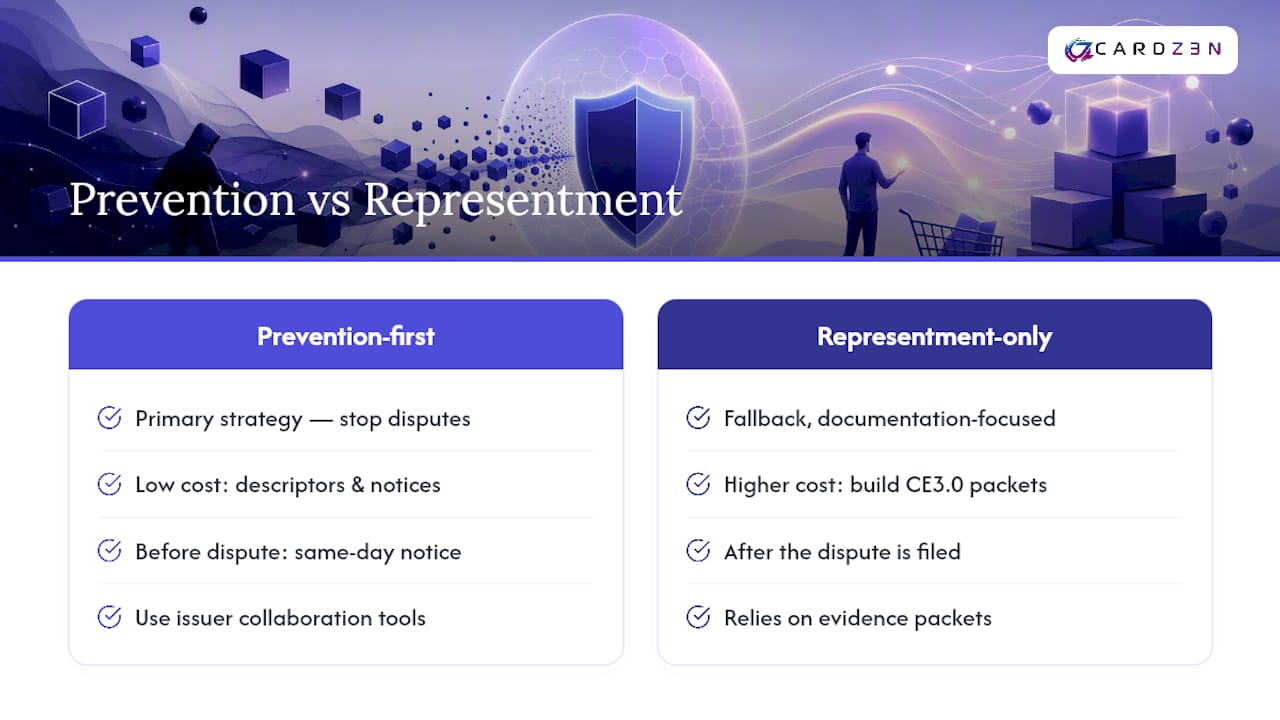
Prevention wins on math alone. A clear billing descriptor and a same-day shipping notification cost you almost nothing and stop a dispute before it starts. Building a CE3.0 evidence packet after the fact costs staff hours, and even a strong case only wins back what you’d have kept for free with better upfront communication. Issuer collaboration tools deserve more attention than they get, since surfacing transaction detail directly to the cardholder’s bank resolves confusion before it becomes a formal dispute at all.
Where merchants get this wrong: they wait for chargeback volume to become a crisis before fixing descriptors or messaging. Fix the cheap stuff first. Save your representment effort for the disputes that survive good prevention, because those are the ones actually worth fighting.
— Joshua Benedetti
CARDZ3N is the difference between fighting friendly fraud chargebacks case by case and having prevention built into your processing setup from day one. Through its ChargebackZ3N division, CARDZ3N pairs high-risk merchant account underwriting with gateway integrations, evidence workflows aligned to CE3.0 standards, and descriptor and transaction-data practices designed to stop disputes before they start. That’s a different posture than bolting a dispute tool onto a generic merchant account after the chargebacks already started piling up.
This fits merchants running subscription billing, high-volume ecommerce, or any business where friendly fraud has started eating into margin faster than sales can outpace it. If your current processor treats chargebacks as your problem alone, it’s worth comparing that against CARDZ3N’s high-risk merchant account and payment processing options, or reviewing the chargeback management and dispute prevention services directly to see how prevention gets built into the account itself.
Criminal prosecution for a single friendly fraud dispute is rare, but organized or repeated schemes involving significant dollar amounts can trigger fraud charges, since the transaction is a real financial crime once intent to deceive is proven.
Common examples include a customer disputing a subscription renewal they forgot to cancel, a family member’s purchase the cardholder didn’t recognize, and a liar-buyer disputing a delivered, satisfactory order to get a free refund.
A customer orders a product, receives it in good condition, then contacts their card issuer claiming it never arrived instead of contacting the merchant, forcing the merchant to fight the chargeback with delivery and tracking evidence.
It’s serious at both the transaction and account level: individual disputes cost you the goods, fees, and staff time, and a chargeback ratio that crosses network thresholds can trigger monitoring programs, higher fees, or loss of your processing account entirely.
Every merchant's processing setup is different, so the right answer depends on your industry, sales channels, average ticket size and chargeback history. CARDZ3N's payments specialists review those details with you and match your business with the right sponsor bank, gateway and risk tools, whether you sell online, in store, by invoice or on a recurring subscription.
We work with merchants across the USA, Canada, the UK and the EU, including high-risk, B2B and fast-growing businesses that traditional processors often turn away. If you would like a second opinion on your current rates, contract terms or approval options, contact our team for a free, no-obligation processing review.
Joshua Benedetti is the CEO of CARDZ3N, a Las Vegas-based merchant services provider specializing in high-risk payment processing and B2B payment technology.
Joshua Benedetti on LinkedInCARDZ3N Inc is headquartered in Las Vegas, Nevada, and provides merchant services to businesses that traditional processors turn away. Backed by top-tier sponsor banks and processors, CARDZ3N combines institutional stability with the speed of a specialized team that understands high-risk industries. Services include high-risk account underwriting and placement, gateway solutions across the major gateway platforms, POS integrations, ACH and check processing, chargeback prevention through ChargebackZ3N, and business lending and working capital. Its AerospacePay division serves OEMs, MROs, FBOs, and repair stations with B2B and B2G payment processing. CARDZ3N serves merchants in the USA, Canada, the UK, and the EU.
Start protecting your revenue from chargebacks today — schedule your complimentary consultation with CARDZ3N’s dispute management specialists.