
 CARDZ3N — Home
Contact us today for personalized advice and strategic solutions tailored to your goals.

Call us
+1 (702)-623-3528










An ACH return code is a three-character identifier, always the letter “R” followed by two digits, that tells you exactly why an electronic payment failed to post. This guide gives you the full R01 through R85 reference, the NACHA-defined return windows that govern each one, and the remediation workflows your team needs to act fast without triggering compliance problems.
Every ACH return code originates from one of three places: the Receiving Depository Financial Institution (RDFI), the Originating Depository Financial Institution (ODFI), or the ACH Operator itself. Knowing which party issued the return tells you almost everything about how to fix it.
The RDFI is the receiving bank, the institution holding the account you tried to debit or credit. When a code points to an account problem, closed account, insufficient funds, invalid account number, the RDFI generated it after the entry reached the bank. The ODFI is your originating bank, the one that submitted the transaction into the ACH network on your behalf. Some returns loop back through the ODFI when a receiving bank flags a dispute or when your originating bank itself catches an error before submission.
The ACH Operator, either the Federal Reserve or The Clearing House, handles the actual movement of files between institutions. Certain returns never touch a bank account at all. They happen at the file level because a field was formatted incorrectly, a routing number failed a checksum, or a batch header didn’t match network specifications. Plaid’s documentation on ACH returns draws this exact distinction: format rejects are a technical failure, not a customer failure, and they should route straight to engineering rather than to a collections queue.
A few operating basics worth internalizing before you look at individual codes:
This table covers the standard NACHA return codes, drawn from the Modern Treasury developer documentation and Plaid’s ACH return guide. Codes flagged “IAT” apply specifically to International ACH Transactions; codes flagged “Federal” are reserved for government payment programs.
A handful of codes drive nearly every return your business will actually process, and each one demands a different response.
Pro Tip: Build a simple routing rule into your reconciliation system: R01 and R09 go to a “retry queue” with a delay timer, R02 through R04 go to a “data correction queue” for outreach, and R05/R07/R10/R11/R29 go straight to a “hold and investigate” queue with debits frozen. That three-way split alone eliminates most misclassification errors.
Codes R05, R07, R10, R11, and R29 all signal the same underlying problem from different angles: the account holder disputes that the debit was authorized. R05 covers an unauthorized debit to a consumer account. R07 means the customer revoked an authorization that once existed. R10 covers cases where the customer says they never gave authorization to your business in the first place. R11 flags a debit that technically had authorization but didn’t match the terms the customer agreed to, wrong amount, wrong date, wrong frequency. R29 is the corporate equivalent of an unauthorized-debit claim, used when the account belongs to a business rather than a consumer.
Timing differs sharply between these two categories. Consumer accounts get a 60-calendar-day window to dispute an unauthorized debit, under NACHA’s operating rules. Corporate accounts operate on a much shorter clock, frequently limited to the standard two-banking-day return window unless a separate agreement extends it.
When one of these codes lands, document everything before you respond to the customer:
More than half of ACH fraud disputes trace back to a merchant’s own authorization records being incomplete or poorly timestamped, which is exactly why the documentation step above isn’t optional busywork. Weak records turn a defensible dispute into an automatic loss.
A returned payment is a data point, not a crisis, provided your team follows the same sequence every time. Skipping steps is what turns a routine R01 into a customer relations problem or a compliance flag.
Pro Tip: Keep a standing evidence template ready before you ever need it, fields for authorization date, customer communication log, retry history, and resolution notes. Sponsor banks respond far better to a merchant who hands over a filled template in ten minutes than one who scrambles to reconstruct records after a rate review notice arrives.
Modern Treasury’s research on handling returns at scale makes a point worth repeating here: manual return tracking breaks down fast once volume climbs. Integrated reconciliation systems that automatically tag each return by code, route it to the right queue, and timestamp the resolution aren’t a luxury for high-volume originators. They’re the difference between staying inside NACHA’s return-rate thresholds and triggering a sponsor bank review.
Prevention beats remediation every time, and most of the leverage sits earlier in the process than teams expect.
Pro Tip: If your return rate for unauthorized codes (R05, R07, R10, R11, R29) creeps above 0.5%, treat it as an authorization-collection problem before you treat it as a customer problem. Weak consent capture at signup is the root cause far more often than actual fraud.
A Notification of Change is not a return. It’s a correction request, coded C01 through C14, telling you that an entry posted successfully but contained outdated or slightly incorrect information, an account number that changed after a bank merger, or a routing number that shifted after an institution restructured. The money moved. The instructions just need updating for next time.
NACHA rules require originators to apply the correction within a set window, typically before the next scheduled entry, or risk generating an actual return down the line.
Treat every NOC as a mandatory update ticket, not an informational notice.
Sponsor banks and NACHA both monitor return rates continuously, and they don’t wait for a crisis to act. Once your unauthorized-return rate or overall return rate crosses defined thresholds, expect a request for a remediation plan before anything more severe happens.
Outcomes escalate in stages. First comes closer monitoring and a request for written explanation. If the rate doesn’t improve, expect reserve requirements to increase, holding back a larger share of your processing volume as a buffer against further losses. Continued noncompliance can lead to processing limits or account suspension, which for a growing merchant means real revenue disruption at the worst possible time.
The merchants who navigate a remediation request well share one habit: they show up with evidence already assembled. A month-by-month return breakdown by code, documented corrective actions taken (tightened authorization capture, added account validation, retrained a customer service queue), and a clear timeline for improvement turns a defensive conversation into a credible plan. Sponsors respond to specifics, not promises.
High-risk merchants, subscription billers, nutraceutical sellers, CBD and hemp businesses, generate return patterns that standard processors flag as red alerts even when the underlying business is healthy. Recurring billing models naturally produce more R01 and R09 codes than one-time transactions simply because of payment timing, and that reality gets misread by processors unfamiliar with the vertical.
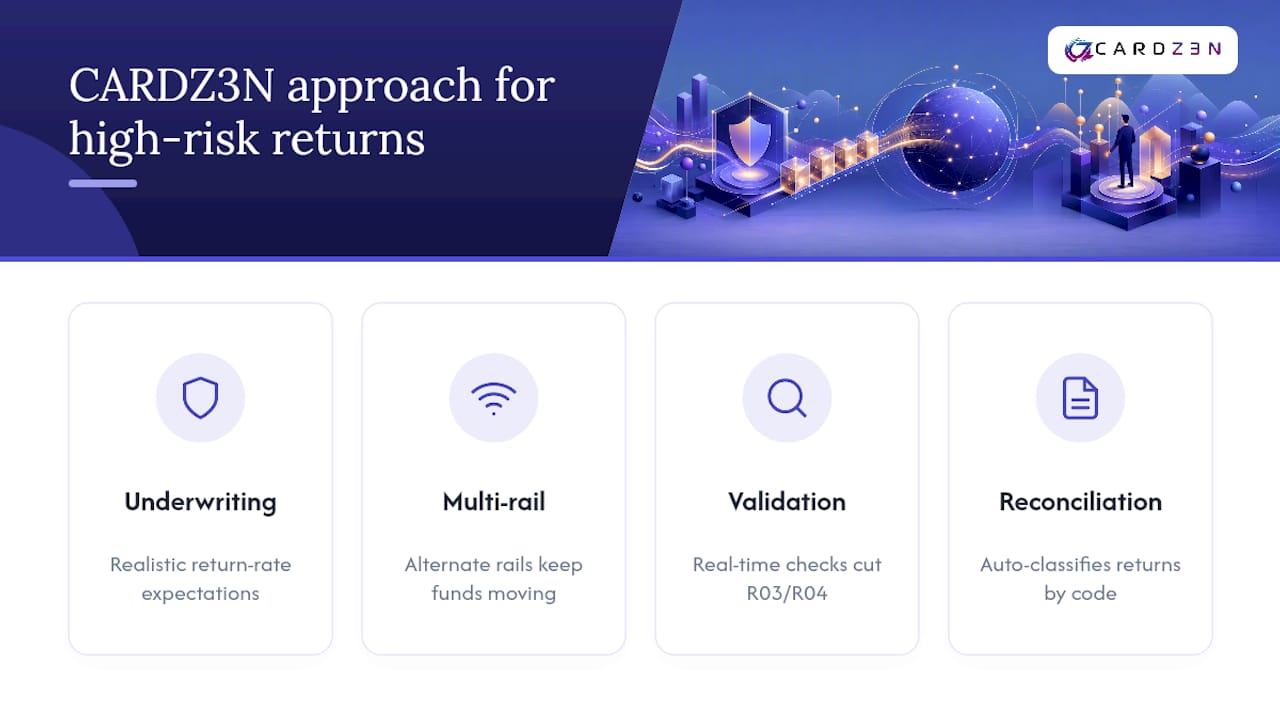
Underwriting built for high-risk categories accounts for this from day one, setting realistic return-rate expectations tied to the actual business model rather than a generic benchmark. Multi-rail routing across several sponsor banking relationships also matters here: if one processing rail experiences a temporary return spike, resilient placement keeps transactions moving through an alternate path instead of stalling cash flow entirely.
Practical integration points make the difference in daily operations, real-time account validation to cut R03/R04 volume before it starts, chargeback prevention workflows that run alongside ACH monitoring since disputes and unauthorized returns often travel together, and reconciliation automation that classifies returns by code the moment they land.
If your business has faced a sponsor bank warning, an unexpected reserve increase, or repeated account reviews tied to return-rate volatility, that’s the signal it’s time to talk to a processor built specifically for high-risk merchants instead of hoping a generalist platform adapts.
Three things separate teams that handle returns smoothly from teams that don’t, and none of them are complicated.
First, automation beats vigilance. No finance team, however sharp, catches every misclassified return by hand once volume climbs past a few hundred transactions a month. A system that routes by code removes the human error entirely.
Second, documentation is your insurance policy, not paperwork. The authorization record you save today is the thing that turns an R10 dispute into a non-event instead of a chargeback loss six weeks from now.
Third, communication with the customer matters more than the code itself. An R02 handled with a quick, friendly outreach for updated account details preserves a relationship. The same code ignored for two billing cycles turns into a churned customer and a frustrated support queue.
Use the reference table above as your working document, not a one-time read. Pin it near wherever your team reviews daily returns.
— Joshua Benedetti
If you’ve read this far because your return rates keep drawing sponsor bank attention, or because a mainstream processor flagged your subscription or high-risk billing model as too volatile to keep, a generalist platform was probably never built to solve that problem. CARDZ3N specializes in exactly the merchants that get turned away elsewhere, CBD and hemp, nutraceuticals, subscription and MLM billing, vape, and other high-risk categories where return patterns get misread as red flags instead of normal business behavior.
What sets the approach apart is transparency most high-risk processors avoid: clear reserve structures and quote-based pricing instead of vague fine print, backed by relationships with top-tier sponsor banks and multi-rail routing that keeps processing resilient when one channel hits friction. If ACH returns, reserve increases, or repeated account reviews have become a recurring headache, explore CARDZ3N’s high-risk merchant account and payment processing options and get a quote built around your actual transaction volume and risk profile.
For rule verification beyond this guide, start with NACHA’s own guidance differentiating unauthorized return reasons and its ISO 20022 camt.053 returns mapping guide for treasury teams working on format migrations. Plaid’s ACH return reference and Modern Treasury’s developer documentation both maintain detailed, regularly updated R01–R85 tables. Stripe’s rejection code breakdown offers a useful categorization framework for teams building internal remediation playbooks.
R27 indicates a trace number error, meaning the unique identifier attached to the original entry didn’t match network records. It’s an ACH Operator issued, file-level error that points to a technical formatting problem rather than an account issue, so route it to engineering, not customer service.
R07 means the customer revoked an authorization that previously existed for a recurring debit. It falls under the unauthorized-return category, giving consumer accounts up to a 60-calendar-day window to file the dispute, and it requires you to stop the debit series immediately and investigate before any resubmission.
R20 signals that the account is a non-transaction account, meaning it can’t accept ACH debits or credits at all, such as certain savings or loan accounts. You’ll need to contact the customer for a different account rather than attempting a retry.
R23 means the receiver refused a credit entry, most often because the payment amount, timing, or purpose didn’t match what they expected. Reach out to confirm the correct payment details before resubmitting, since retrying with the same information will likely trigger the same refusal.
Any code in the unauthorized-dispute category, R05, R07, R10, R11, or R29, requires immediate action: stop the debit series and begin documentation before any further attempt to collect. Standard codes like R01 or R09 can usually wait for a scheduled retry cycle instead.
Every merchant's processing setup is different, so the right answer depends on your industry, sales channels, average ticket size and chargeback history. CARDZ3N's payments specialists review those details with you and match your business with the right sponsor bank, gateway and risk tools, whether you sell online, in store, by invoice or on a recurring subscription.
We work with merchants across the USA, Canada, the UK and the EU, including high-risk, B2B and fast-growing businesses that traditional processors often turn away. If you would like a second opinion on your current rates, contract terms or approval options, contact our team for a free, no-obligation processing review.
Joshua Benedetti is the CEO of CARDZ3N, a Las Vegas-based merchant services provider specializing in high-risk payment processing and B2B payment technology.
Joshua Benedetti on LinkedInCARDZ3N Inc is headquartered in Las Vegas, Nevada, and provides merchant services to businesses that traditional processors turn away. Backed by top-tier sponsor banks and processors, CARDZ3N combines institutional stability with the speed of a specialized team that understands high-risk industries. Services include high-risk account underwriting and placement, gateway solutions across the major gateway platforms, POS integrations, ACH and check processing, chargeback prevention through ChargebackZ3N, and business lending and working capital. Its AerospacePay division serves OEMs, MROs, FBOs, and repair stations with B2B and B2G payment processing. CARDZ3N serves merchants in the USA, Canada, the UK, and the EU.
Start protecting your revenue from chargebacks today — schedule your complimentary consultation with CARDZ3N’s dispute management specialists.