 CARDZ3N — Home
Contact us today for personalized advice and strategic solutions tailored to your goals.

Call us
+1 (702)-623-3528




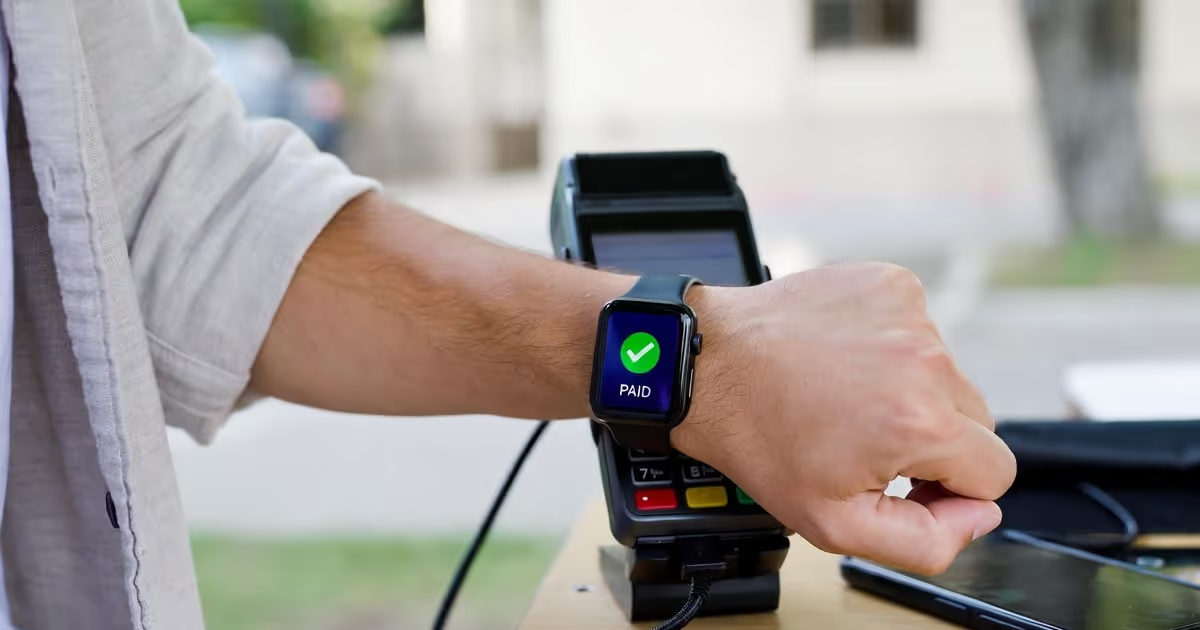





A contactless payment is a transaction made by tapping — rather than inserting, swiping, or handing over cash — a card, phone, or wearable device near a payment terminal. This "tap to pay" experience runs on a short-range wireless technology called Near Field Communication (NFC), which securely exchanges encrypted payment data in under a second, without requiring a PIN or signature for most everyday purchases.
If you've ever tapped your debit card at a coffee shop or paid with an NFC mobile payment app like Apple Pay at the grocery store, you've used contactless payment. Tap to pay is now the default way most people pay in stores across the US, UK, and EU.
Every contactless card and NFC-enabled phone contains a small chip and antenna. When you hold it within about one to two inches of a compatible terminal:
Because the data exchanged is tokenized and unique to that single transaction, a contactless tap doesn't expose your card number the way a mag-stripe swipe historically did.
You'll recognize a contactless-enabled card or terminal by the universal symbol: four curved lines that get progressively larger, resembling a Wi-Fi signal turned on its side.
Contactless payment isn't limited to plastic cards. The most common forms include:
These terms get used interchangeably, but they describe different layers of the same transaction:
In short: all mobile payments are contactless, but not all contactless payments are mobile.
Limits vary by country and, increasingly, by individual bank:
| Region | Typical limit (no PIN required) | Notes |
|---|---|---|
| United States | No fixed federal cap | Each card network and issuer sets its own threshold before requiring a PIN or signature; many terminals default to $100 or the issuer's own limit |
| United Kingdom | Previously a flat £100 cap | As of March 2026, the FCA allows individual banks and payment providers with strong fraud controls to set their own contactless limits instead of a single fixed cap, giving consumers more flexibility to raise, lower, or turn off contactless entirely |
| European Union | Commonly around €50 | Varies by country; most require a PIN once a per-transaction or cumulative daily threshold is reached |
There's no limit to how many contactless transactions you can make in a row — only to the value of each individual tap before a PIN is required, and in some cases a cumulative limit before a PIN-verified transaction resets the counter.
Yes — contactless payments are generally considered as secure as, or more secure than, inserting or swiping a card, for several reasons:
The convenience that makes contactless fast for consumers — no PIN entry, no physical contact with a shared keypad — is a byproduct of the same tokenization that keeps it secure.
For merchants, contactless isn't just a consumer convenience — it directly affects checkout speed and customer experience:
To accept contactless payments, your business needs:
If you're setting up a new merchant account or your current processor doesn't support contactless, modern payment technology and merchant account setup can typically be in place within days — including for high-risk or specialty merchant categories that traditional processors turn away.
What is NFC, and how is it related to contactless payments?
NFC (Near Field Communication) is the short-range wireless technology that powers contactless payments. It allows a card or device to exchange encrypted payment data with a terminal when held within a couple of inches, without physical contact.
Is contactless payment safe?
Yes. Contactless payments use tokenized, encrypted data unique to each transaction, the same fraud protections as chip and PIN, and a proximity requirement that limits exposure to unauthorized use.
How do contactless payments work without a PIN?
Terminals and card networks set a maximum transaction value below which a PIN isn't required, based on the low fraud risk of small, tokenized transactions. Once that threshold is exceeded, a PIN or biometric verification is required.
What's the difference between a contactless payment and a mobile payment?
A mobile payment is a contactless payment made from a phone or wearable via a digital wallet, rather than a physical card. All mobile payments are contactless, but contactless payments also include tapping a physical card.
Do I need special equipment to accept contactless payments?
Yes — you need an NFC-enabled terminal or card reader connected to a merchant account and processor that support contactless authorization. Most POS hardware sold today includes this by default.
How does tap to pay work?
Tap to pay is the everyday name for a contactless transaction: you hold a card or NFC mobile payment device near a terminal, the chip exchanges an encrypted one-time token with the reader, and the payment is authorized in about the time it takes to swipe a card — no PIN entry required below the issuer's limit.
What is an NFC mobile payment?
An NFC mobile payment is a contactless payment made from a smartphone or wearable — through Apple Pay, Google Pay, or Samsung Pay — using the same Near Field Communication technology as a tap-to-pay card, but with the card details tokenized and stored on the device instead of printed on plastic.
Ready to accept contactless payments at your business? Talk to our team about merchant accounts and POS integrations built for fast, secure tap-to-pay checkout — including for high-risk and specialty merchants.
Every merchant's processing setup is different, so the right answer depends on your industry, sales channels, average ticket size and chargeback history. CARDZ3N's payments specialists review those details with you and match your business with the right sponsor bank, gateway and risk tools, whether you sell online, in store, by invoice or on a recurring subscription.
We work with merchants across the USA, Canada, the UK and the EU, including high-risk, B2B and fast-growing businesses that traditional processors often turn away. If you would like a second opinion on your current rates, contract terms or approval options, contact our team for a free, no-obligation processing review.
Joshua Benedetti is the CEO of CARDZ3N, a Las Vegas-based merchant services provider specializing in high-risk payment processing and B2B payment technology.
Joshua Benedetti on LinkedInCARDZ3N Inc is headquartered in Las Vegas, Nevada, and provides merchant services to businesses that traditional processors turn away. Backed by top-tier sponsor banks and processors, CARDZ3N combines institutional stability with the speed of a specialized team that understands high-risk industries. Services include high-risk account underwriting and placement, gateway solutions across the major gateway platforms, POS integrations, ACH and check processing, chargeback prevention through ChargebackZ3N, and business lending and working capital. Its AerospacePay division serves OEMs, MROs, FBOs, and repair stations with B2B and B2G payment processing. CARDZ3N serves merchants in the USA, Canada, the UK, and the EU.
Start protecting your revenue from chargebacks today — schedule your complimentary consultation with CARDZ3N’s dispute management specialists.