


 CARDZ3N — Home
Contact us today for personalized advice and strategic solutions tailored to your goals.

Call us
+1 (702)-623-3528










A velocity check counts how many times a specific data element (a card number, IP address, device ID) appears within a set time window and flags activity that crosses a defined threshold. It exists to catch fraud that happens fast: card testing scripts, bot-driven signup bursts, and account takeover attempts that generate dozens of transactions in minutes. Velocity checks work best as one layer in a broader detection system, not as a standalone gatekeeper.
Different attacks leave different fingerprints, and each velocity type is built to catch a specific one. Running only one type leaves obvious gaps.
Short windows (minutes to an hour) catch rapid bursts like automated card testing. Longer windows (24 hours to 30 days) catch slower-moving abuse, like a fraud ring that spaces out purchases to avoid tripping obvious limits. Stripe’s guidance on velocity checks treats these entity types as the baseline building blocks most fraud teams start with, and running both window lengths in parallel is what actually closes the gap between the two attack speeds.
Every velocity rule reduces to three components: a quantity (the threshold), a data element (what you’re counting), and a timeframe (the window). A rule reads something like “flag more than 5 transactions on the same card number within 24 hours,” and that structure holds whether you’re screening card numbers, IPs, or shipping addresses.
Here’s the evaluation flow a rules engine typically follows:
That counter-and-TTL pattern is the engineering backbone of most velocity systems. A key-value store like Redis handles this well because TTL expiration is native, and lookups need to happen in milliseconds to avoid adding latency to checkout. The U.S. Payments Forum’s white paper on velocity checks notes that the technique depends on a supporting database capable of tracking these counts accurately across sessions, which is why teams that bolt velocity logic onto a system never designed for fast key lookups tend to see checkout slowdowns first and false negatives second.
Real-time screening evaluates every transaction before authorization completes, adding a few milliseconds of latency but catching fraud before money moves. Batch screening runs on a schedule (hourly or nightly) and works fine for lower-risk review queues, but it means a card testing burst can complete before anyone notices. For anything touching checkout or login, real-time is the only option worth building.
Pro Tip: Build cumulative-amount rules alongside count rules. A merchant that only counts transactions will miss a fraudster who makes two authorizations for $4,500 each instead of ten for $50, even though both patterns represent the same total exposure.
Getting the mechanics right matters less than getting the inputs and layering right. A perfectly coded rule engine fed the wrong data still misses fraud.
Start with the data elements that actually matter: hashed card PAN, device fingerprint, IP address, email domain, shipping and billing address, and transaction amount. Normalize each field before comparison. An IP address logged as IPv4 in one system and IPv6 in another will silently break your counts, and a card number stored with different masking formats across two services will never match.
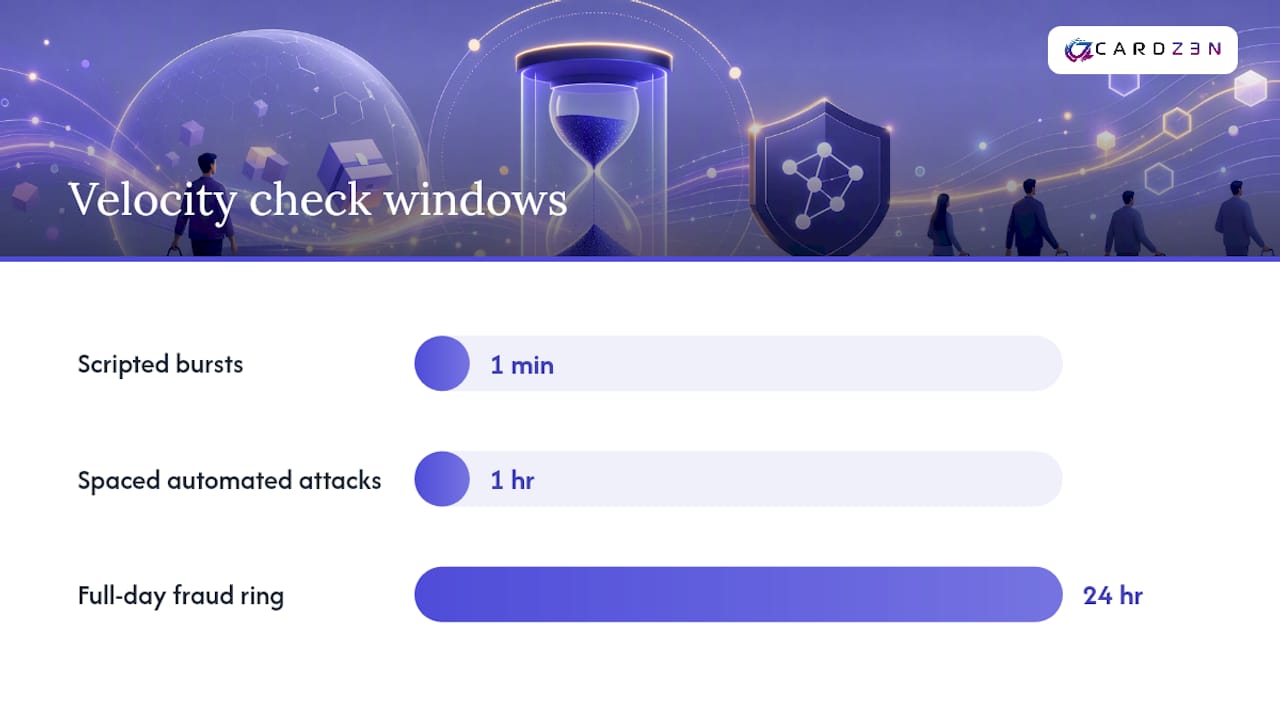
Layering matters more than any single threshold. A one-minute window catches scripted bursts. A one-hour window catches slower automated attacks that space out requests to dodge the first check. A 24-hour window catches a fraud ring working across a full business day. Running all three in parallel, rather than picking one, is what the Fraud points to as the difference between a rule that gets evaded in a week and one that holds up.
Velocity checks shouldn’t work alone. Pairing them with device fingerprinting and behavioral signals (typing cadence, mouse movement, session duration) gives you context a raw count can’t. A customer hitting your velocity threshold because they’re buying gift cards for a holiday event looks very different from one doing it because a script is testing stolen cards, and behavioral data helps tell them apart.
Response levels need to be defined before you flip rules on, not after:
Chargeback Gurus recommends treating every triggered rule as a feedback data point, feeding outcomes back into threshold tuning rather than letting rules run unmonitored for months. A merchant using an integrated payment gateway with built-in rule configuration can usually adjust these response tiers without a full engineering sprint, which matters when a new fraud pattern shows up mid-quarter and you can’t wait for a release cycle.
Pro Tip: Route step-up authentication only to mid-confidence triggers. Sending every flagged transaction straight to 3DS2 annoys legitimate customers just as much as a hard decline does, and it trains your best buyers to abandon carts.
Tuning is where most velocity programs actually live or die.
Start with cohort baselines. A brand-new account making three purchases in an hour looks suspicious. An established customer with two years of order history doing the same thing is probably stocking up for a gift. Applying the same threshold to both groups guarantees false positives on your best customers, so split thresholds by account age, order history, and even acquisition channel.
Static cutoffs age poorly because fraud patterns shift and legitimate buying behavior shifts with them (holiday spikes, subscription renewal days). Dynamic thresholds, set as a percentile of normal activity or a z-score against a rolling baseline, adjust automatically as behavior drifts. Combine those with amount bands so a rule triggers differently for a string of $5 authorizations versus a string of $500 ones.
Build a grey path before you build a hard decline. Instead of an automatic block, route borderline triggers to step-up authentication or a quick manual review. This preserves the sale for legitimate customers while still stopping the fraud attempt, and Fraud.net’s guidance on layered velocity design treats this middle path as essential to keeping false positive rates manageable.
Velocity rules that go untested for months tend to decay in effectiveness as fraudsters learn the exact thresholds through trial and error. Testing a threshold change against a control group before rolling it out fully catches this decay before it costs you real revenue.
Velocity checks require storing identifiers tied to real transactions and real people, which puts them squarely inside data privacy obligations. Hash or pseudonymize card PANs, email addresses, and device identifiers rather than storing them in plain text. The U.S. Payments Forum’s white paper flags this as a design requirement, not an afterthought, particularly for merchants operating under CCPA or GDPR-adjacent obligations.
Avoid storing full PANs in your velocity datastore when a hashed or tokenized reference does the same job. Set retention windows that match your actual detection needs, not indefinite storage. A 90-day rolling window typically covers the slower-moving fraud patterns without keeping years of customer data you don’t need.
Documentation matters beyond compliance. When a customer disputes a decline, being able to show exactly which rule triggered and why is what turns a support escalation into a five-minute resolution.
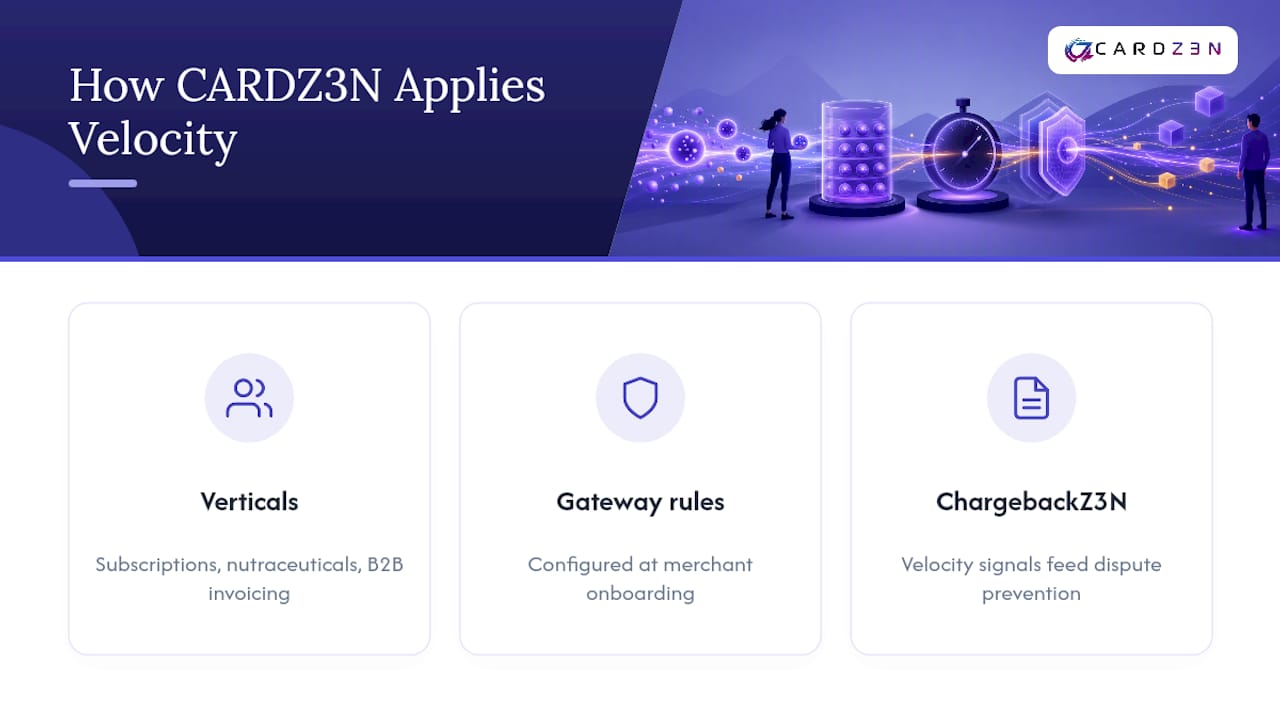
High-risk verticals see fraud patterns mainstream processors rarely encounter at the same volume: subscription billing that attracts serial trial abuse, nutraceutical storefronts hit with card testing bursts, and B2B invoicing exposed to synthetic vendor accounts. Velocity rules can be configured at the gateway level as part of merchant account setup, potentially tying them into underwriting risk profiles rather than treating fraud controls as a bolt-on after boarding. Those same velocity signals feed chargeback prevention through ChargebackZ3N, so a flagged pattern that slips through authorization still gets caught before it becomes a dispute.
Velocity checks are cheap, fast to deploy, and genuinely effective against high-frequency, obvious fraud bursts, which is exactly why they remain a baseline control rather than a legacy one. Their limitation is scope: a patient fraudster who spaces out transactions or rotates infrastructure slips past count-based rules entirely. Small merchants can run effective programs on velocity and amount bands alone. Enterprise fraud programs facing sophisticated rings need to add device telemetry, cross-merchant intelligence, and machine learning scoring on top, treating velocity as the first filter rather than the last word.
— Joshua Benedetti
Most processors hand you a generic risk dashboard and leave the rule tuning to you. Some payment providers build velocity thresholds, response tiers, and chargeback workflows into account setup from day one, so merchants avoid reverse-engineering fraud controls after issues arise. That’s the practical difference for a high-risk merchant: fraud tooling that’s configured around your actual transaction patterns instead of a one-size-fits-all default. A first call typically covers your current processing volume, which platforms and gateways you need integrated, and an assessment of the fraud patterns specific to your vertical. Pricing is generally quote-based and reserve structures should be disclosed upfront, not buried in a contract addendum. If you’re evaluating a high-risk merchant account with velocity-aware fraud tools built in, request a quote and get a straight answer on what your account setup and reserve terms would look like.
This article is general information, not a substitute for advice from a qualified financial advisor. Consult a qualified financial professional about your own circumstances before acting on anything here.
In banking and payments, a velocity check counts how often a specific data element, like a card number or account login, occurs within a set time window, flagging activity that exceeds a defined threshold as potentially fraudulent.
Velocity checks themselves are a standard, widely used fraud detection technique built into most payment gateways and processors, not a product or service you sign up for separately. If you’re seeing a decline referencing “velocity,” it means a transaction pattern crossed a merchant’s or issuer’s threshold, not that something is wrong with the payment method itself.
No single signal proves a transaction is fraudulent, but velocity checks combined with device fingerprinting and behavioral analysis give a strong composite signal, flagging transactions for step-up authentication or manual review rather than an automatic yes-or-no verdict.
Velocity refers to the rate at which a specific action or transaction occurs against a single entity (a card, account, IP, or device) over time; unusually high velocity is one of the clearest early indicators of automated or scripted fraud attempts.
Thresholds should be reviewed at least monthly, since fraud patterns and legitimate customer behavior both shift, and a rule that worked well last quarter can start generating false positives or missing new evasion tactics without warning.
Every merchant's processing setup is different, so the right answer depends on your industry, sales channels, average ticket size and chargeback history. CARDZ3N's payments specialists review those details with you and match your business with the right sponsor bank, gateway and risk tools, whether you sell online, in store, by invoice or on a recurring subscription.
We work with merchants across the USA, Canada, the UK and the EU, including high-risk, B2B and fast-growing businesses that traditional processors often turn away. If you would like a second opinion on your current rates, contract terms or approval options, contact our team for a free, no-obligation processing review.
Joshua Benedetti is the CEO of CARDZ3N, a Las Vegas-based merchant services provider specializing in high-risk payment processing and B2B payment technology.
Joshua Benedetti on LinkedInCARDZ3N Inc is headquartered in Las Vegas, Nevada, and provides merchant services to businesses that traditional processors turn away. Backed by top-tier sponsor banks and processors, CARDZ3N combines institutional stability with the speed of a specialized team that understands high-risk industries. Services include high-risk account underwriting and placement, gateway solutions across the major gateway platforms, POS integrations, ACH and check processing, chargeback prevention through ChargebackZ3N, and business lending and working capital. Its AerospacePay division serves OEMs, MROs, FBOs, and repair stations with B2B and B2G payment processing. CARDZ3N serves merchants in the USA, Canada, the UK, and the EU.
Start protecting your revenue from chargebacks today — schedule your complimentary consultation with CARDZ3N’s dispute management specialists.