
 CARDZ3N — Home
Contact us today for personalized advice and strategic solutions tailored to your goals.

Call us
+1 (702)-623-3528









An eCheck is a specific type of ACH debit that mimics a paper check’s mechanics. ACH is the entire network, governed by Nacha, that moves both debits and credits between U.S. bank accounts. Landlords collecting rent usually want eCheck-style debits with strong authorization records; B2B payables teams often want ACH credits for vendor payouts and payroll. Neither replaces a wire when speed or irrevocability matters more than cost.
An eCheck is the digital stand-in for a paper check, moving the same routing and account information over the ACH network instead of through a physical clearinghouse. Chase describes it as functioning like a paper check but processed electronically, which is why landlords and small vendors gravitate toward it as their first ACH product.
Getting a customer’s authorization is the part businesses most often botch. Nacha requires a clear, documented authorization before you originate a debit, and it needs to specify the amount, timing, and account details being pulled.
Common authorization methods include:
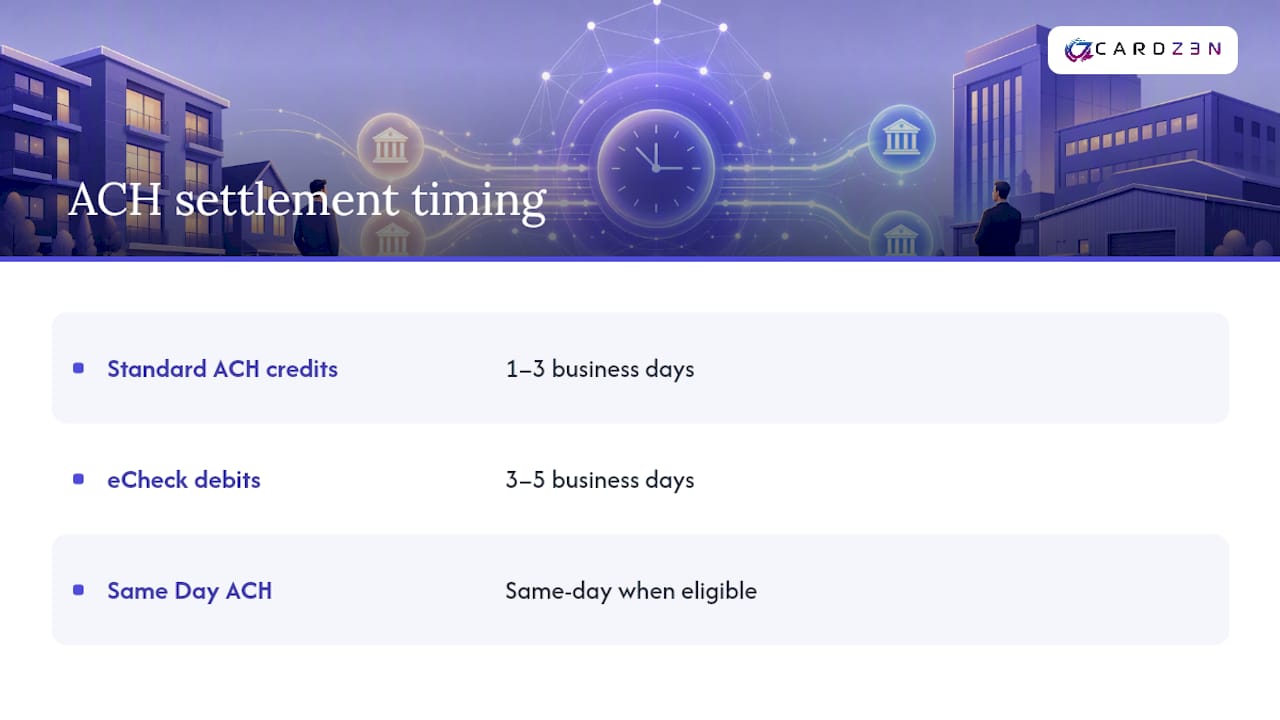
Clearing typically takes 3 to 5 business days, per Chase’s guidance, though Stripe notes that Same Day ACH can shorten that window for eligible transactions submitted before cutoff times. A landlord collecting rent on the first of the month, or a business paying a one-off contractor invoice, both fit this pattern well.
ACH stands for Automated Clearing House, the batch-processing system that routes both credits and debits between nearly every bank and credit union in the United States. Credits push money out (payroll, vendor payments); debits pull money in (rent collection, subscription billing). An eCheck is always a debit. Not every ACH debit is styled as an eCheck, but every eCheck rides the ACH rail, a distinction Investopedia draws clearly.
Nacha’s operating rules are what make this predictable for originators instead of chaotic. They standardize:
The U.S. Treasury itself routes large government disbursements through this same network, which tells you something about its reliability at scale. Batching thousands of transactions into a single settlement cycle is also why ACH stays cheap: per-transaction cost drops sharply compared to card networks, since there’s no interchange fee structure behind it.
The overlap confuses people because it’s real: an eCheck is an ACH debit, so comparing “eCheck vs ACH” is really comparing a specific product to its parent network. But the differences that matter operationally are worth isolating.
Speed. Standard ACH transactions, eCheck or otherwise, settle in 1 to 3 business days for credits and commonly 3 to 5 business days for certain eCheck debits tied to check-like authorization flows, according to Stripe’s clearing breakdown. Same Day ACH compresses that for eligible transactions submitted early enough in the origination window.
Cost. ACH and eCheck transactions typically run flat fees per transaction, which are lower than the percentage fees common with card processing and much less costly than flat fees for domestic wire transfers. Volume matters here: a landlord collecting $2,000 rent through card processing loses far more to fees than through ACH.
Reversibility. This is where eChecks carry more risk than people expect. Because they’re debits, they can bounce for insufficient funds or get disputed under Nacha’s return code system, generally within a window for unauthorized debit claims.
Same Day ACH processes a very high volume of transactions annually, and Nacha’s rules extend that speed without loosening the authorization and return standards originators must follow, per Nacha.
What both share: neither is instant like a wire, both depend on the payer’s account having funds at settlement, and both are dramatically cheaper than card rails for recurring, predictable payments.
Choosing between them comes down to four questions: how often does the payment recur, how much friction can the payer tolerate, how cost-sensitive is the transaction, and how much fraud exposure are you willing to carry.
Pro Tip: Landlords should collect a voided check or verified bank details at lease signing, not at the first missed rent payment. Retroactively chasing authorization after a bounce is far harder than building it into onboarding.
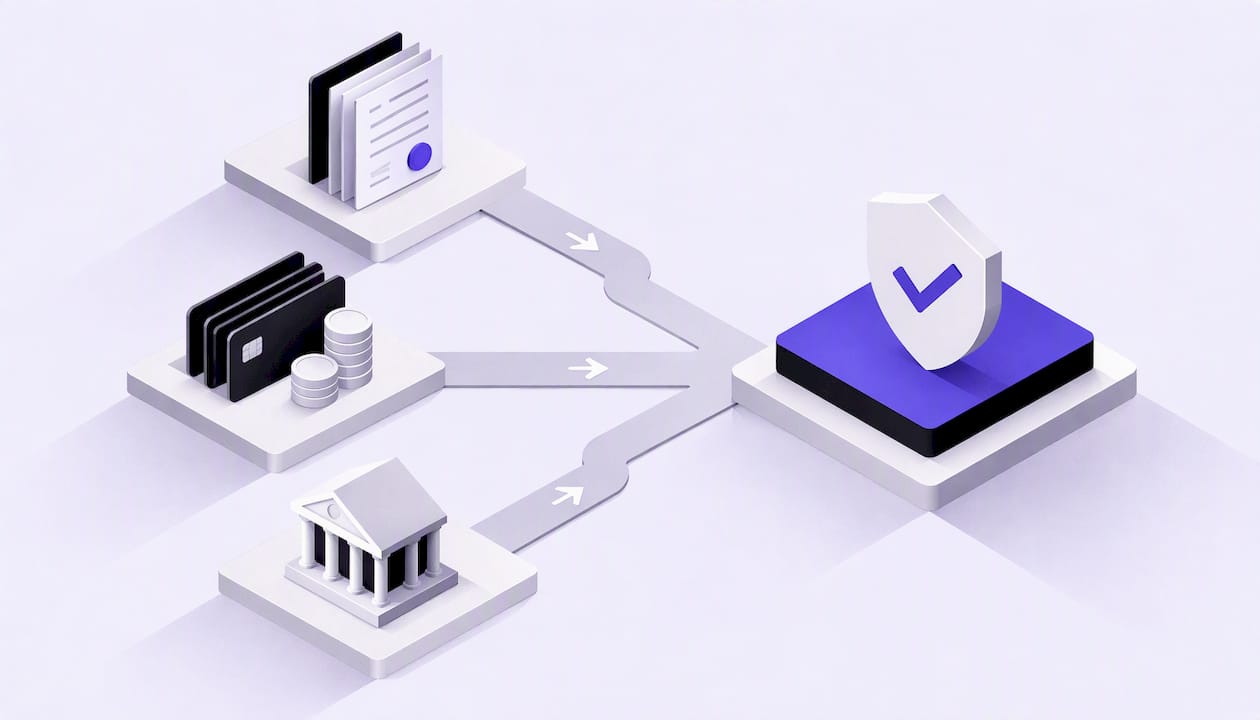
Every ACH transaction, eCheck or not, follows the same path: the originator (you, or your processor on your behalf) submits the transaction to an originating bank, which batches it and sends it to an ACH operator. The operator routes it to the receiving bank, which posts it to the payer’s or payee’s account.
Batching is the whole point. Rather than processing transactions one at a time, banks bundle them into cycles that run multiple times a day.
Scheduling submissions around these cutoffs, rather than submitting reactively, is how businesses with tight cash flow avoid gaps between when a debit is authorized and when funds actually land.
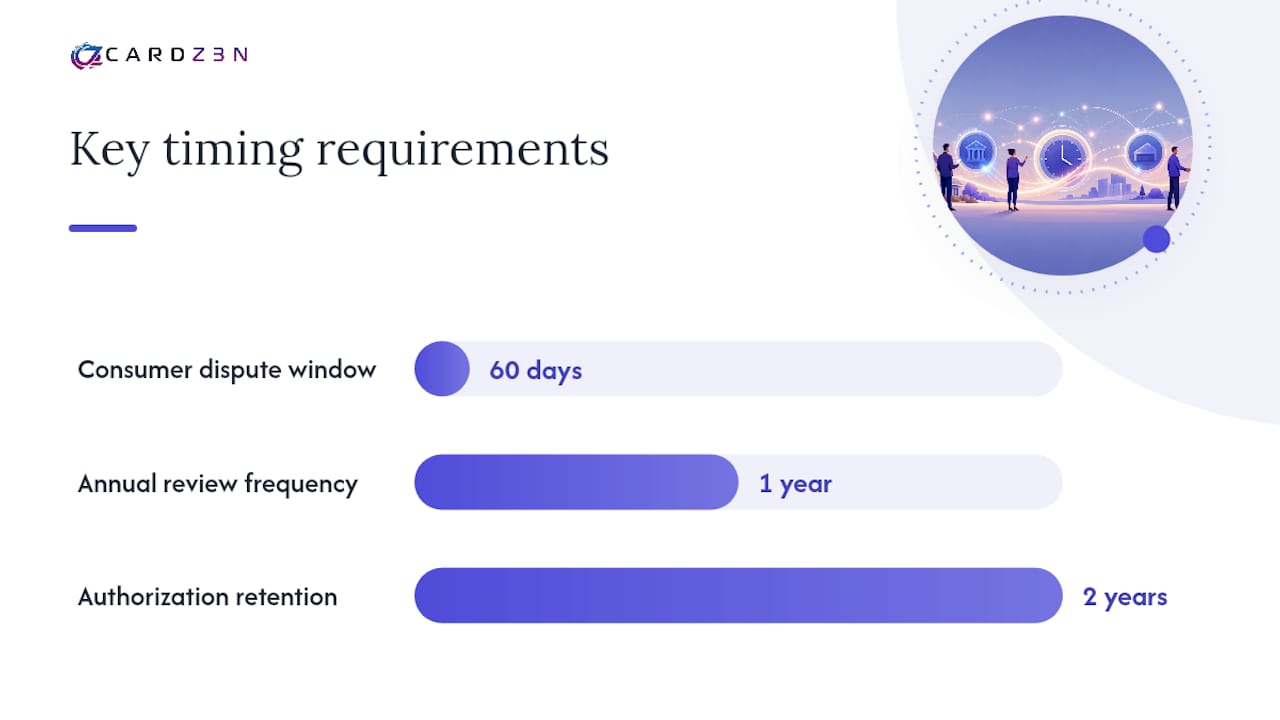
eChecks and ACH debits carry lower fraud risk than paper checks, since there’s no physical instrument to forge, but they carry different risk: unauthorized debit claims and insufficient-funds returns. Nacha’s return code system gives originators a standardized way to see why a transaction failed, and consumers generally have up to 60 days to dispute an unauthorized debit.
Controls worth running regardless of business size include:
Pro Tip: Keep every signed authorization, whether digital or a recorded call, for at least two years past the last transaction. Nacha audits and dispute investigations both hinge on whether you can produce that record.
For merchants underwriters consider higher risk, tighter monitoring isn’t optional. CARDZ3N’s chargeback prevention division works specifically with merchants who need enhanced monitoring layered on top of standard ACH controls.
Most processors charge a flat per-transaction fee for ACH and eCheck debits, often between $0.25 and $1.50, sometimes paired with a small monthly platform fee. Return fees, charged when a debit bounces, typically run $2 to $10 per incident and originators should budget for them separately from successful transaction volume.
Batching doesn’t just speed things up. It’s also what keeps the per-transaction fee low, since the bank’s processing cost per item drops as volume rises.
Getting from “we want to accept ACH” to actually processing payments takes more than picking a gateway. Every merchant needs an ACH origination agreement with a bank or processor, proper authorization language on every collection form, and a return-handling process before the first transaction goes live.
Most articles on eCheck versus ACH stop at definitions. What gets underweighted is how much the answer changes once a merchant is flagged as higher risk, whether that’s due to industry, chargeback history, or transaction size.
Underwriters reviewing higher-risk ACH programs typically require enhanced identity verification, active transaction monitoring, and reserve structures calibrated to the merchant’s return history rather than industry averages. That’s a meaningfully different setup than a low-risk landlord collecting rent from the same twelve tenants every month. CARDZ3N’s underwriting and B2B payment processing work centers on getting these merchants placed with sponsor banks that understand the risk profile, rather than forcing every merchant into a generic ACH template that wasn’t built for their volume or return rate.
The practical recommendation: don’t wait for a return spike to build governance. Set risk-based origination rules, tiered settlement timing for new versus established payers, and a documented escalation path for repeat returns before volume grows past the point where fixing it retroactively becomes expensive.
— Joshua Benedetti
CARDZ3N is the direct alternative to piecing together ACH acceptance through a generic processor that treats every merchant the same regardless of risk profile. For a landlord or B2B business weighing eCheck against full ACH support, the practical difference is underwriting built around your actual return and chargeback history, not a one-size template that ignores it.
Gateway integrations, ACH and check processing, chargeback prevention services, and business lending for merchants who need working capital while their program scales are offered. Visit the high-risk merchant account page to see how CARDZ3N structures ACH and eCheck acceptance for U.S. businesses, or reach out directly to get a quote on your specific volume and risk profile.
An eCheck is a specific type of ACH debit, so every eCheck is an ACH transaction, but not every ACH transaction is an eCheck since ACH also includes credits like payroll deposits.
Yes, ACH is a U.S. banking network governed by Nacha rules and operated through U.S. financial infrastructure; cross-border payments require different rails entirely.
Zelle typically settles through the RTP network or direct bank partnerships rather than standard ACH batching, though it’s broadly classified as an electronic funds transfer like ACH.
Yes, U.S. banks widely accept eChecks since they process over the same ACH network as direct deposits and other electronic transfers, as Chase confirms in its own consumer guidance.
eChecks are debits used to collect money, while direct deposit is an ACH credit used to pay money out, so payroll relies on ACH credit rather than the eCheck debit process.
Every merchant's processing setup is different, so the right answer depends on your industry, sales channels, average ticket size and chargeback history. CARDZ3N's payments specialists review those details with you and match your business with the right sponsor bank, gateway and risk tools, whether you sell online, in store, by invoice or on a recurring subscription.
We work with merchants across the USA, Canada, the UK and the EU, including high-risk, B2B and fast-growing businesses that traditional processors often turn away. If you would like a second opinion on your current rates, contract terms or approval options, contact our team for a free, no-obligation processing review.
Joshua Benedetti is the CEO of CARDZ3N, a Las Vegas-based merchant services provider specializing in high-risk payment processing and B2B payment technology.
Joshua Benedetti on LinkedInCARDZ3N Inc is headquartered in Las Vegas, Nevada, and provides merchant services to businesses that traditional processors turn away. Backed by top-tier sponsor banks and processors, CARDZ3N combines institutional stability with the speed of a specialized team that understands high-risk industries. Services include high-risk account underwriting and placement, gateway solutions across the major gateway platforms, POS integrations, ACH and check processing, chargeback prevention through ChargebackZ3N, and business lending and working capital. Its AerospacePay division serves OEMs, MROs, FBOs, and repair stations with B2B and B2G payment processing. CARDZ3N serves merchants in the USA, Canada, the UK, and the EU.
Start protecting your revenue from chargebacks today — schedule your complimentary consultation with CARDZ3N’s dispute management specialists.