
 CARDZ3N — Home
Contact us today for personalized advice and strategic solutions tailored to your Canadian business.

Call us
+1 (702)-623-3528









In the fast-paced universe of business transactions, understanding the nuances of B2B payments is crucial. As businesses strive to optimize operations and improve financial efficiency, the intricacies of these transactions can't be overlooked. Imagine a world where your business payments are seamless, fast, and secure. This isn't just wishful thinking; it's an attainable reality with the right approach to B2B payments. By diving deep into the differences between B2B and consumer payments, we unlock strategies that could revolutionize your business's financial dealings.
How do these differences affect your business, and why are they important to you?
In the bustling world of business, payment processing stands as the backbone of financial transactions. Efficient B2B payment processing is a lifeline that ensures smooth operations and healthy cash flow. But what sets B2B payments apart from their consumer counterparts, and why should businesses care?
Business owners understand that effective B2B payment processing is essential for maintaining healthy cash flow. Unlike consumer transactions, which are often straightforward, B2B payments can be complex, involving higher volumes and intricate invoicing processes. Financial managers appreciate how streamlined B2B payment solutions can reduce processing times and enhance efficiency. When a business can quickly process payments, it maintains liquidity and avoids potential cash crunches.
Professionals engaged in B2B transactions recognize the profound impact the right payment gateway can have on their financial outcomes. By selecting an appropriate B2B payment gateway, businesses can ensure secure transactions, reduce fees, and enhance payment execution. This process is not merely about transferring funds; it is about doing so in a manner that protects the financial interests of the business.
Companies should also be aware that B2B payment processing often involves dealing with more complex invoicing than consumer payments. This complexity necessitates robust accounting and ERP systems to handle payment automation, invoice capture, and reconciliation. When integrated properly, these systems can streamline processes and enhance relationships with suppliers and clients.
Moreover, ACH payments and electronic bank transfers play a pivotal role in B2B transactions. These methods ensure secure and efficient payment execution, minimizing the need for manual intervention and reducing errors. For decision-makers, this translates to more time for strategic activities rather than being bogged down by routine payment processes.
So, what separates B2B payments from consumer payments? The distinctions are not just about transaction size. They also involve different levels of complexity, risk, and control. Understanding these differences is key to optimizing your B2B payment processing strategy.
Firstly, business transactions generally involve larger amounts and necessitate more secure payment methods compared to consumer payments. When a company pays a supplier, the stakes are higher. A single missed or incorrect payment can disrupt supply chains or damage crucial relationships. Therefore, security controls and approval workflows must be robust to prevent fraud and ensure that funds are transferred correctly and on time.
Second, B2B payments often come with extended payment terms and intricate invoicing processes. While a consumer might pay at checkout or through an automatic subscription, businesses frequently operate on net-30, net-45, or net-60 terms.
This delay requires careful planning and B2B cash flow management to ensure that obligations are met without straining resources. Businesses must balance when they pay suppliers with when they receive payments from customers.
The approval process is another key difference. Unlike consumer payments, which are typically completed in a single step, B2B payments often require multiple stages of approval. A standard B2B workflow might include creating a purchase order, receiving an invoice, performing three-way matching, and obtaining multi-level approvals before releasing a payment. This structured approach ensures that transactions comply with necessary standards for authorization and compliance, which is vital for maintaining financial integrity and internal controls.
Tax and regulatory requirements further distinguish B2B from consumer payments. B2B transactions often need to account for sales tax, VAT, use tax, and industry-specific regulations. Cross-border B2B payments may involve additional rules regarding sanctions, anti-money laundering, and reporting. Financial managers must understand these requirements to avoid penalties, maintain compliance, and protect the organization from regulatory risks.
Finally, there are technical differences in payment platforms and gateways designed for business versus consumer markets. A B2B payment gateway usually supports multiple payment methods—such as B2B credit cards, B2B ACH payments, wires, real-time payments, and virtual cards—as well as features like payment terms, invoice matching, and bulk payments. Consumer payment gateways, on the other hand, are designed for quick, one-time card or wallet transactions with minimal need for complex invoicing or approval processes. Opting for solutions tailored to B2B requirements ensures that your payment infrastructure can manage current demands and scale effectively as your business grows.
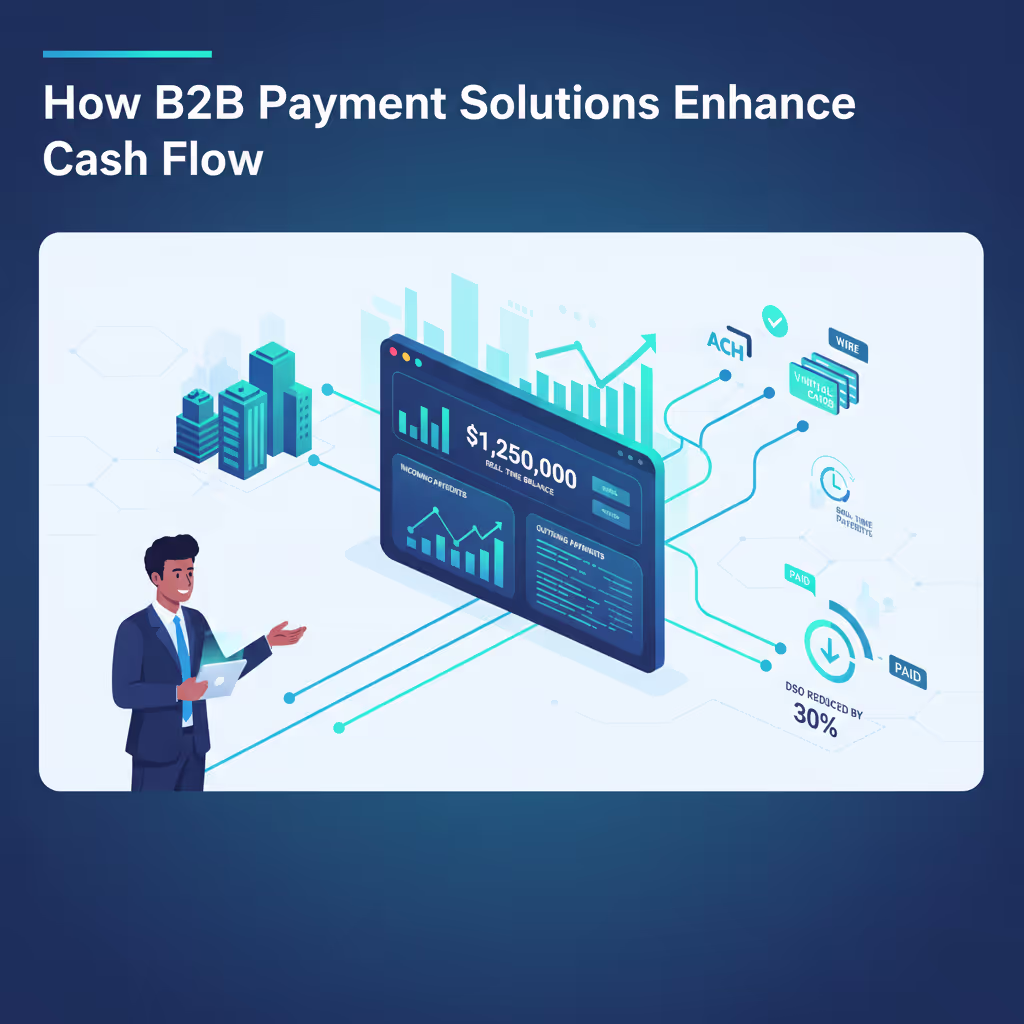
Cash flow is the lifeblood of any organization, and well-designed B2B payment solutions can significantly enhance it. By optimizing the way money flows in and out of the business, companies can see immediate improvements in liquidity, forecasting, and financial resilience.
Companies that utilize advanced B2B payment solutions often experience improved B2B cash flow through faster transaction processing and better visibility. When payments are processed efficiently, funds are available sooner, allowing businesses to reinvest in operations, pay down debt, or take advantage of strategic opportunities. Accelerating collections and managing disbursements more intelligently can be a game-changer for working capital.
Automation plays a central role here. Businesses can reduce administrative costs by automating B2B payment processing and invoicing. Automation minimizes the need for manual data entry, reduces errors, and frees up valuable time for finance and accounting teams to focus on more strategic initiatives. This reduction in overhead directly impacts the bottom line, making the business more profitable and efficient.
For financial managers, accurate payment tracking and reporting significantly enhance their ability to forecast cash flow. With detailed insights into when and how payments are made, managers can see upcoming inflows and outflows, adjust spending, and avoid surprises. This visibility supports more confident decisions about hiring, investment, inventory purchases, and strategic projects.
Decision-makers also realize that integrating B2B payment solutions with core accounting systems, ERP platforms, and treasury tools streamlines financial operations. When payment systems are fully integrated, tasks such as invoice capture, application of cash, and payment reconciliation become more straightforward. This reduces the burden on accounting teams and improves data accuracy across the organization.
Businesses that adopt effective B2B payment strategies—supported by a capable B2B payment gateway and B2B merchant services—often find themselves in stronger financial positions with greater operational efficiency. They are better equipped to accept payments from a wide range of customers, support international and cross-border payments, and manage risk. Over time, these capabilities help pave the way for sustainable growth and stability in an increasingly competitive market.
One of the most common tools in B2B merchant services is the B2B credit card. B2B credit card payments are especially useful when speed, convenience, and rewards matter. They can help businesses quickly pay suppliers, cover recurring software subscriptions, or manage expenses for distributed teams, all while earning points or cash back.
Credit card payments in a B2B context often settle faster than checks and may offer more predictable timing than some other methods. That speed can improve B2B cash flow by reducing uncertainty around when funds will be received. For suppliers, accepting B2B credit cards can shorten days sales outstanding (DSO), limit collection risk, and provide a better experience for customers who prefer to pay with cards.
However, B2B credit card fees are typically higher than those for bank-based methods such as ACH. Interchange and processing fees are usually charged as a percentage of the transaction, sometimes with additional per-transaction charges. While specialized B2B merchant services and level 2/3 data can reduce costs, credit card acceptance still tends to be one of the more expensive payment options. For this reason, many businesses reserve B2B credit cards for transactions where the benefits—faster payment, rewards, or customer preference—justify the added expense.
B2B ACH payments are another core component of modern B2B payment processing. ACH (Automated Clearing House) transfers move funds directly between bank accounts, making them well suited for recurring payments, subscription billing, payroll, and regular supplier invoices.
One of the biggest advantages of B2B ACH payments is cost. ACH fees are typically much lower than credit card processing fees, often charged as a flat per-transaction amount rather than a percentage of the total. This makes ACH ideal for high-value invoices and ongoing relationships where cost control is a priority. Over time, shifting a portion of your B2B payment volume from cards to ACH can meaningfully reduce payment-related expenses.
ACH transfers also support better predictability and control compared with paper checks. Payments can be scheduled, tracked, and reconciled more easily through a B2B payment gateway or integrated treasury platform. This predictability improves B2B cash flow planning, allowing both payers and payees to manage their bank balances more effectively. For many finance teams, ACH becomes the default “workhorse” method for domestic B2B payments.
While both B2B credit cards and B2B ACH payments play important roles in a modern payment mix, they differ markedly in how fees are structured and how they affect your bottom line.
B2B credit card transactions typically involve percentage-based interchange fees plus processing costs. For example, each payment may incur a fee of a few percentage points of the transaction amount, along with fixed per-transaction charges. For large B2B invoices, these percentage-based fees can add up quickly. Businesses that rely heavily on card payments may see higher overall payment costs, even if they enjoy benefits like rewards, chargeback protection, or improved customer satisfaction.
In contrast, B2B ACH payments usually carry much lower, mostly flat fees. Instead of paying a percentage of the transaction, businesses often pay a small, fixed fee for each ACH transfer. This structure makes ACH especially attractive for high-dollar B2B payments, where even a small percentage fee on a large invoice can be significant. By steering larger payments to ACH while using B2B credit cards for smaller or time-sensitive transactions, companies can optimize both cost and convenience.
The right strategy is rarely all-or-nothing. A balanced approach—enabled by a capable B2B payment gateway and thoughtful B2B merchant services—allows businesses to offer multiple payment options while nudging customers toward the methods that best support cash flow and margin goals. Over time, this mix can improve profitability, strengthen relationships, and provide a smoother payment experience for all parties.
Understanding and optimizing B2B payments can profoundly impact your business’s financial health. From maintaining strong B2B cash flow to navigating complex regulatory and compliance landscapes, the right combination of B2B payment processing, merchant services, and gateways offers clear advantages.
B2B payments differ from consumer payments in transaction volume, complexity, risk, and regulatory requirements. By choosing effective B2B payment gateways, leveraging tools like B2B credit cards and B2B ACH payments, and integrating systems across accounting and ERP platforms, businesses can enhance efficiency, reduce costs, and gain stronger control over cash flow.
As you evaluate your own payment strategy, consider which mix of methods and technologies will best support your growth and resilience. The more intentional you are about B2B payment processing today, the better positioned your business will be to adapt, compete, and thrive in the years ahead.
B2B payments refer to transactions between two businesses. Unlike consumer payments, these transactions often involve larger sums and may require additional services like invoicing, purchase orders, and extended payment terms. B2B payments can be conducted through various methods such as wire transfers, checks, ACH payments, or specialized payment gateways. Efficient B2B payment processes are crucial for maintaining healthy cash flow and solid business relationships.
A B2B payment gateway is a technology solution that facilitates electronic transactions between businesses. Unlike consumer payment gateways, B2B gateways handle larger volumes and more complex processes, such as invoicing and bulk payments. It supports methods like B2B credit cards, B2B ACH payments, wires, and virtual cards, while handling encryption, authorization, and settlement behind the scenes. They are designed to accommodate the specific needs of businesses, including multi-currency support and customized reporting. These gateways ensure secure, efficient, and reliable transactions, making them essential for modern businesses engaged in regular trade with other companies.
Yes, many modern payment platforms are built to support both B2B payments and consumer (B2C) payments on the same underlying infrastructure. In practice, they offer additional features for B2B use cases—such as invoicing, customized payment terms, higher transaction limits, and integrations with ERP or accounting systems—while still allowing you to accept consumer-style card or digital wallet payments when needed. This flexibility helps businesses manage all their payment flows through a unified B2B merchant services stack.
Many digital wallets and online payment platforms can be used for B2B payment processing, especially for smaller invoices, services, or cross-border transactions. Businesses may use these tools to send invoices, accept online payments, or manage subscriptions, often alongside more traditional methods like ACH and wires. However, for larger, recurring B2B transactions, companies generally rely more on B2B ACH payments, wires, and card-based solutions integrated into a dedicated B2B payment gateway for better control, lower fees, and stronger back-office integration.
By choosing CARDZ3N, you can focus on what matters most - growing your business, while they handle your payment processing needs. (702) 623-3528, 4262 Blue Diamond Rd Bldg 102 Ste 191 Las Vegas, NV 89139
Every merchant's processing setup is different, so the right answer depends on your industry, sales channels, average ticket size and chargeback history. CARDZ3N's payments specialists review those details with you and match your business with the right sponsor bank, gateway and risk tools, whether you sell online, in store, by invoice or on a recurring subscription.
We work with merchants across the USA, Canada, the UK and the EU, including high-risk, B2B and fast-growing businesses that traditional processors often turn away. If you would like a second opinion on your current rates, contract terms or approval options, contact our team for a free, no-obligation processing review.
Joshua Benedetti is the CEO of CARDZ3N, a Las Vegas-based merchant services provider specializing in high-risk payment processing and B2B payment technology.
Joshua Benedetti on LinkedInCARDZ3N Inc is headquartered in Las Vegas, Nevada, and provides merchant services to businesses that traditional processors turn away. Backed by top-tier sponsor banks and processors, CARDZ3N combines institutional stability with the speed of a specialized team that understands high-risk industries. Services include high-risk account underwriting and placement, gateway solutions across the major gateway platforms, POS integrations, ACH and check processing, chargeback prevention through ChargebackZ3N, and business lending and working capital. Its AerospacePay division serves OEMs, MROs, FBOs, and repair stations with B2B and B2G payment processing. CARDZ3N serves merchants in the USA, Canada, the UK, and the EU.

9/30/2026
MATCH List (TMF) ExplainedStart protecting your revenue from chargebacks today — schedule your complimentary consultation with CARDZ3N's Canadian dispute management specialists.